Ce site présente l'histoire de l'Afrique du Nord avant les conquêtes arabes – This website presents the history of North Africa before the Arab conquests – يعرض هذا الموقع تاريخ شمال إفريقيا قبل الفتوحات العربية
In late Antiquity, the people of the Mediterranean world were wondering how to make sense of the ancient myths and legends that had been at the foundation of their culture for centuries, now that they were Christian and no longer believed in the gods of their ancestors. Fulgentius, a North African author of the Vandal era, wrote several books in which he suggests an allegorical reading of Greco-Roman myths, drawing a moral and spiritual message from them.
A hidden message behind myths of another age
The world of ancient mythology is a supernatural world, full of magic, fantastic creatures, talking animals and men changed into animals or into stone. Also, in the mythological universe, the gods who live among men have very human passions: they are murderers, rapists, adulterers, thieves, liars, and commit all sort of crimes. The most reasonable men of the time, especially the philosophers, have always been embarrassed by the absurdity and immorality of these myths. To provide an explanation, they tried to discern a deeper meaning behind those imaginary stories.
Neoplatonic philosophers were especially active in reexamining the ancient myths at the light of their more sophisticated understanding of the world, to find a hidden sense behind their words.
Odysseus and Circe
Their method is best explained by an example. In Homer’s Odyssey, the hero Odysseus and his companions land on the island of the sorceress Circe. When Odysseus’ companions, in their hunger, precipitate themselves on Circe’s table, she changes them all into pigs. Odysseus, on his way to save his companions, meets the god Hermes, who gives him a magical plant, together with instructions of how to triumph of the sorceress. The magical plant protects Odysseus against Circe’s magic. In the end, Circe agrees to return his companions to their human form. For the Neoplatonics, the change of Odysseus’ companions into pigs represents human degradation: when we give in to our primary impulses, to corrupting sensual pleasures, we become like wild animals. Odysseus, on the other hand, is protected by the knowledge of the wise, which gives him the strength to resist the destructive magic of the sorceress.
Ymagines Fulgencii: medieval images inspired by Fulgentius the Mythographer
Allegorical reading of myths became even more prominent in the Christian era. It allowed the Christians in the Greco-Roman world to reclaim possession of the old pagan myths, in which they discovered moral lessons, teaching them how to live a virtuous life, and even spiritual lessons, on God and his plan for them. One of the most prominent authors who developed this Christian allegorical reading of mythological texts was the North African Fulgentius the Mythographer.
Who was Fulgentius the Mythographer?
Fabius Planciades Fulgentius was a North African Christian author, who lived and wrote in the Vandal era, from the 5th to the 6th Centuries CE. Very little is known of his life, not even where in North Africa he lived. His writing style in Latin, his knowledge of Greek and his mastery of classical authors and popular cults indicate he was probably a trained rhetorician or grammarian. He understood the Libyc language and could read the Libyc alphabet, which shows he probably had Amazigh origins. The prologue of his Mythologies mentions that he was married.
Fulgentius of Ruspe
Since the Middle Age, certain scribes identified Fulgentius the Mythographer with Fulgentius of Ruspe, a North African bishop who lived in the same era, and was the leader of the North African Christian resistance against Vandal Arianism. However, this identification is contested by modern specialists.
Fulgentius the Mythographer’s work is traditionally dated from the late 5th and early 6th Century. However, a passage of his work resembles a verse of Corippus, another North African author who wrote around 550, after the Byzantine reconquest. Some specialists believe that he quotes Corippus, which would mean that he wrote after him. Others believe he is older than Corippus, and the resemblance is a pure coincidence. If he indeed does quote Corippus, this would prove that Fulgentius the Mythographer cannot be identified with Fulgentius of Ruspe, as the latter died in 527.
Fulgentius the Mythographer’s work was very popular all through the Middle Age, and had a strong influence on medieval Christian mythographers.
Fulgentius the Mythographer’s works
The most well-known work of Fulgentius the Mythographer are his Mythologies, a series of three books, with 50 chapters altogether. Each chapter tells a myth, and then interprets it allegorically, drawing a moral and spiritual message from it. For his interpretation, he uses etymologies of character names, which are often highly doubtful; but this was common at the time. In his prologue, the author explains that he wanted to strip the classical Greek myths of all their fictitious elements, in order to reveal the obscure truths they contain. While he had a Christian motivation, the lessons he draws from the myths are quite general and can be applied to any public.
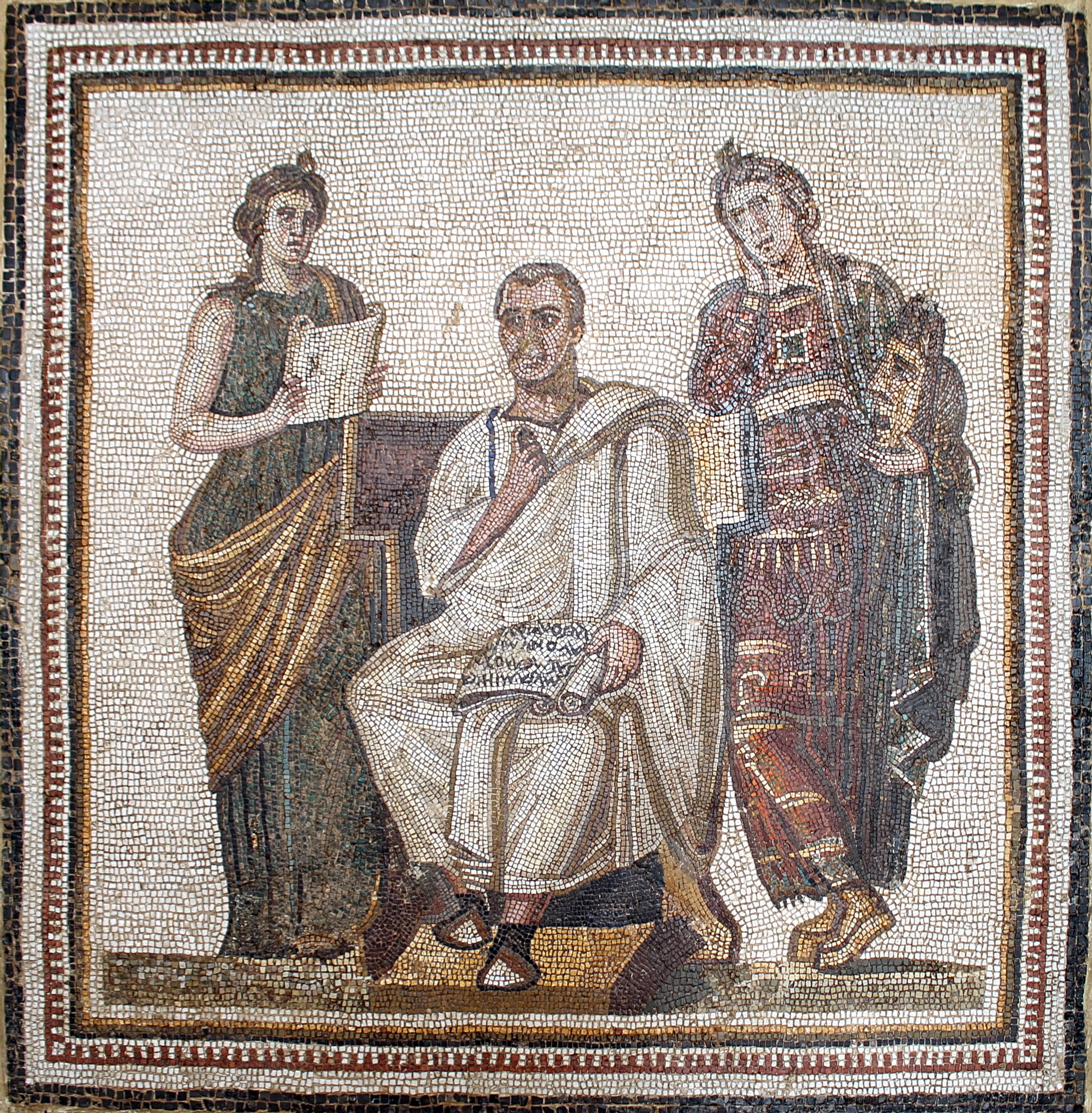
In another work, Fulgentius the Mythographer exposes an allegorical reading of the Aeneid of Virgil, which he sees as an allegory of all human life. In this book, he ghost of Virgil appears to the author, together with the Muses (goddesses of art), to explain the truths contained in the Aeneid. Virgil addresses the author on a condescending tone, and makes fun of the readers’ tendency to read his poem literally, without grasping the deeper meaning behind his words. Allegorical interpretations of Virgil were already common (including one by the Roman African grammarian Aelius Donatus), but Fulgentius the Mythographer was the first one to do this in a Christian perspective.
Fulgentius the Mythographer also wrote an Explanation of obsolete words, which gives an explanation of 62 ancient Latin words appearing in classical literature, as well as a historical book, On the Ages of the World and Men.
Statius
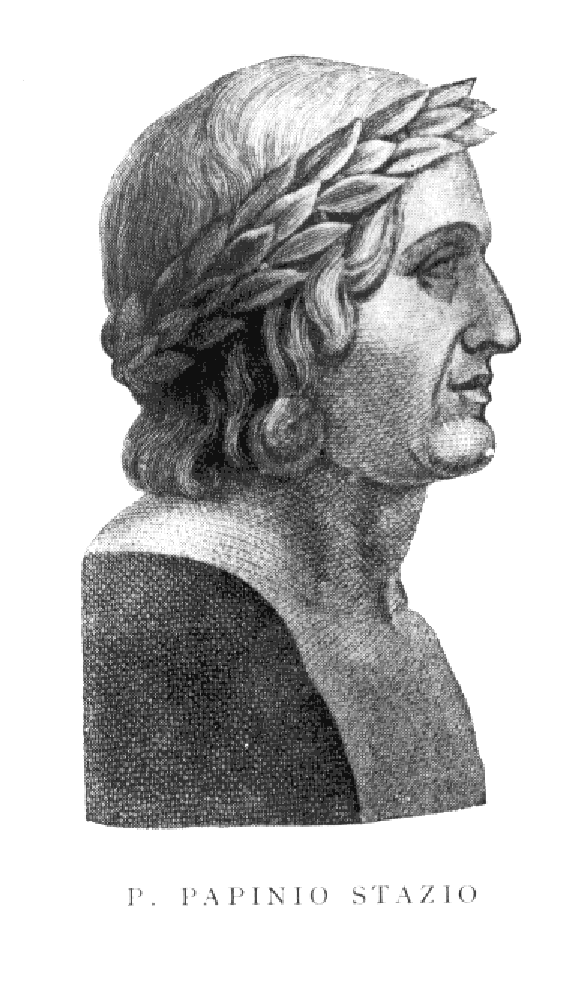
Finally, an allegorical reading of the Thebaid, a poem by the 1st-Century Roman poet Statius, was also attributed to Fulgentius the Mythographer, probably by mistake: this work was written later, during the Middle Age. Its author imitates Fulgentius the Mythographer’s writing style. Statius was a contemporary of the first Christians, and a medieval tradition without any historical base, mentioned in Dante’s Divine Comedy, claims that he secretly converted to Christianity, and that his works contains a hidden Christian message.
After the 5th-Century Vandal conquest, North Africa, previously one of the most strongly Christian areas in the Roman world, faced a serious religious crisis: its bishops were banished and its population forced to adopt the Arian doctrine held by the Vandals. In this context, bishop Fulgentius of Ruspe, sometimes called the “second Augustine”, became known as the champion of North African Christianity. For over 20 years, he faithfully preached the Catholic doctrine, stood up to the Vandal authorities, and held public debates with Arian bishops. He was exiled several times, but continued to defend his convictions through his writings. Without his influence, the North African Church probably would not have survived the Vandal occupation.
Context
Bishop Quodvultdeus of Carthage, who was exiled by the Vandals
The Vandals followed the Arian religion, a doctrine considered heretical by the official Christian Church. North African Christians were distraught by this new doctrine which they had never been confronted with yet: while Augustine of Hippo had written a book against Arianism, only few were still fluent enough in Latin to read it. Also, the Vandals wanted to force all their subjects to accept their doctrine, and they persecuted the indigenous North African Christians, both Catholics and Donatists. Over a thousand North Africans were killed for refusing to convert to Arianism.
Life of Fulgentius
Fulgentius of Ruspe
Fabius Claudius Gordianus Fulgentius was born around 465, in Thelepte (Medinet-el-Kedima, close to Feriana, in the Tunisian governorate of Kasserine), in a Roman Christian family. His grandfather, a Carthaginian Senator, was banished to Italy after the Vandal conquest of Africa, and all his property was confiscated. His two sons returned to Africa after he died: the family house was lost, but they could recover some land in Byzacene (Southern Tunisia) and settled there. Fulgentius’ father died when he was a child, and he was raised by his mother, who taught him Greek and Latin. At a very young age, Fulgentius memorized all of Homer’s works.
Fulgentius’ family was highly respected. As an adult, his excellent reputation enabled Fulgentius to obtain a job as a tax collector. As a brilliant career was opening up in front of him, his study of religious texts, especially a sermon by Augustine of Hippo on the Psalm 36, convinced him to renounce his worldly life and devote himself to God. Around 22 years of age, he decided to become a monk.
Monastery in Byzacene (Image created by ChatGPT)
About this time, Faustus, a bishop who had been expelled from his diocese by the Vandal King Huneric, established a monastery in Byzacene. Fulgentius asked Faustus to take him as a novice. Faustus first tried to dissuade him, due to his fragile health, but the young man was so insistent that he finally agreed. With the other monks, Fulgentius lived a life of prayer, away from society.
A short time later, Arian attacks forced Fulgentius to leave for another monastery, where he took responsibilities. In 499, he fled to Sicca (El Kef) during another wave of persecution. The following year, he traveled to Rome. He then returned to Byzacene, where he founded his own monastery. His reputation was spreading more and more in the whole region.
In 504, Fulgentius became the new bishop of Ruspe (Henchir Sbia, close to Mahdia). At this time, the Vandal King Thrasamund had forbidden any new bishops from being appointed after the death of a standing bishop. Fulgentius was exiled to Sardinia with around 60 other bishops. In exile, he wrote books to instruct the African Christians in their faith, especially by refuting the errors of Arianism.
Writing on a church vault, mentioning King Thrasamund, Henchir El Gousset, Kasserine governorate, Tunisia
Fulgentius returned to Africa in 515, at the invitation of King Thrasamund, for a public debate with an Arian bishop. Thrasamund was so impressed by his knownedge that he allowed him to stay in Carthage, but not to return to Byzacene. Fulgentius continued writing and preaching the Catholic doctrine. He was exiled again in 520.
Thrasamund died in 523. His successor Hilderic, whose mother was Catholic, led a policy of religious tolerance. Fulgentius was allowed to return from exile and take back his function as bishop of Ruspe. After his return, he worked to end abuses that had developed in the Church while he was away. He was such an eloquent and efficient preacher that the bishop Bonifatius of Carthage cried every time he heard him preach, and thanked God publicly for giving such a preacher to his Church.
Close to the end of his life, Fulgentius, who was still more drawn to the solitary monastic life than to the responsibilities of a bishop, retired to a monastery on the Circinia Islands (Kerkennah). However, his influence in Ruspe was so strong that the faithful called him back. He continued serving as bishop of Ruspe until his death in 527.
The Vandals, who invaded North Africa in the 5th Century, practiced Arianism and wanted to force all their subjects to adopt their doctrine. They persecuted the indigenous North African Christians. Several thousand North African Christians were killed for refusing to convert to Arianism.
Context
The Vandals, like other Germanic people, followed the Arian religion, a doctrine considered heretical by the official Christian Church. After the arrival of the Vandals in North Africa, the local believers were bewildered by this new doctrine that they had never faced before: Augustine of Hippo had written a book against Arianism, but not many still understood enough Latin to read it.
Also, unlike the Goths, who were also Arian, but tolerant of other confessions, the Vandals wanted to impose their doctrine onto all their subjects. Because of this, they persecuted the North African Christians, both Catholic and Donatist. Several hundred Christians were put to death for their faith during the Vandal era, and many religious sisters were raped. The bishop Victor of Vita (Beni Derraj), who witnesses those events, wrote a detailed book on the persecutions.
History of the persecutions
Quodvultdeus, bishop of Carthage
After the Vandal conquest of Carthage, bishop Quodvultdeus (his name means “what God wants”) was exiled, together with most other North African bishops. Those bishops were embarked on an old ship without sales or ores, that luckily managed to cross the sea and reach Naples. The exiled bishops settled in Italy. One of them, Gaudiosus, later became bishop of Naples.
After Quodvultdeus’ exile, Carthage remained without a bishop for several years. In 454, the Vandal King Gaiseric, under the pressure of the Roman Emperor Valentinian III, finally agreed to the nomination of a new bishop of Carthage: Deogratias. After the sack of Rome by the Vandals, bishop Deogratias sold all the Church possessions to redeem the Romans who had been kidnapped and sold as slaves in Carthage. He then hosted them in the city’s larger churches before sending them back to Rome. After Deogratias died in 457, there was again no bishop.
Olivia was a Christian woman from Sicily, who was kidnapped by the Vandals and sold as a slave in Tunis, where she was put to death for her faith. Her tomb is now the Zitouna Mosque, in Tunis.
During Gaiseric’s reign, bishop Victor of Cartennae (Tenes, modern-day Algeria) wrote a refutation of Arianism, dedicated to Gaiseric. This book is lost, but its author is mentioned in On Illustrious Men, by Gennadius of Massilia, a collection of short biographies of influential Christian figures.
Eudocia
Coin with the effigy of Huneric
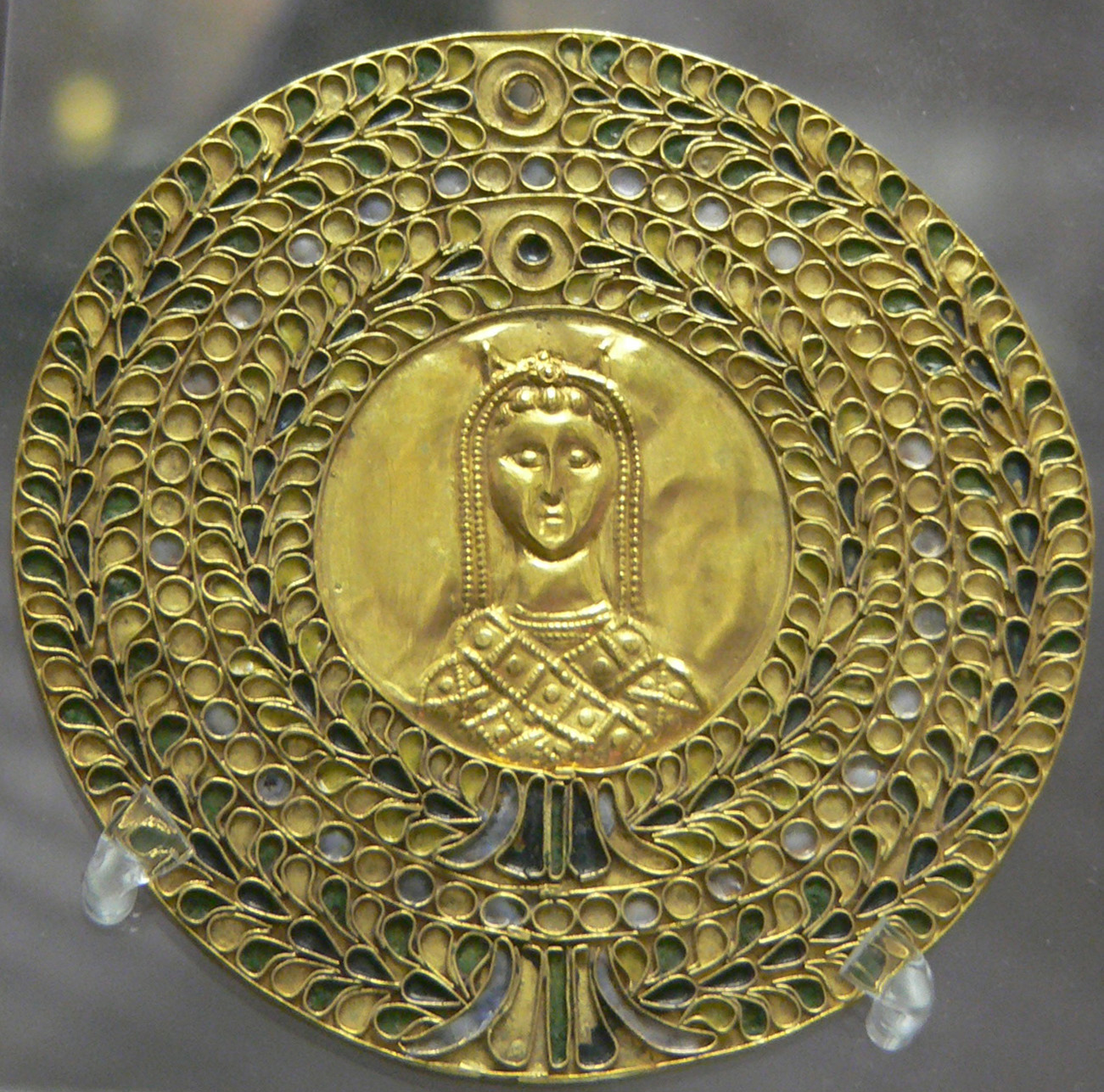
Persecution worsened during the reign of Gaiseric’s son Huneric (477-484). In his early reign, Huneric tried to appease the tensions in his kingdom by allowing the election of a new bishop of Carthage, Eugene, after 24 years of vacancy. Later, however, he resumed his father’s repressive policies. Huneric’s religious policy would be the cause of tension between him and his wife Eudocia, the daughter of the Roman Emperor Valentinian III, who was a Catholic Christian. Eudocia ended up fleeing to Jerusalem, where she died.
In 483, Huneric summoned 466 North African Catholic bishops to Sicca (El Kef), for a public debate with Arian bishops. There, he tried to force them to deny their faith. After they refused, he had them arrested. Victor of Vita recounts how he bribed guards in order to be able to visit the prisoners. In the end, they were deported into the desert. Most of them died on the way, and the survivors were executed on arrival.
The number of victims might be exaggerated, but the facts are certainly true. Only two of those martyrs are known by name: the bishops Felix of Abbir Germaniciana (Henchir en Naam) and Cyprian of Unizibira (Henchir Zembra). Victor of Vita also mentions the daughter of the bishop of Zuritana (Ain Djour), who was imprisoned together with her son.
Frumentius and Victorian
In 484, Frumentius, a Carthaginian salesman, and Victorian, the proconsul of Hadrumetum (Sousse), were put to death for their faith in Hadrumetum.
The same year, bishop Laetus of Nepta (Nefta) was burned alive by the King’s orders. 50 years later, Laetus reportedly appeared in a dream to the Byzantine Emperor Justinian, imploring him to deliver North Africa from the Vandals.
The inhabitants of Tipasa, after refusing to convert to Arianism, had their right hand and their tongue cut off. According to Victor of Vita, they miraculously continued talking and confessing their faith.
Victor of Vita also mentions three monks from Gafsa, who were put to death for refusing to convert to Arianism.
Other believers were sold into slavery by the Vandals, to Amazigh tribes inside the continent. Victor of Vita writes that some of these tribes converted to Christianity through those slaves. This was the case especially for the Caprapicti tribe of Southern Tunisia. The legendary Christian roots of certain Amazigh tribes like the Sanhaja of the Rif or the Regraga to the North of Essaouira might go back to such captives.
The storm calms down
King Gunthamund (484-496), Huneric’s successor, ended the persecutions. Victor of Vita’s book was probably written during his reign.
Fulgentius of Ruspe
Gunthamund’s successor Thrasamund (496-523), hoping to eradicate Catholicism in his Kingdom without violence, forbid the nomination of new bishops after the standing bishop’s death. Around 504, bishop Victor of Vita, the author of the book on the history of the persecutions, ordained Fulgentius bishop of Ruspe (Henchir Sbia). He then was exiled to Sardinia for disobeying the royal prohibition, and died in exile in 510. In the following years, Fulgentius of Ruspe became the most influential figure of North African Catholicism. He had public debates with Arian bishops and wrote books against Arianism. He was exiled several times, but remained committed to his cause until his death in 527.
In 523, Hilderic (523-530), son of Huneric and Eudocia, became the King of the Vandals. Hilderic, whose mother was Catholic, led a policy of religious tolerance. A new bishop of Carthage, Bonifatius, was named, and Fulgentius of Ruspe was allowed to return from exile and preach the Catholic doctrine. During Hilderic’s reign, the Vandals started converting to Catholicism.
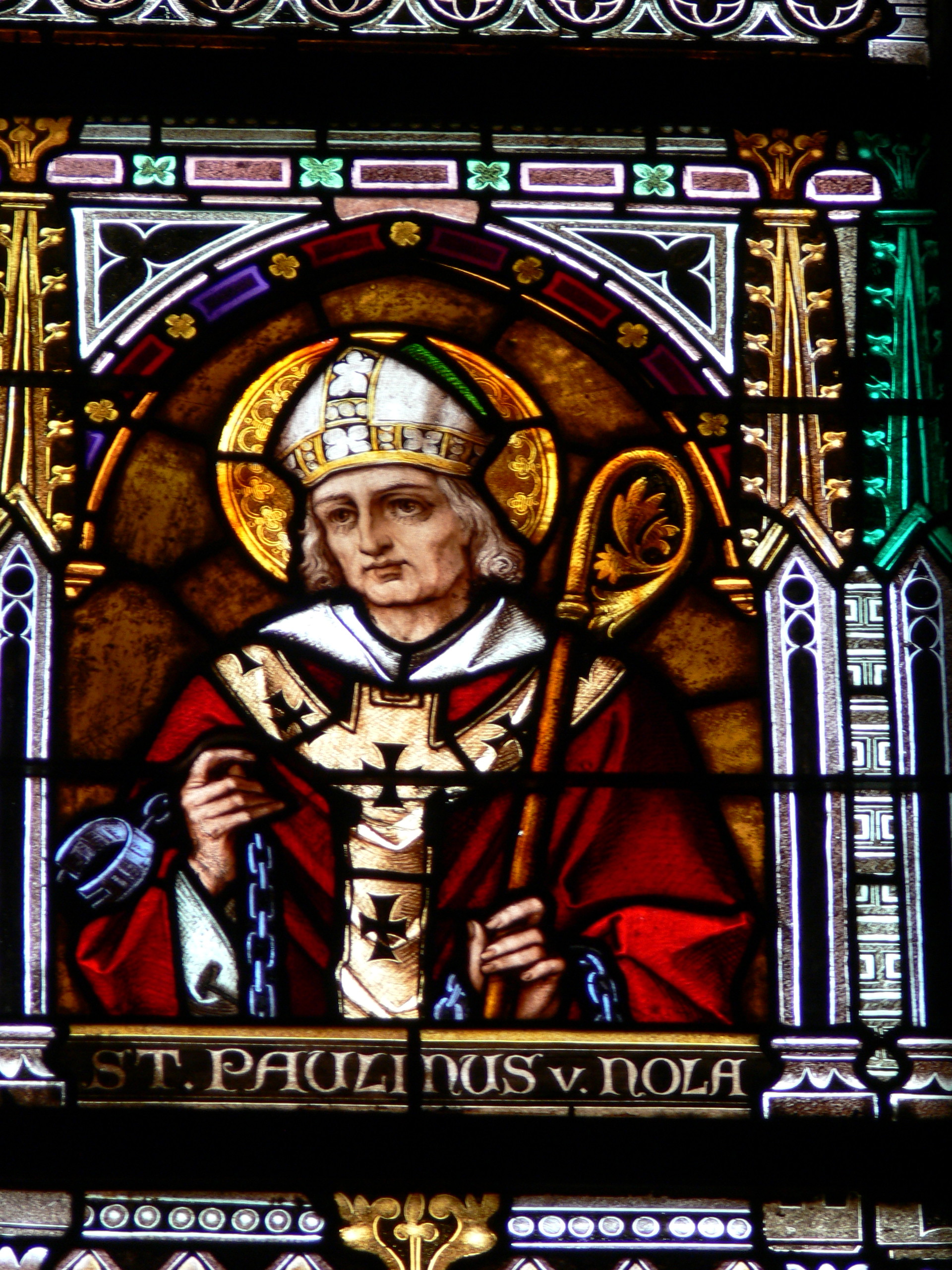
Paulinus of Nola was a Roman Senator and, later, bishop of the Italian city of Nola. A legend tells that after a Vandal raid in Southern Italy, he sold himself as a slave to the Vandals, in exchange for the son of a widow, who had been kidnapped. He spent some time serving the son-in-law of the Vandal King as a gardener, and then was freed when his master found out who he was.
Who was Paulinus of Nola?
Paulinus of Nola
Pontius Meropius Paulinus was a Roman aristocrat. Born 352 in Burdigala (Bordeaux), he was from a rich and influential family that owned domains in Gaul, Spain, and Southern Italy. He was educated by the famous Gallo-Roman poet Ausonius.
In his youth, Paulinus, like most young men of his rank, started a public career in the Roman administration. In 377, he was named consul by Emperor Gratian. In 380, he became governor of Campania, a Roman province in Southern Italy. In 384, he married Therasia, a Spanish noblewoman, and they moved to Spain together.
EIn 395, Paulinus and Therasia left Spain for Nola, in Campania. Paulinus considered Saint Felix, a bishop of Nola who had been put to death for his faith by Emperor Decius around 260, as his model: Felix also had sold all his possessions to give the money to the poor. At his arrival in Nola, he restored and enlarged the Basilica devoted to Saint Felix. Every year, he wrote a poem in his honor.
Therasia died around 410. Shortly after her death, Paulinus was ordained bishop of Nola. He spent the rest of his life in the city, until his death in 431.
Paulinus of Nola in Africa?
Paulinus of Nola as a slave in Africa – Image created by ChatGPT
According to a Christian tradition, while Paulinus was bishop of Nola, he used the Church treasure to redeem the inhabitants of the region who had been enslaved by the Vandals during a raid in Southern Italy. Finally, when a widow whose son had been kidnapped by the Vandals came to see him, as there wasn’t enough money left for the ransom, Paulinus sold himself as a slave in exchange of the widow’s son.
In Africa, Paulinus was asked about his skills, and answered that he was a good gardener. He was thus given as a slave to the son-in-law of the Vandal King (probably Gaiseric), who loved gardens. Some time later, the King found out through a dream who this slave really was, and freed him.
This story was told by Pope Gregory the Great, who lived over a century after Paulinus of Nola. Its historicity is doubtful, but the story seems quite plausible, in the light of all the other stories about the life of Paulinus of Nola.
During the first centuries of the Christian era, North Africa, from its large, cosmopolitan cities to its most remote rural areas, proved to be an especially fertile ground for the Christian Gospel. Carthage, the capital of Roman Africa, became a particularly influential Christian center. The Canon of the New Testament, that is, the list of the Scriptures that the Church recognizes as inspired by God, was officially defined at a Church Council organised in 397 in Carthage.
Why write on this? The North African societies are Muslim today. It is still good to remember that our ancestors also held different beliefs. Also, it is in no way against Islam to talk about other sacred books. To the contrary: the Quran itself always talks with great respect about the books revealed by God to ancient prophets, like the Torah of Moses, the Zabour of David (also known as the Psalms) or the Injil of Jesus, and encourages Muslims to study them. All those books are contained in the Bible.
يَٰٓأَيُّهَا ٱلَّذِينَ ءَامَنُوٓا۟ ءَامِنُوا۟ بِٱللَّهِ وَرَسُولِهِۦ وَٱلْكتاب ٱلَّذِى نَزَّلَ عَلَىٰ رَسُولِهِۦ وَٱلْكتاب ٱلَّذِىٓ أَنزَلَ مِن قَبْلُ وَمَن يَكْفُرْ بِٱللَّهِ وَمَلَٰٓئِكَتِهِۦ وَكتابهِۦ وَرُسُلِهِۦ وَٱلْيَوْمِ ٱلْءَاخِرِ فَقَدْ ضَلَّ ضَلَٰلًۢا بَعِيدًا O believers! Have faith in Allah, His Messenger, the Book He has revealed to His Messenger, and the Scriptures He revealed before. Indeed, whoever denies Allah, His angels, His Books, His messengers, and the Last Day has clearly gone far astray. (Surah 4:136)
فَإِن كُنتَ فِى شَكٍّ مِّمَّآ أَنزَلْنَآ إِلَيْكَ فَسْـَٔلِ ٱلَّذِينَ يَقْرَءُونَ ٱلْكتاب مِن قَبْلِكَ لَقَدْ جَآءَكَ ٱلْحَقُّ مِن رَّبِّكَ فَلَا تَكُونَنَّ مِنَ ٱلْمُمْتَرِينَ If you ˹O Prophet˺ are in doubt about ˹these stories˺ that We have revealed to you, then ask those who read the Scripture before you. The truth has certainly come to you from your Lord, so do not be one of those who doubt. (Surah 10:94)
Origins of the Sacred Scriptures
The Hebrew Bible
The Hebrew Sacred Scriptures, recognized both by the Jews and the Christians, were written in Hebrew (with a few passages in Aramaic, another Semitic language). Jewish tradition divides them into three parts: the Torah (תּוֹרָה), or Law; the Nevi’im (נביאים), or Prophets; and the Ketuvim (כְּתוּבִים), or Writings. Together, they are called the Tanakh.
The Canon of the Hebrew Bible is centered on the Torah, the most ancient Sacred Scripture, whose authority was universally acknowledged since the 5th Century BCE. Consensus around the other Sacred Scriptures was established gradually. The oldest Canonic list, from Josephus, around 95 CE, mentions all the books we have today.
Septuagint manuscript
In the 3rd Century BCE, the Jewish community in Alexandria, Egypt, translated the Hebrew Bible into Greek. This Greek translation is called Septuagint, because of the 70 translators who worked to make it. The Septuagint marks a fundamental theological break in Jewish theology: with the translation of its Sacred Scriptures into Greek, the vernacular language of the Mediterranean world, Judaism moved from a tribal religion, centered on divine revelation granted to a single people, to a universal religion, whose message is addressed to all men.
The Septuagint contains a few additional books, that are not part of the Hebrew Bible but were written more recently. Those books were never recognized by the Jews as holding the same authority as the Hebrew Bible. Some editions of the Bible still print them as appendices, under the name “deuterocanonical books” (second Canon).
The Christian Bible
The Greek word Evangelion (Good News) is the heart of the Christian message
The first Christians adopted the Septuagint. They called those books Old Testament (Old Covenant, as opposed to the New Covenant between God and man, sealed by Christ), the first part of the Christian Bible.
Next to the books they inherited from the Jews, the Christians also had new Sacred Scriptures, written in Greek: the Gospels (mentioned in the Quran as Injil), on the life of Jesus Christ, as well as other books written by the first apostles. Those books constitute the New Testament, the second part of the Christian Bible.
Transmission of the manuscripts
Coptic biblical manuscript
From the beginning, Christianity was founded on the calling to preach the Good News of salvation in Christ to all men in the whole world. Consequently, everywhere Christians went, they took hand-written manuscripts of their Sacred Scriptures with them. Christian preachers encouraged new believers to make their own hand-written copies. For this reason, many manuscripts have been found in the whole Roman world and beyond: next to the 5800 known Greek manuscripts and fragments, we have over 10000 Latin manuscripts, as well as over 9000 manuscripts in other languages, like Coptic (1000-1500 manuscripts) or Syriac.
Papyrus 52: the oldest known New Testament manuscript (Source)
The oldest known fragment of a New Testament manuscript was discovered in Egypt in 1935. It is dated to 125-150, and contains a few verses from the Gospel of John. (Source) While this manuscript was copied just a few decades after the original Gospel was written, it had already traveled all the way to Egypt !
There are eleven manuscript fragments that could go back to the 2nd Century of the Christian era (meaning they would have been written less than a century after the original), although only four of them have been dated to the 2nd Century with certainty by the specialists. (Source)
The oldest near-complete manuscript of a whole Gospel is Papyrus 66, which was found in Egypt. Dated to around 200 (a bit more than a century after the original), it contains almost the whole Gospel of Mark. (Source)
The oldest manuscripts were written on papyrus rolls, a form of paper produced in Egypt from papyrus, a plant that grows along the Nile. Papyrus is difficult to keep intact over long periods of time, which explains why all the oldest manuscripts are only fragments. Around the 3rd-4th Century, papyrus was replaced by a new, more resistant writing support: parchment, made of animal skins. Consequently, from this time on, more complete manuscripts can be found.
Codex Vaticanus: the oldest complete biblical manuscript
Three especially well-preserved manuscripts, dating back to the 4th and 5th Century, are considered the oldest complete copies of the Christian Bible. Codex Vaticanus, dated to 300-350, is kept at the Vatican Library. Codex Sinaiticus (on the cover picture of this article), dated to 325-360, was in Egypt, at Saint-Catherine’s Monastery, at the feet of Mount Sinai, until the 19th Century, when it was “discovered” (and, according to the monastery, stolen) by the German biblical scholar Constantine von Tischendorf. It is now kept at the British Library, in London. Codex Alexandrinus, dated to 400-440, is originally from Alexandria, and also kept at the British Library.
Reliability of the manuscripts
With handwritten texts copied many times, often by believers who weren’t necessarily very educated, mistakes were unavoidable. There are obvious differences between manuscripts, even between the three great codices mentioned above. So, how can we know if the writings we have today are the same as the original?
Dead Sea Roll
For the Hebrew Bible, we can mention the Dead Sea Rolls. In 1946, Bedouin shepherds found papyrus rolls, completely by chance, in a cave close to the Dead Sea, at Qumran, Palestine. Archaeologists who came to examine their discovery found a collection of over 900 manuscripts dating back from the 3rd Century BCE to the 1st Century CE. Among those rolls, which belonged to a Jewish sect known as the Essenes, were the oldest known manuscripts of all the books of the Hebrew Bible, including the Deuterocanonical books, together with other Jewish religious writings. The Dead Sea Rolls are the most amazing archaeological discovery of the 20th Century! There is no significant difference between those manuscripts and the biblical books we have today.
For the Christian Bible, the answer to our question can precisely be found in the great number of manuscripts. Over 5000 Greek manuscripts of the Bible have been found, not to mention the many translations. Having so many manuscripts allows us to compare their texts. Also, the oldest manuscripts are chronologically very close to the original Scriptures: the oldest complete manuscripts were written only 3 centuries after the original, and some fragments are even older, which is proof that they are reliable.
Critical analysis of biblical manuscripts, or textual criticism, is a highly complex scientific method that involves comparing the existing manuscripts, in order to find and correct mistakes, and to reconstitute the original text as far as possible. If, for example, a small number of manuscripts contain a variation with the vast majority of manuscripts, this means that the majority version is authentic. If a variation appears only on more recent manuscripts, we can conclude that it is a mistake and the older manuscripts are correct. Specialists thus have managed to reconstruct over 99% of the original text with a high degree of certainty. As for the few remaining divergences between the manuscripts considered the most reliable, none of them concerns a major doctrine.
Formation of the biblical Canon
Muratorian fragment
As for the Hebrew Bible, the first Christians had to decide which of their many writings should be considered inspired by God. Selection criteria were quite simple: an inspired book must have been written by an apostle or by someone who knew the apostles, during the apostolic era, and conform to the apostolic doctrine. The list of Sacred Scriptures is called Canon, from the Greek kanôn (κανών), a stem of reed used to determine the length of an object.
Most Sacred Scriptures, including the four Gospels, the Acts of the Apostles and the Epistles of the Apostle Paul, have always been recognized by all Christians. Other books, like the Epistle to the Hebrews (because it is anonymous) and Revelation, were debated. Finally, some believers wanted to add other books that finally weren’t included, usually because they weren’t written by he apostles, but by the following generation.
Muratorian Canon
The oldest list of Christian Sacred Scriptures is found in the Muratorian Fragment, written around 170-200 by the Church of Rome. This list mentions 21 of the 27 books of the current New Testament, together with two other books that are not now part of the New Testament. Most of the omitted books are very short, which means they were probably not known everywhere at this time. The Muratorian Fragment also mentions books it rejects.
The theologian Origen of Alexandria, the father of biblical exegesis, did not leave us a list of the books he considered Sacred Scriptures, but he wrote commentaries of all the books of the current Bible.
After the Constantinian Reform, the Church needed to officially determine which Scriptures were to be considered sacred. The Codex Vaticanus and the Codex Sinaiticus, the two oldest complete Bibles, both contain the books of the Bible as we know it today, which shows that the issue was consensual. A letter by bishop Athanasius of Alexandria, written in 367, also lists the same books.
Council of Carthage – Image created by ChatGPT
The final decision was made in North Africa: in 393, a synod of bishops met in Hippo (Annaba), to officially approve the Canon of the Christian Bible as it still exists today. At the time, Augustine was not yet bishop of Hippo, but he already served as priest in this city, and certainly took part in the synod. The synodal decision was confirmed in 397, at the Council of Carthage, and then sent to the Church in Rome for approval.
Around the same time, the Christian theologian Jerome of Stridon worked for over 20 years, from 382 to 405, to retranslate the entire Bible into Latin. For this task, he settled in Bethlehem, in a cave believed to be Christ’s birthplace, where the Church of the Nativity was later built. For the Old Testament, he translated the Hebrew original texts, not the Greek Septuagint – an use that has been followed by other Bible translators since. His translation, known as the Vulgate, is the official Bible of the Catholic Church until today. Jerome is considered as the patron of translators.
The Bible in North Africa today
The history of the Bible in North Africa didn’t end with the Council of Carthage, nor even with the arrival of Islam. Last April, a team of Moroccan translators published the first translation of the complete Bible in Moroccan Darija. (Source) This Darija Bible is the fruit of 30 years of work. It is meant first for the Moroccan Christian minority, but also for all Moroccans who wish to discover a book that the Quran speaks highly of, the most read book in the world for 2000 years. It can be read on this app.
Synesius of Cyrene, a Neoplatonic philosopher from Cyrenaica, was the last major figure from a previously highly influential region. Originally from Balagrae (Al-Bayda), he represented Cyrenaica as ambassador to the Imperial court. After a prestigious political career, he even became bishop of Ptolemais by the end of his life. His works sought to reconcile classical Greek-Latin thought and Christian theology.
Origins
Synesius of Cyrene
Synesius was born around 370, close to Balagrae (Al-Bayda). He was the eldest son of an ancient noble family with Greek origins, who claimed descendence from the kings of Sparta. He grew up on the family domain in the Jebel Akhdar, surrounded by nature and the pleasures of rural life. At the same time, he received an elite education, in Cyrene, then Alexandria.
At this time, the formerly prosperous region of Cyrenaica was declining. Cyrene, weakened by the 365 earthquake and by the recurring attacks of the surrounding Amazigh tribes, had been replaced by Ptolemais as provincial capital. In this context, the young Synesius discovered his life vocation: preserving Greek-Roman civilization in Cyrenaica.
Around 395, he traveled to Athens. While he had high expectations about this visit to the city of philosophers, he returned to Cyrene very disappointed. This trip made him aware of the decline of the Hellenistic intellectual tradition.
Mission to Constantinople
Around 398, Synesius was sent as an emissary of Cyrenaica to the imperial court, to plead the cause of his fellow citizens and petition the Emperor for a tax exemption, so that the region may rebuild itself. In his address to Emperor Arcadius, he advises him on how to reign with wisdom, with special insistence on the importance of fighting corruption. After long diplomatic negotiations, his mission was finally successful. From this experience, he kept a deep dislike for the political intrigues of the imperial court, which upset the young philosopher’s idealism.
Astrolabe
In Constantinople, he contacted Paeonius, a military officer from the Emperor’s circle, who was interested in Hypatia’s scientific experimentation. As an introductory present, he gave him a scientific tool which he had fabricated in Alexandria: an astrolabe, to measure the position of the stars. Together with this gift, he wrote an essay encouraging civil and military authorities to show interest in science and philosophy.
Is was probably also during this stay in Constantinople that he had his first significant contacts with Christianity, which was highly influential at the imperial court. The majority of the Roman world, including in Cyrenaica, were already following the new religion, but Synesius’ family were part of the conservative elite that remained faithful to the old religious traditions. However, his discovery of Christianity did not lead to a break with this heritage: on the contrary, it led him to seek to preserve classical Greek-Roman thought by integrating it into Christian thought.
Career in Alexandria and Cyrenaica
Alexandria
Synesius returned to Cyrene in 402. The following year, he got married, in Alexandria. His wife, whose name is unknown, was from an influential Alexandrian family, and she was a Christian. They had three children, who all died before him. The letters Synesius wrote show that he deeply loved his wife and was very attached to his family. He wrote a poem in honor of his wife.
In his spiritual journey, Synesius slowly came closer to Christianity, without ever cutting off his Hellenistic roots. His wife’s Christian faith, as well as his friendship with bishop Theophilus of Alexandria, certainly played a decisive role in his gradual conversion. At the same time, he remained very close to Hypatia, who, while she was a pagan, was tolerant of Christians and had many Christian students. A few years after he got married, Synesius finally asked to be baptized.
Bishop of Ptolemais
Church ruins in Ptolemais
In 410, Synesius’ friend bishop Theophilus of Alexandria chose Synesius to become the new bishop of Ptolemais. As bishop of the capital of Cyrenaica, he would have authority over all the bishops in the province. This nomination was surprising: while Synesius was a trained classical philosopher, his knowledge of the Christian sacred texts was limited. It is possible that he wasn’t even baptized yet! Despite this, Theophilus believed that the Church needed leaders with his education, to manage the growing Christian influence in society. Synesius’ case was not unique: many other young nobles who had only recently converted received responsibilities in the Church around the same time.
Synesius was hesitant to accept this nomination. First, most Christian leaders at the time were celibate, and he didn’t want to have to renounce his family. Also, some of his ideas, especially his belief in the preexistence of the soul, a fundamental Neoplatonic tenet, went against official Christian doctrine. He finally agreed, on condition that he would not have to separate from his wife, and that he would not be forced to confess certain Christian doctrines he did not believe in, like the creation of the soul, bodily resurrection, and the future destruction of the world. In exchange for these concessions, he committed not to preach his ideas publicly. The fact that this arrangement was accepted is an indicator of the doctrinal flexibility of Christian church authorities at this time.
Church ruins in Ptolemais
As the bishop of Ptolemais, Synesius opposed Andronicus, the prefect of Cyrenaica, a tyrant who had tortured innocent citizens. After calling him several times to repent, he finally excommunicated him (excluded him from the Church). This decision could have cost him his life, but he stood firm against the injustices his fellow citizens were suffering. In a letter he wrote, Synesius testifies that during this confrontation, he was tempted to renounce his charge as a bishop, especially when one of his friends, the treasurer of public funds, was imprisoned by Andronicus. However, all this ended up strengthening his resolve to continue.
He also had to solve a conflict between the bishops of Darnis (Derna) and Erythrum (Al-Athrun), over a church that was located at the border between their two dioceses. His skills in civil administration came in handy in this business. His mediation effort shows how important peace and harmony inside the church was to him.
In 413, Synesius’ third and last son died. This was another very hurtful experience for him. Synesius himself died in 414, at around 44 years of age. On his deathbed, he wrote a last letter to Hypatia; she would be killed the following year.
Works
Synesius’ most famous works are his nine Hymns: poems of Neoplatonic inspiration, describing the mystical quest of the human soul as it seeks unity with God. The first Hymns were written while he wasn’t yet a Christian, and the following ones show how his thinking evolved, to integrate Christian ideas into his Neoplatonic spirituality. All his works are a unique and fascinating synthesis between Christianity and Neoplatonicism.
Synesius’ life is known mostly from his 159 Letters, which he wrote to his wife, to his brother, to Hypatia, to Theophilus of Alexandria, to other bishops, etc. These letters also give a good look on his noble character.
One of his letters is the last mention of silphium: he writes that this plant no longer exists in his lifetime, and that its disappearance is one of the causes of the decline of his native Cyrenaica.
Some of his letters mention poems he wrote, which are lost.
During his whole life, Synesius was fascinated by dreams, which he saw as a way for the soul to discover hidden truths and to communicate with God. Around 405, he wrote a treatise on dream interpretation.
Another one of his work is humorous: in On Baldness, he argues that being bald is better than having hair, because a bald head looks more like a sphere, the most perfect of all shapes.
From his years as a bishop, we still have two homilies (church sermons), that give us an idea of how he interpreted the Christian sacred texts.
Finally, he wrote a lost book on how to breed hunting dogs. Hunting was his great passion, which he reluctantly gave up when his responsibilities no longer allowed him to practice it.
Hypatia of Alexandria was a Neoplatonist philosopher, mathematician, and astronomer, who was leading the Neoplatonist school of Alexandria in the 4th-5th Centuries. She was renowned for her knowledge and respected by all for the wisdom of her teaching and council. She is the first female mathematician whose life is so well documented.
Hypatia was born between 355 and 370, depending on the sources. She was the daughter of the mathematician Theon of Alexandria. Her father was the director of the Museion, a highly renowned Neoplatonist school. While she had many suitors, she wasn’t interested in men and never married (legend has it that she gave an especially pushy suitor a tissue soaked with her menstrual blood).
Hypatia taught mathematics and astronomy to students who originated from the whole Mediterranean basin. While she was a Pagan herself, she was very tolerant of Christians and had many Christian students, including future bishops. Her most famous student was Synesius of Cyrene, who deeply admired her.
As for her works, she wrote a commentary of Diophantus of Alexandria’s Arithmetics, and of Apollonios of Perga’s treatise on conic sections. She probably also participated in her father’s edition of Claudius Ptolemy’s Almagest. She knew how to make astrolabes (instruments used to calculate the date and time based on the planets’ position) and hydrometers (instruments used to determine a liquid’s density). In astronomy, she mostly devoted herself to the calculation of the date of the equinox.
Fictional portrait of Hypatia, by Alfred Seifert
Hypatia was a well-known and respected figure in Alexandria. The Christian historian Socrates Scolasticus speaks very highly of her: “There was a woman at Alexandria named Hypatia, daughter of the philosopher Theon, who made such attainments in literature and science, as to far surpass all the philosophers of her own time. Having succeeded to the school of Plato and Plotinus, she explained the principles of philosophy to her auditors, many of whom came from a distance to receive her instructions. On account of the self-possession and ease of manner, which she had acquired in consequence of the cultivation of her mind, she not unfrequently appeared in public in presence of the magistrates. Neither did she feel abashed in coming to an assembly of men. For all men on account of her extraordinary dignity and virtue admired her the more.” Despite this, she became a victim of the growing intolerance of Alexandrian Christianity, eager to overcome the old order.
In 412, bishop Theophilus of Alexandria died and his nephew Cyril succeeded him. While Theophilus seems to have been on good terms with Hypatia, Cyril mistrusted her. In 414, after several violent incidents between Jews and Christians in Alexandria, bishop Cyril had all the city’s synagogues closed and expelled the Jewish population. These measures shocked Orestes, the city governor, who was a close friend of Hypatia. Orestes, who had himself recently converted to Christianity, shared Hypatia’s desire for peaceful coexistence between Christians, Jews and Pagans. He was also concerned that the bishop was overstepping his prerogatives and impinging on the powers of the civil authorities, with the support of the Alexandrian popular classes, who were strongly Christian and more and more fanaticized.
The conflict between the bishop and the governor degenerated into a violent clash. In this confrontation, Cyril could count on the support of the monks (parabalani) of the Nitrian desert, South-West of Alexandria. During a riot, a monk named Ammonius threw a stone on Orestes, wounding him at the head. Orestes, furious, had him tortured so violently that he died. Cyril wanted to proclaim him a martyr, but most Christians were opposed to this move, which increased the tensions even more.
Death of Hypatia
In this context, rumors started to spread that Hypatia, who was advising the governor, was working against any reconciliation between him and the bishop. The monks, furious, seized her and killed her. Socrates Scolasticus recounts her murder: “Some of them therefore, hurried away by a fierce and bigoted zeal, whose ringleader was a reader named Peter, waylaid her returning home, and dragging her from her carriage, they took her to the church called Cæsareum, where they completely stripped her, and then murdered her with tiles. After tearing her body in pieces, they took her mangled limbs to a place called Cinaron, and there burnt them.”
Was Bishop Cyril himself behind Hypatia’s death? Did the monks act on his orders, or at their own initiative? This point is still debated by specialists. Whether or not Cyril did order Hypatia’s murder, the intolerant measures he took definitely contributed to the toxic atmosphere that led the monks to take action.
While Socrates Scolasticus doesn’t claim that Cyril ordered Hypatia’s murder, he mentions that her death was very detrimental to the bishop’s popularity: most Alexandrian Christians appreciated Hypatia and were shocked when she was killed.
The history of Christianity, in North Africa and the whole Mediterranean world, is closely linked to the history of the Roman Empire. Despite this, since the first centuries of the Christian era, there also were Christians among the Amazigh tribes beyond the Roman borders, in the Atlas Mountains and the Saharan desert. Remains of churches have been found in tiny villages that weren’t even documented by the Roman administration.
Beginnings
Tertullian of Carthage, the first witness of an African Christian presence beyond the Roman borders
The first mention of a Christian presence in the parts of Africa beyond the Roman limes goes back to the 3rd Century, when the Christian writer Tertullian of Carthage wrote about the “various races of the Getules, and the multiple borders of the Moors … inaccessible to the Romans, but subjugated by Christ”. This shows that already during Tertullian’s lifetime, there were Christians among the Getules and the Southern Moors who lived beyond Roman Mauretania.
Hw did Christianity spread in those regions? The most often, it was through Amazigh merchants who came to sell their goods in the coastal cities, or agricultural workers working on farms in Roman Africa: they discovered the Christian faith, and then brought it back to their family and tribe. There were also Christians who had been taken prisoners during raids at the Roman borders, and preached their faith to the tribes among whom they were now living.
At times, the Roman authorities exiled Christian leaders into oases and isolated desert regions. Those leaders then preached their faith to the inhabitants. This is how Christianity reached the Siwa Oasis.
The main Southern Mauretanian city beyond the Roman borders was Tamusiga (Essaouira). No traces of a Christian presence in Tamusiga in the Roman era have been found, but the city’s strong links with Roman Mauretania makes such a presence likely. Also, a Christian presence among the Guanche Amazigh of the Canary Islands is not proven, but likely, given the links between the island and the continent.
Outside the major Romanized cities, the North African Amazigh were hostile to Roman power. As the Romans also persecuted Christians, the Amazigh saw Chistianity as a religion of resistance against Rome.
The break
After the Roman Empire became Christian in the course of the 4th Century, the Roman African Church started worrying more about maintaining its new status as State religion than about preaching the Christian message beyond the Roman borders. The “free men” living inside the continent were no longer drawn to Christianity as it became linked with the Roman administration.
A new form of Christianity, Donatism, considered as heretical by the Roman Church, was far more successful. One of the main reasons for its success was that it expressed the Christian faith in local languages, while the Roman Church used only Latin. In the 4th and 5th Centuries, there were far more Donatists than Roman Christians, and Donatist communities could be found all through North Africa. Donatism was directly linked to Amazigh nationalism: as long as the Romans were persecuting the Christians, the Amazigh massively converted to Christianity; now that the Romans wanted to force them to be Roman Christians, they preferred a different Christianity.
Later on
After the Vandal conquest, Christians sold as slaves by the Vandals to far-away tribes converted their new masters to their faith. This was the case with the Caprapicti tribe of Southern Tunisia. It is possible that the legendary Christian roots of certain Amazigh tribes, like the Sanhaja of the Rif or the Regraga to the North of Essaouira, go back to the influence of such captives.
In the 6th Century, the Byzantine reconquest of North Africa opened the door for a new missionary wave towards the inner regions of the continent. Christian preachers from Tripolitania preached the Christian message in the oases of Cydamus (Ghadames) and Augila (Awjila). In 569, the Garamantes of the Fezzan converted to Christianity. At the same time, Christianity spread in the South of modern-day Algeria and Morocco, beyond a Roman border that no longer existed.
Archaeological traces
Several Amazigh tribes of the Atlas and the coastal plains of modern-day Morocco were Christian. Some tribal chiefs left us a testimony of their allegiance to Christ. For example, a writing discovered of the road from Constantine to Jijel mentions the King of the Ucutamani (Kutama), who reigned over Kabylie, and held the title “God’s servant”.
Djorf Torba stele: the character to the right is holding a cross
In Djorf Torba, in the Algerian wilaya of Bechar, a monument, built between the end of the 5th Century and the beginning of the 6th Century, contains several steles: one of them shows a man holding a cross in his hand. (Source)
The famous Djeddars, thirteen funerary mausoleums to the South of Tiaret, Algeria, also contain Christian symbols, showing that their builders, 5th-Century Moorish Aguellid, were Christian. (Source)
Next to those monuments, more simple Christian writings wan be found in the oasis of Figuig and the Souss Plain.
By the 4th and 5th Centuries, a large majority of the North African population was Christian, but they belonged to a religious movement that was considered heretical by the official Church. Donatism started in Africa as an indigenous protest movement against Roman control over religious affairs.
Context
In the early 4th Century, the Christian Church in the Roman Empire was hit by a new wave of persecution, the worst in its history. Christian church buildings were destroyed, their sacred texts burned, and over 3.000 believers killed for their faith. The African church was particularly affected, owing it its reputation as “church of the martyrs”.
Constantine, the first Christian Emperor
In 311, Emperors Galerius (Eastern Empire) and Constantine (Western Empire) signed an edict of toleration, effectively putting an end to persecution: for the first time, Christians could practice their faith freely. The following year, in 312, Emperor Constantine himself converted to Christianity.
Those changes were an immense relief for Christians in the Roman Empire; but they also had unexpected consequences: now that the Emperor was a Christian, the Church would be more and more influenced by Roman imperial politics, at the expense of its spiritual vocation. This was not a welcome development for the people groups who, like the North African Amazigh, were hostile to Roman domination and loved their freedom.
Birth of Donatism
The Donatist controversy started as a theological controversy over the right attitude to adopt toward the believers who had been forced to deny their faith during persecution, This question was already debated in the church during the previous century, at the time of bishop Cyprian of Carthage.
Late portrait of Donatus
In 311, just after the end of the persecution, a Carthaginian deacon, Caecilianus, was chosen as the new bishop of Carthage. Some Christians protested against his nomination, as Caecilianus was accused of giving over sacred texts to the Roman authorities during the persecution, for them to be burned. Caecelianus’ adversaries believed that a man guilty of such misconduct could not have responsibilities in the church. 70 Numidian bishops met secretly in Carthage, to choose another bishop: Mensurius. When Mensurius died shortly later, Donatus, previously the bishop of Casae Nigrae (Negrine, wilaya of Tebessa, Algeria), was chosen to succeed him. The charismatic Donatus became the leader of the movement.
Church ruins, Tipasa, Algeria
Two years later, Donatism was condemned by a church council presided by the bishop of Rome. Caecilianus was cleared of the accusations against him and recognized as the only legitimate bishop of Carthage. The council also ruled that the validity of sacraments did not depend on the dignity of the men who administered them, but on God who was at work through those men, so that even if Caecilianus was indeed guilty, God could still continue to communicate his grace to the church through him.
Donatist church, Sbeitla, Tunisia
The Donatists still persisted in their refusal to submit to a bishop they saw as unworthy. All through Roman Africa, more and more bishops joined their side with their flock. Other older Christian dissident groups joined them too. The whole North African Christian church was divided: today, many towns contain the ruins of two churches, one Catholic (Roman) and one Donatist, often next to each other. Beyond the theological question at the root of the conflict, North African Christians were refusing to let the church in Rome dictate their choices.
Donatists and Catholics both claimed the legacy of Tertullian and Cyprian of Carthage: the Donatists referred to their insistence on holiness and intransigence toward sin, while the Catholics called on their teaching on the unity of the Church.
While the Catholics only used Latin for Christian worship, the Donatists spoke the local Amazigh languages, and this certainly explains their success.
With time, more and more crowds joined the Donatist churches: fugitive slaves, landless farmers, rural Amazigh who were hostile to the Roman presence on their ancestral lands, etc. The Donatists quickly became a majority in North Africa. It was at this time that Christianity reached the furthest inland. However, due to its popularity, the movement lost its spirituality. Most Donatists certainly were sincere believers, but the movement compromised itself by accepting people with more sociopolitical motivations. It wouldn’t take long before they even allied themselves with political powers…
The Circumcellions
Circumcellions
The Circumcellions, or Agonistici, were violent gangs who claimed to fight the injustices suffered by the Rural North African populations. They demanded for all slaves to be freed and all debts to be cancelled (as it was mostly the poor who were in dept to rich landowners). They marauded in the countryside, burning down farms and attacking travelers and all those they saw as enemies.
While the Circumcellions’ claims were originally merely social, around 340, they allied with the Donatists. Through this alliance, they took over for themselves the Christian idea of martyrdom: they now attacked Roman military outposts, armed only with staffs, hoping to die as martyrs. Their war cry was: “Laudate Deum”, “Praise be to God”.
Many Donatists did not look favorably at all on the Circumcellions’ excesses. The Donatist leaders in Carthage wanted to clearly dissociate themselves from them, but they were afraid of dividing their movement, as the Numidian and Mauretanian bishops supported them.
Around 345, after the Circumcellions started a full-scale insurrection against slave owners and creditors, the Roman authorities finally intervened to repress them. The Romans saw no difference between the Donatists and the Circumcellions: both movements were dangerous agitators to be eliminated.
Firmus’ uprising
Petra (Maklou), Firmus’ fortress
After the Circumcellions, the Donatists found a new ally of convenience, but this alliance would eventually be just as harmful for them.
With time, more and more Donatists became disillusioned with the direction the movement had taken. Around 370-380, the theologian Tyconius was excluded by the Donatists because he spoke out against their radicalism. Around 385, the Catholic bishop Optatus of Milevis (Mila) wrote a treaty against the Donatists, that would bring many moderate Donatists back to the Catholic church.
Augustine of Hippo
The famous Augustine, the greatest Roman African Christian theologian, discovered the Donatist controversy in 395, after he became bishop of Hippo. While the Donatists were a majority in the city’s Christian community, he managed to convince most of them to return to the Catholic church, through dialogue and his charitable attitude. He also met several Donatist bishops of neighboring cities, and, despite their disagreements, he spoke about them with much respect and described them as good, godly men.
The main figure of the later Donatist movement was bishop Optatus of Thamugadi (Timgad). In 395, he supported Gildon (Firmus’ brother) in his uprising against the Emperor.
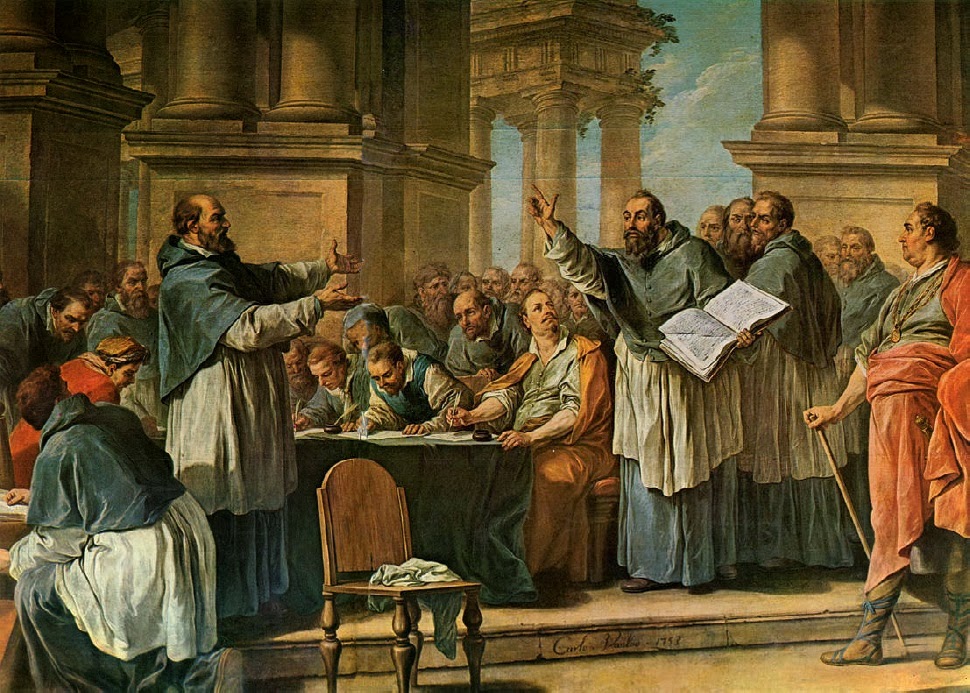
In 411, Emperor Honorius decided to organize a conference in Carthage, in order to solve the Donatist controversy once and for all. 286 Catholic bishops and 279 Donatist bishops met to debate about their differences. The speaker of the Catholic side was Augustine of Hippo, while the Donatists were represented by Petilianus, the Donatist bishop of Constantine, previously a renowned lawyer. Marcellinus, the proconsul of Roman Africa, presided the debate.
Augustine discussing with the Donatists
This debate was characterized both by the conciliatory attitude of the Catholics, who were ready to let the Donatists keep their bishops and church buildings if they agreed to return to the Catholic church, and by the arrogance of the Donatists, who refused any kind of compromise. At the end, the Donatists were condemned to reintegrate the Catholic church. The Donatist bishops and congregations who agreed could keep their bishoprics and their church buildings, while those who refused would be imprisoned.
Most Donatists submitted to the ruling and joined the Catholic church. Those who still refused were persecuted by the Roman authorities, with the blessing of the Catholic church authorities. The sad story of the persecution of the last Donatists shows how a religion that was still recently persecuted could itself start persecuting others as soon as it found itself associated with political power.
Small Donatist communities survived in rural areas during the Vandal occupation, and then underwent a renewal in the Byzantine era. The Donatist presence probably facilitated the Arab conquest of the region: the Jews and Donatist Christians, who were persecuted by the Byzantines, saw the Muslim invaders as liberators.
Impact of Donatism
Donatist mosaica, Sbeitla, Tunisie
The Donatist controversy is characteristic of the tension that always arises between an universal religion, institutionally centralized, and its local expression in a specific culture. The Donatists remind us of the Kharijite movements that prospered in North Africa centuries later, opposing an “Amazigh Islam” against “Arab” Islam. In the Christian world, their refusal to submit to an official church they saw as “unholy”, compromised with political power, brings them close to the 16-Century Protestant Reformers.
After the Roman Empire became Christian, many Roman temples and civil buildings were transformed into churches. For the Christians, this was a way to reclaim the ancient Roman genius, by putting its most beautiful constructions in the service of their religion. A good example is the Severan Basilica, an emblematic building of the Libyan city of Leptis Magna.
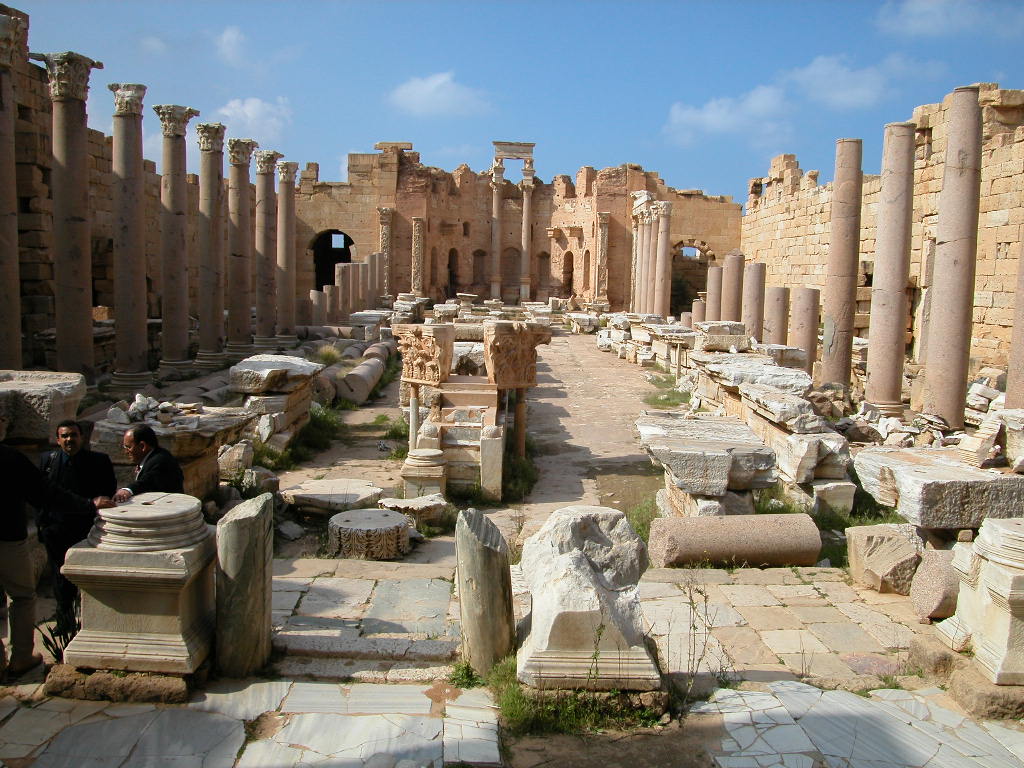
Severan Basilica
The Severan Basilica was built by the Roman Emperor Septimius Severus, who was born in Leptis Magna. Its history is linked to the Arch of Septimius Severus: when Septimius Severus visited Leptis Magna in 203, the local authorities built the Arch in his honor. To thank them, the Emperor then built the Basilica, inspired by the Ulpia Basilica, in Rome. Septimius Severus’ son and successor Caracalla later finished the construction of the Basilica.
Northern apse of the Basilica
The Basilica was about 95 meter long and 35 meter large. Is was divided into three naves, which were separated by ranges of columns. The columns were made of Egyptian purple granite and Euboean green marble. At the two sides, there were apses (semi-circular walls) with platforms on which the magistrates could stand. The Basilica served as a public court, among other uses.
Two of the Basilica’s columns contain especially remarkable decorations. One represents Hercules, the other Dionysus.
The Basilica’s church pulpit
In 533, the Severan Basilica, which had fallen in ruins during the Vandal occupation, was restored. It then became a Christian church, consecrated to Mary the mother of Jesus.
The church pulpit was built with the stones of an old altar in the Basilica, to symbolize the pagan idols’ powerlessness and the triumph of the Christian God. A baptistery, in the shape of a cross, was also built. However, apart from those elements that were necessary to Christian worship, the old Roman Basilica was left largely intact. Roman Christians did not see their faith as a break with the past, but they wished to preserve all that made the glory of ancient Rome, by removing only what went directly against their faith.