

Français – عربي – ⵜⴰⵎⴰⵣⵉⵖⵜ – English
Massalia was a Greek colony in Southern Gaul. After its foundation in the 6th Century BCE, the city would grow quickly, and establish several trade counters in Gaul, Spain, Corsica, and Liguria. From the beginning, Massalia would be in conflict with Carthage, as the Carthaginians feared that the Greek city would threaten their Western Mediterranean hegemony. During the following centuries, Massalia became the main port city in the region, and a major rival to Carthage.
Foundation
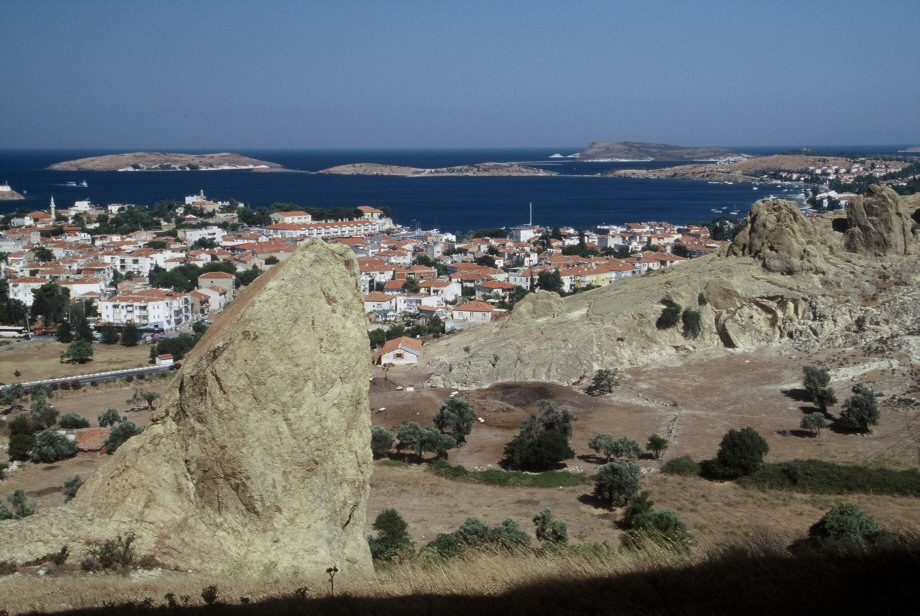
Massalia was founded around 600 BCE, by a group of Greek merchants, who came from the city of Phocaea (in modern-day Western Turkey). In the next few decades, three other colonies were founded from Massalia: Emporion (in the Spanish province of Girona), Hemeroskopeion (in the Spanish province of Alicante), and Alalia (modern-day Aleria, in Corsica). In 545, after Phocaea was conquered by the Persians, a new wave of colonists joined Massalia and the other Phocaean colonies. By the end of the 6th Century, Massalia, an influential trade center, was the dominant power in the region.
The Greek philosopher Aristotle mentions a myth related to the foundation of Massalia: Euxenes (also named Protis in other sources), the leader of the first colonists, was hosted by Nanos, the king of a local Celtic tribe, who was about to celebrate his daugher Petta (or Gyptis)’s wedding. According to custom, the king organised a banquet, during which the girl was to offer a cup of wine to the man she wished to marry. When she offered the cup to Euxenes, the king agreed for them to be married. Their marriage sealed the union between the region’s former inhabitants and the newcomers.
Conflict with Carthage

The emergence of Massalia was a source of concern for Carthage, especially with its colonies in Spain: the Greek presence was a threat to the Carthaginian trading routes.
Around 540, the Carthaginians allied themselves with the Etruscans of Northern Italy, to attack Alalia, the Phocaean city in Corsica. Massalia sent around forty ships to help. The two fleets fought at sea, at the battle of Alalia. The Phocaeans were defeated and forced to abandon Alalia; the city came under Carthaginian control. In the long term, however, the Phocaeans would emerge stronger from this defeat: their domination on the Gaulish coasts, from Emporion to Liguria, was now recognized.
Massalia at its zenith

During the next few centuries, the port of Massalia became the largest port in the Western Mediterranean basin, after Carthage. The Phocaeans founded other commercial outposts, in Agathe (Agde), Olbia (Hyères), Tauroentium (Six-Fours-les-Plages), Antipolis (Antibes) and Nikaia (Nice).
The Constitution of Massalia was praised in the whole Greek world, as a model of political stability. The city was an oligarchy: a boulê (assembly) of 600 members chose 15 “first citizens”, who administered the city; three of them were the most influential, holding most executive powers.
Massalia became a cultural crossroads between the Greek world and Gaul. Under its influence, the Gauls learned to write their language in the Greek alphabet.
Massalia was also a city of explorers : around the end of the 6th Century, Euthymenes sailed down the North African coast, beyond the Senegal river; and in the 4th Century, Pytheas sailed all the way to Britain, and then explored the Baltic Sea and the Scandinavian coasts. While those Greek navigators were preceded on their routes by Carthaginian explorers, they probably went even further than them.
During the Punic Wars, Massalia was a trusted ally of Rome. After the Second Punic War, the Carthaginians left Spain, allowing Massalia to extent its influence.
Massalia during the Roman area

Between 125 and 121, through a series of military campaigns, Rome took control of almost the whole Massalian hinterland. The region became the Roman province of Transalpine Gaul. Massalia itself became a client city of Rome.
During the Roman Civil War (49-45) between Caesar and Pompey, Massalia, while officially neutral, hosted Pompey’s fleet. Caesar avenged himself by besieging the city. Massalia was thus forced to submit to Rome.
Massalia again underwent considerable development during the Roman era: the city forum was rebuilt, and a theater and public baths were added. Especially, with the enlargement of its port, it became one of the largest ports in the Empire.
Christianity probably entered Gaul via Massalia: the first recorded Christian mission was the one to Lugdunum (Lyon), capital of Roman Gaul, around 175; but not only those Christians, who were from Asia Minor, certainly came by ship via Massalia, but there probably already was a Christian community in Massalia before them.
The Phocean city today

Today, Marseille is the second-largest city in France. In the 20th Century, its strategic location enabled it to become the main port of trade with the French colonial empire. This monopoly was threatened by decolonization. After Algerian independence, in 1962, many “Pieds-Noirs” (French settlers in Algeria) came to live in Marseille on their return from Algeria. At the same time, because of this history, there is also a strong North African community living in the city. The most famous North African-French, football star Zinedine Zidane, who won the World Cup for France in 1998, was born on 23 June 1972 in Marseille.

1 thought on “Massalia: a rival of Carthage”