Greeks in North Africa

Eudoxus of Cyzicus: a Greek explorer at the service of King Bocchus of Mauretania

Français – عربي – ⵜⴰⵎⴰⵣⵉⵖⵜ – English

Eudoxus of Cyzicus was a Greek explorer of the 2nd Century BCE, from the court of the Ptolemaic Kings of Egypt. He is mostly known as the first to sail from the Red Sea all the way to India by crossing the Ocean instead of staying along the Arabian coast, thanks to his mastery of the monsoon winds. By the end of his life, he went on an expedition to explore the African coasts, on account of King Bocchus of Mauretania. He probably died during this expedition, without reaching his goal: sailing around the African continent.

Context

The Silk Road: from Europe to India and China

The Greeks, especially from Ptolemaic Egypt, traded with India for spices and the other riches of the Orient – especially silk, a luxurious tissue produced in China. However, the Greek salesmen rarely traveled all the way to India: they stopped half-way, in Arabia, and exchanged merchandise with intermediaries in port cities like Aden in modern-day Yemen. Because of the monsoon – dangerous winds agitating the Indian Ocean – their ships didn’t dare to cross the ocean, but only sailed along the coast of the Arabian Peninsula.

Eudoxus in India

Ruins of Cyzicus, Eudoxus’ native city

Eudoxus was born around 150 BCE, in Cyzicus, a Greek city of Asia Minor (modern-day Turkey). Around 130, he was sent as his city’s emissary for a religious festival to Alexandria, to the court of King Ptolemy VIII Physcon. Emissaries were usually elected by their fellow citizens, which shows that Eudoxus was highly respected by the inhabitants of Cyzicus. He already had a reputation as a great navigator, and was hoping to use this trip to Egypt as an opportunity to sail up the Nile.

Around the same time, an Indian sailor who had been shipwrecked in the Red Sea arrived in Alexandria. To thank the city’s inhabitants for saving him, he offered to show Greek navigators the way to India. Eudoxus of Cyzicus was chosen to lead this expedition. Some sources claim that Ptolemy VIII sent Eudoxus away to India because he was the Queen’s lover, but this is a much more recent legend.

Monsoon cloud in India

In the following years, Eudoxus of Cyzicus sailed twice from Egypt to India, down the Red Sea, and then through the Ocean, without staying along the Arabian coast. He became the first navigator in the Western world to sail the seas agitated by the formidable monsoon winds.

Possible itinerary of Eudoxus of Cyzicus

For his first trip in 118, Eudoxus received the guidance of the shipwrecked Indian sailor. He returned with a cargo of aromatic herbs and precious stones, which was seized by Ptolemy VIII at his return. His second trip, in 116, shortly after Ptolemy VIII died, was organised by Queen Cleopatra III. This time, he traveled alone.

Another Greek navigator, Hippalus, is mentioned in some sources as the first to introduce knowledge of the Indian monsoon into the Greek world. He might have been the captain of Eudoxus’ ship.

Many in Antiquity doubted Eudoxus’ travels, but nowadays, modern historians consider it very likely that they really happened.

Eudoxus travels around Africa

World map according to Eratosthenes
Phoenician ship with a horse-head on its prow

On his return way from his second trip to India, Eudoxus was pushed South by adverse winds, along the African coast, all the way to the Somali Peninsula. There, he found the remains of a wrecked ship. The local population told him this ship had come from the South. By examining the remains, especially the horse-head figure on its prow, he understood that it was a Phoenician ship from the city of Gades, Spain, that was sailing around Africa when it got shipwrecked.

Necho II

This discovery gave Eudoxus a desire to sail around Africa. Such an exploit had already been achieved several centuries earlier, by an expedition of Phoenician navigators organised by Pharaoh Necho II, but this expedition was little known at the time. Eudoxus, influenced by the works of the geographer Eratosthenes of Cyrene, probably believed the continent to be much smaller than it really is (see map above).

Itinerary of Vasco da Gama (1497-1499) : Eudoxus’ dream?

Eudoxus might have had an even greater ambition: reaching India by sailing around the Southern tip of Africa; this way, he could escape the control of the Ptolemy, who systematically confiscated his cargo every time he returned from India. This dream would remain unaccomplished for over 1.000 years, until 15-Century Portuguese explorers sailed around the Cape of Good Hope.

Bocchus of Mauretania

Eudoxus returned to Cyzicus, where he sold all his possessions to finance his expedition. He then went to Gades, from where he started his tour of Africa, following the itinerary of Hanno the Navigator. He stopped in Mauretania, to solicit the patronage of King Bocchus (Jugurtha‘s father-in-law, who betrayed him to the Romans). Bocchus refused to support his expedition, forcing Eudoxus back to Gades.

Shortly later, Eudoxus took sea again for another expedition. The Greek historian Posidonius, who lived in Gades and recounts Eudoxus’ expeditions, has very little to say about this second attempt: he only mentions that he still hadn’t returned to Gades around the year 100. The Roman author Pliny the Elder writes that Eudoxus reached his goal, but it is much more likely that he died during this expedition.

Learn more

Greeks in North Africa

The Bactrian Greeks: a Libyan origin

Français – عربي – ⵜⴰⵎⴰⵣⵉⵖⵜ – English

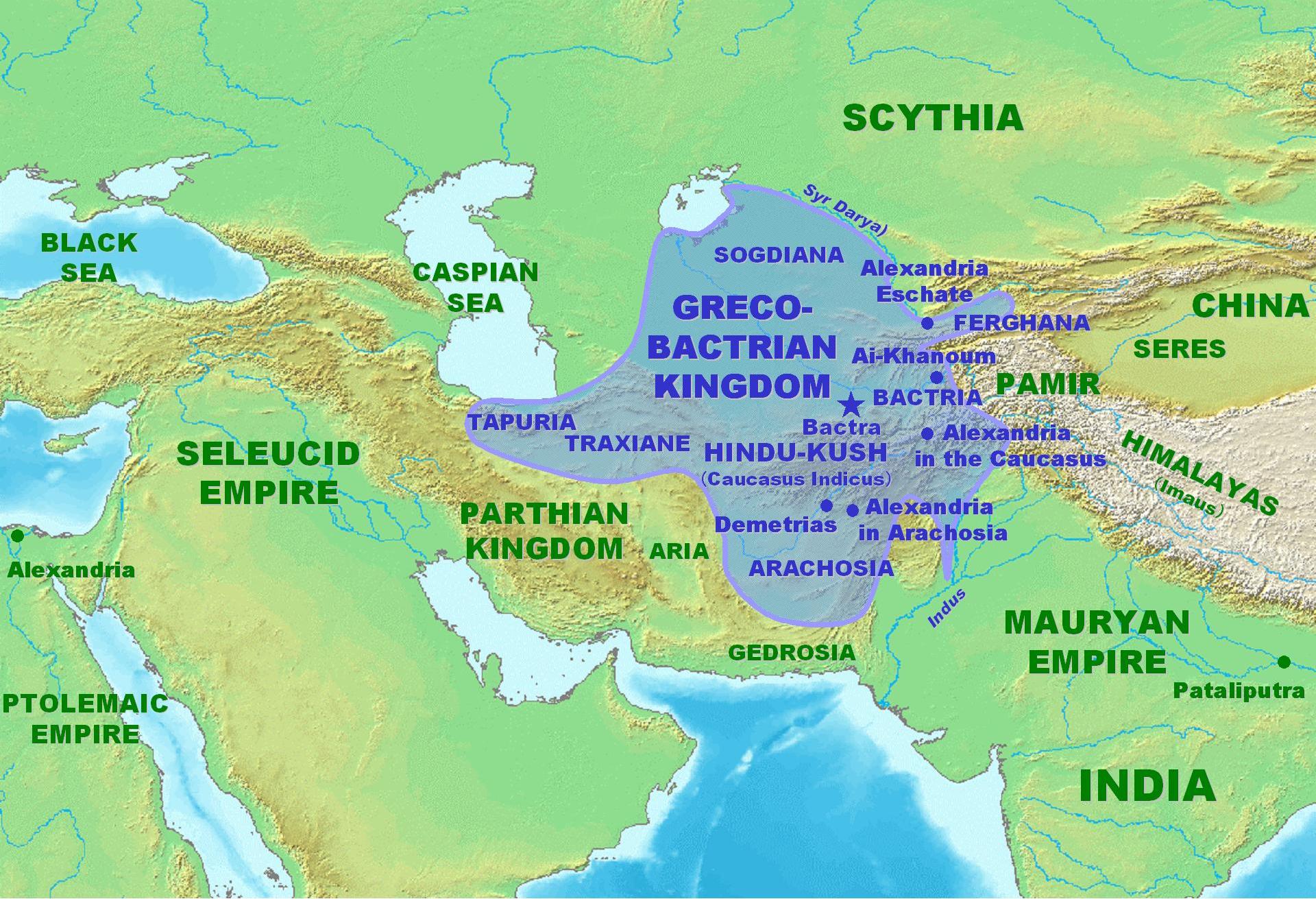
After the Persian conquest of Cyrenaica, the Persian Emperor Darius I deported the population of the city of Barca (El-Marj) to Central Asia. The Barcan exiles were the first members of the Greek community in Bactria, which would undergo a strong development in the following centuries, even founding a Greek kingdom in the region.

Reconstitution of the first Greek city in Central Asia, shortly after the arrival of the Barcan exiles – Image created by ChatGPT

Cyrenaican Greeks in Central Asia

Emperor Darius I of Persia, who deported the inhabitants of Barca to Bactria

After the murder of King Arcesilaus III of Cyrene, in 515, the Persians, who were already occupying Egypt for around 10 years, intervened in Cyrenaica at the invitation of Arcesilaus III’s mother Pheretima. The Persian army besieged Barca (El-Marj), where Arcesilaus III had been killed, and ordered the city to deliver the murderers. The city’s inhabitants refused.

Barca remained under siege for nine months. After the city fell, the Persians delivered the murderers of Arcesilaus III to Pheretima, who had them crucified in Cyrene. The other inhabitants were deported to the Persian province of Bactria (Central Asia, modern-day Afghanistan), where they founded a city which they called Barca. The exact location of this first Greek city in Central Asia was never identified, but it was certainly located in the Balkh Valley, to the North of modern-day Afghanistan. The Greek writer Herotodus, who writes about these events, mentions that this community still existed in his lifetime, close to a century later.

Later on

Bactrian coin imitating the owl of Athena

The Barcan exiles were the first Greeks to settle in Bactria. A few decades later, the Greek presence in the region grew through the arrival of priests fro the city of Didyma, in Asia Minor (modern-day Turkey), who were settled here by the Persian Emperor Xerxes I. Greek war prisoners exiled to Bactria and Greek mercenaries serving in the Persian army followed.

Alexander the Great conquered Bactria in 328, three years after his victory over the Persian Emperor Darius III. Alexander the Great married Roxana, daugther of Oxyartes, the Persian satrap (governor) of Bactria. The Bactrian Greeks now lived under Greek sovereignty. Veterans of Alexander the Great’s army also settled in Bactria.

Gold coin with the effigy of Diodotus I, the founder of the Greco-Bactrian Kingdom

After the death of Alexander the Great, Bactria became part of the Seleucid Empire. In 250, Diodotus, the governor of Bactria, revolted against the Seleucids and proclaimed himself King of Bactria, founding the Greco-Bactrian Kingdom. This Greek kingdom in Central Asia survived for over a century, until its defeat by the Parthian Empire. The descendants of the Barcan exiles were part of the kingdom’s population, even though they had long ceased to be a distinct group from the other Greeks.

The Greco-Bactrian Kingdom: a Greek kingdom in Central Asia

To learn more about the Bactrian Greeks, we recommend this article (in English) from this excellent historical blog on the Greeks in Asia.

Greeks in North Africa

Arcesilaus IV of Cyrene: chariot race champion at the Pythian Games

Français – عربي – ⵜⴰⵎⴰⵣⵉⵖⵜ – English

In the 5th Century BCE, King Arcesilaus IV of Cyrene won the chariot race at the Pythian Games, a sports competition organized every four years in the Greek city of Delphi, with a team of Libyan horses.

Context

Pythian Games Stadium, Delphi

Cyrene, a Greek colony in Libya, was governed since its founding by the Battiad dynasty. Since the Persian conquest in 515, the Kings of Cyrene were submitted to the Persian Empire.

Greece, one of the most influential nations of the ancient world, organised the Panhellenic Games, four sports competitions open to athletes from all the Greek cities. The four competitions were the Olympic Games, the best well-known competition, in Olympia; the Pythian Games in Delphi ; the Nemean games, at the sanctuary of Zeus in Nemea; and the Isthmian Games, close to Corinth. Each competition was organised every four hears, so that there was one competition every year. Another competition, the Panathenaic Games, was also organized every four years in Athens.

The Pythian Games were dedicated to the god Apollo, who had a sanctuary in Delphi. According to mythology, the games were founded by Apollo, to celebrate his victory over the serpent Python.

Arcesilaus IV at the Pythian Games

Arcesilaus IV on his chariot – Image created by ChatGPT

Arcesilaus IV (465-440), the last King of Cyrene, won the chariot race at the Pythian Games in 462. He was running with a team of Libyan horses. The Greek poet Pindar celebrated his victory in two of his Odes.

The same year, another Cyrenaican athlete, Amnesias from Barca (El-Marj), won the wrestling competition. Amnesias, who was a shepherd, is famous for training by wrestling against a bull while keeping his flocks. He took his bull with him to Delphi for the competition, and then toured Greece with it. (Source)

Later on

Gold coin with the effigy of Arcesilaus IV, showing his victory at the chariot race

After his victory, Arcesilaus IV tried to use his popularity to attract new Greek colonists to Euhesperides (Benghazi). He was hoping to build himself a place of refuge, where the population would be indebted to him, as his popularity in Cyrene was declining. This initiative proved itself to be completely inefficient: after the 440 revolution that overthrew the Cyrenean monarchy, Archesilaus IV fled to Euhesperides, but he was assassinated as soon as he arrived into the city.

300 years after Arcesilaus, Mastanabal, the son of King Massinissa of Numidia, won the chariot race at the Panathenaic Games, a sports competition organised in Athens.

Greeks in North Africa

Green gold of Libya: silphium, a very precious plant

Français – عربي – ⵜⴰⵎⴰⵣⵉⵖⵜ – English

Ancient Cyrenaica cultivated and sold a plant that only grew in this region: silphium. This plant, which has now disappeared, was highly appreciated in the whole ancient world: it was used as medication, perfume and condiment.

Silphium stem – Painting by the Libyan artist Shefa Salem – Source

Silphium was a plant with a thick, hollow stem, thick roots covered in black bark, thin leaves, and yellow flowers. A silphium stem could be up to 3 meters high.

Coin from Cyrene, with a silphium stem

The cities of Cyrenaica exported silphium everywhere in the ancient world. This plant was highly valuable: a silphium stem was sold for its weight in gold. Because of its value, silphium played a crucial role in the region’s economy, and many coins from Cyrene and the neighboring cities show a silphium stem.

The value of silphium came from its resin, called laserpicium in Latin. Through an incision in the stem, the resin flowed out with a pleasant fragrance. Incisions in the roots produced a translucent resin, that was more pure and more highly concentrated, making it even more valuable.

Cup showing silphium being weighed and charged, in Cyrene

Silphium had both medical and culinary uses. It was considered an universal remedy, to cure cough, sore throat, fever, indigestion, warts, gut, and all kinds of ailments. It was also used as an aphrodisiac and a contraceptive, to reduce female fertility.
In cooking, silphium was used as seasoning for many dishes. Silphium leaves were fed to sheep: they have their meet a particularly delicious taste.
Finally, silphium was used as a burnt perfume.

Silphium grew only in Eastern Libya, from around Derna to the Gulf of Sirte. The Greek poet Pindar described Cyrenaica as a “garden of flowers”. Silphium was a wild plant, impossible to cultivate. All attempts to grow it outside its natural environment failed.

Ferula tingitana, a common ferule in North Africa today

What kind of plant was it? Did it look like any other plant that still exists today? Silphium probably was a variety of ferule, a type of plant of which several species can still be found today in the Mediterranean world. Ferula drudeana, a ferule native to central Turkey, produces a similar kind of resin; but there is no known link between this species and Libya. Some specialists also suggested that silphium might have been a hybrid between various species of ferules. This might explain why it was so hard to grow: hybrid plants often have amazing qualities in the first generation, but they are sterile, and cannot be reproduced through grain, but only asexually, through roots.

Silphium disappeared at the beginning of the Roman era. The Roman author Pliny the Elder wrote in his Natural History that the last silphium stem found in Cyrenaica was offered to Emperor Nero, as a curiosity. It was long believed that silphium disappeared because of over-exploitation, but the desertification of its native region is actually a more likely cause of its disappearance. At the beginning of the 5th Century, Synesius of Cyrene mentions silphium in a letter, as a plant that no longer existed in his lifetime. He says that its disappearance is one of the reasons of the decline of his native Cyrenaica.

Christianity in North Africa, Greeks in North Africa, Roman North Africa

Hypatia: the last philosopher of Alexandria

Français – عربي – ⵜⴰⵎⴰⵣⵉⵖⵜ – English

Hypatia of Alexandria was a Neoplatonist philosopher, mathematician, and astronomer, who was leading the Neoplatonist school of Alexandria in the 4th-5th Centuries. She was renowned for her knowledge and respected by all for the wisdom of her teaching and council. She is the first female mathematician whose life is so well documented.

Hypatia was born between 355 and 370, depending on the sources. She was the daughter of the mathematician Theon of Alexandria. Her father was the director of the Museion, a highly renowned Neoplatonist school. While she had many suitors, she wasn’t interested in men and never married (legend has it that she gave an especially pushy suitor a tissue soaked with her menstrual blood).

Hypatia taught mathematics and astronomy to students who originated from the whole Mediterranean basin. While she was a Pagan herself, she was very tolerant of Christians and had many Christian students, including future bishops. Her most famous student was Synesius of Cyrene, who deeply admired her.

As for her works, she wrote a commentary of Diophantus of Alexandria’s Arithmetics, and of Apollonios of Perga’s treatise on conic sections. She probably also participated in her father’s edition of Claudius Ptolemy’s Almagest. She knew how to make astrolabes (instruments used to calculate the date and time based on the planets’ position) and hydrometers (instruments used to determine a liquid’s density). In astronomy, she mostly devoted herself to the calculation of the date of the equinox.

Fictional portrait of Hypatia, by Alfred Seifert

Hypatia was a well-known and respected figure in Alexandria. The Christian historian Socrates Scolasticus speaks very highly of her: “There was a woman at Alexandria named Hypatia, daughter of the philosopher Theon, who made such attainments in literature and science, as to far surpass all the philosophers of her own time. Having succeeded to the school of Plato and Plotinus, she explained the principles of philosophy to her auditors, many of whom came from a distance to receive her instructions. On account of the self-possession and ease of manner, which she had acquired in consequence of the cultivation of her mind, she not unfrequently appeared in public in presence of the magistrates. Neither did she feel abashed in coming to an assembly of men. For all men on account of her extraordinary dignity and virtue admired her the more.” Despite this, she became a victim of the growing intolerance of Alexandrian Christianity, eager to overcome the old order.

In 412, bishop Theophilus of Alexandria died and his nephew Cyril succeeded him. While Theophilus seems to have been on good terms with Hypatia, Cyril mistrusted her. In 414, after several violent incidents between Jews and Christians in Alexandria, bishop Cyril had all the city’s synagogues closed and expelled the Jewish population. These measures shocked Orestes, the city governor, who was a close friend of Hypatia. Orestes, who had himself recently converted to Christianity, shared Hypatia’s desire for peaceful coexistence between Christians, Jews and Pagans. He was also concerned that the bishop was overstepping his prerogatives and impinging on the powers of the civil authorities, with the support of the Alexandrian popular classes, who were strongly Christian and more and more fanaticized.

The conflict between the bishop and the governor degenerated into a violent clash. In this confrontation, Cyril could count on the support of the monks (parabalani) of the Nitrian desert, South-West of Alexandria. During a riot, a monk named Ammonius threw a stone on Orestes, wounding him at the head. Orestes, furious, had him tortured so violently that he died. Cyril wanted to proclaim him a martyr, but most Christians were opposed to this move, which increased the tensions even more.

Death of Hypatia

In this context, rumors started to spread that Hypatia, who was advising the governor, was working against any reconciliation between him and the bishop. The monks, furious, seized her and killed her. Socrates Scolasticus recounts her murder: “Some of them therefore, hurried away by a fierce and bigoted zeal, whose ringleader was a reader named Peter, waylaid her returning home, and dragging her from her carriage, they took her to the church called Cæsareum, where they completely stripped her, and then murdered her with tiles. After tearing her body in pieces, they took her mangled limbs to a place called Cinaron, and there burnt them.”

Was Bishop Cyril himself behind Hypatia’s death? Did the monks act on his orders, or at their own initiative? This point is still debated by specialists. Whether or not Cyril did order Hypatia’s murder, the intolerant measures he took definitely contributed to the toxic atmosphere that led the monks to take action.

While Socrates Scolasticus doesn’t claim that Cyril ordered Hypatia’s murder, he mentions that her death was very detrimental to the bishop’s popularity: most Alexandrian Christians appreciated Hypatia and were shocked when she was killed.

Greeks in North Africa

Aretaphila of Cyrene: the liberator of Cyrene

Français – عربي – ⵜⴰⵎⴰⵣⵉⵖⵜ – English

In Cyrene, not long before the Roman era, a woman called Aretaphila became famous for her brave fight against two tyrants who were oppressing the city: her own husband Nicocrates and his successor Leander. In the ancient world, Aretaphila was considered as a model of a virtuous woman, because of her fight for her people’s freedom.

In 96 BCE, when the last king of Cyrenaica, Ptolemy Apion, died without a heir, his kingdom was bequeathed to the Roman Republic. However, this new territory was at first mostly ignored by the Romans. The first Roman governor was sent to Cyrenaica only in 74.

Aretaphila of Cyrene – Image created by ChatGPT

In these years, a tyrant called Nicocrates took power in Cyrene and brutalized the population. Nicocrates forced Aretaphila, a woman of the city, to marry him, after killing her first husband Phaedimus. Aretaphila was determined to free her people from the violence of this tyrant, and plotted to have him poisoned. Calbia, Nicocrates’ mother, suspected her plans, and convinced her son to have Aretaphila tortured.

Later, Aretaphila convinced her daugther to seduce Leander, the brother of Nicocrates, so that he would overthrow him. Leander managed to kill Nicocrates, and succeeded him.

Sadly, Leander showed himself to be just as tyrannical as his brother. Aretaphila then called on the Libyan Prince Anabus to come to free Cyrene.

Lucullus

In 87, the Roman general Lucullus, an ally of Sulla, visited Cyrene, as part of a naval expedition to gather a fleet from the Roman allies, in order to fight Mithridates. Civil war had been raging in the city for seven years, between Leander’s supporters and opponents. Lucullus ended the conflict, repressed the tyrant, and established a new Constitution. 13 years later, Lucullus would convince the Roman authorities to make Cyrenaica a Roman province.

After the fall of the tyranny, the citizens of Cyrene offered Aretaphila responsibilities in the new city government, but she refused. She reportedly spent the rest of her life in the women’s quarters of her house, working on her loom.

The Greek historian Plutarch mentions Aretaphila in his book On the virtue of women, for her aspiration to free her people from tyranny. There apparently was a cult in her honor among women of this time.

Greeks in North Africa, The other cities of Cyrenaica

The other cities of Cyrenaica: Balagrae, the sanctuary of healing

Français – عربي – ⵜⴰⵎⴰⵣⵉⵖⵜ – English

Balagrae (Al-Bayda), the last of the five cities of the Cyrenaican Pentapolis, was mostly famous for its Temple of Asclepius, the Greek god of medicine. Pilgrims from the whole region came to this temple, hoping to be healed of their illnesses.

Asclepium of Balagrae (Source)

Balagrae was probably founded at the beginning of the 6th Century BCE, as a Greek colony. Is was part of the Pentapolis, an alliance of five Greek cities in Libya, together with Cyrene, the main city, Euhesperides (Benghazi), Taucheira (Tocra) and Barca (El-Marj).

Asclepius, the doctor god

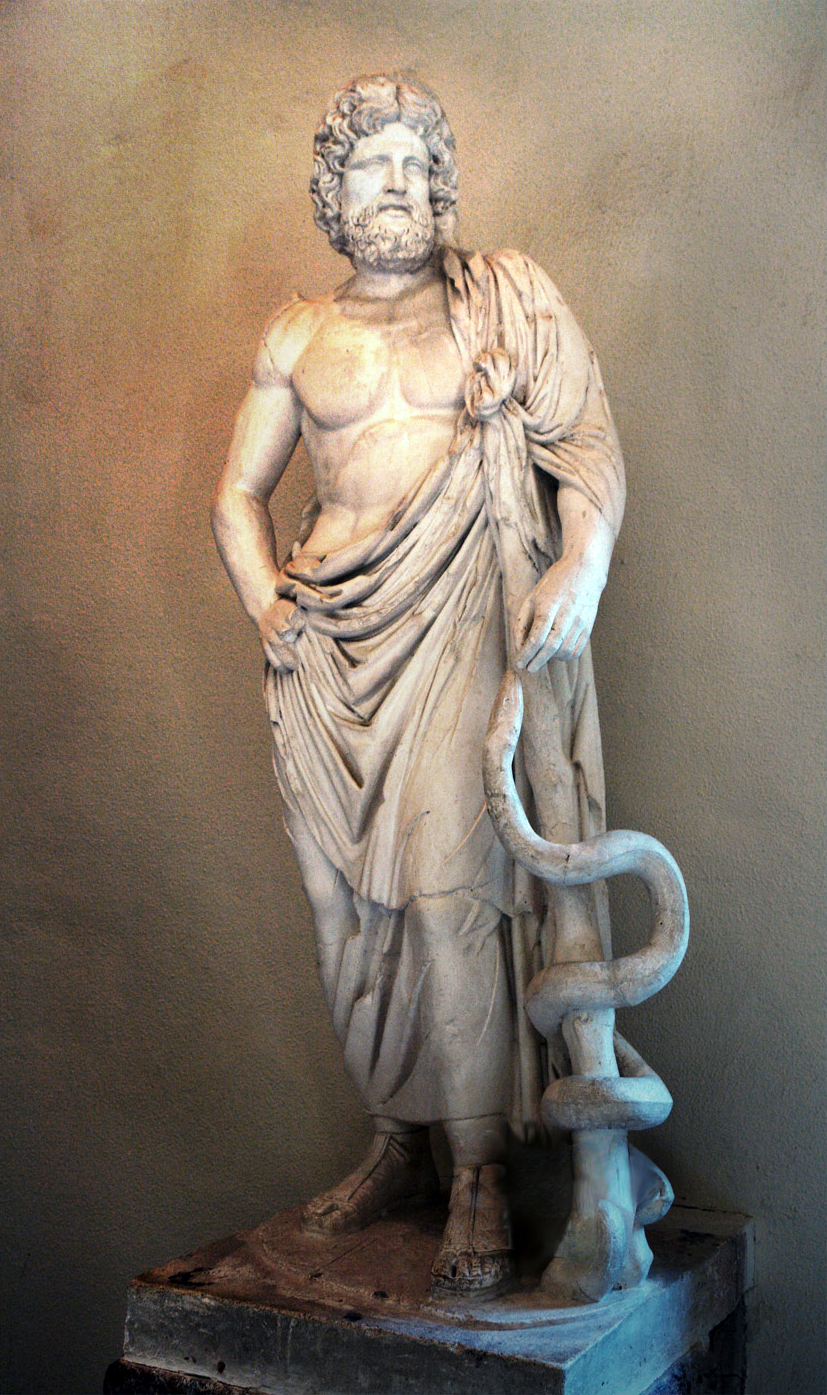
The city of Balagrae was mostly famous for its Asclepium, a temple of Asclepius, the Greek god of medicine. This temple had been founded by colonists from Epidaurus, a city of the Peloponnese that had the largest Asclepian sanctuary in Greece. Pilgrims came to spend the night there, and then, on the next morning, they told the priests about their dreams. The priests then prescribed them a remedy based on their interpretation of the dreams. Snakes, an animal considered as sacred, played an important role in the cult of Asclepius: non-venomous snakes were crawling on the ground in the sanctuary, in the middle of the sick and wounded. Next to the altar and dormitory, the temple also contained a fountain to clean the patients’ wounds, baths, and a gymnasium. The prescribed remedies were mostly purification baths or workout in the gymnasium, together with a specific diet. The Asclepium of Balagrae was especially famous for the healing of children, as shown by the objects discovered during the excavations.

Portico of the Asclepium, Balagrae

A new complex was built in the Roman era, by Emperor Hadrian. It was a 40m-long, 35m-large square, surrounded by porticoes. The complex contained three temples: the largest, at the center, was the Temple of Asclepius, while one of the two others was dedicated to Serapis, the protector god of the city of Alexandria; we don’t know which god was worshipped in the third temple.

Odeon, Asclepium, Balagrae (Source)

The Asclepium also contained an odeon, a small theater for musical concerts. It was known in Antiquity that music had a soothing effect on people with mental illnesses. The Asclepium probably employed musicians who played music for the sick. The odeon might also have served as a meeting place for the medical staff.

Balagrae declined a lot in the Roman era, until it was no longer part of the Pentapolis.

With the advent of Christianity, the Asclepium of Balagrae was transformed into a church. Cyrenaica was the first region in North Africa to be reached by Christianity, and now has some of the best-preserved ruins of ancient Christian churches in North Africa. The Christian philosopher Synesius, who became bishop of Ptolemais, was born in Balagrae.

Senussi Zawiya, Al-Bayda

In the Islamic era, the city was famous for its tomb of Ruwaifi ibn Thabit al-Ansari, a companion of the Prophet Mohammed. More recently, in 1843, it was here that Mohammed Ali al-Senussi founded the Senusiyya order. The white-walled zawiya he built gave the city its name, Al-Bayda (البيضاء, “the White”). Today, Al-Bayda is the fourth-largest city in Libya, after Tripoli, Benghazi and Misrata.

Greeks in North Africa, The other cities of Cyrenaica

The other cities of Cyrenaica: Barca, the Greek-Libyan city

Français – عربي – ⵜⴰⵎⴰⵣⵉⵖⵜ  – English

Barca, one of the cities of the Pentapolis, the confederation of five Greek cities established in Libya, was located at the site of the current city of El-Marj. The city was founded in an area that was previously inhabited by indigenous Libyan tribes, and from the beginning, its population was both Greek and Libyan. The mingling between those two people groups was more pronounced in Barca that anywhere else in Cyrenaica. The indigenous elite was integrated into the city’s administration, as illustrated by the example of governor Alazir. Sadly, nothing is left today of the ancient city of Barca.

Al-Munaykhrat cemetery: one of the few ancient remains that can still be seen close to El-Marj (Source)

The area around Barca was originally inhabited by the Libyan Amazigh Barraci tribe. After the foundation of Cyrene, in 631 BCE, the Greek colonists allied themselves with the indigenous tribes.

Arcesilaus II on his throne

During the reign of King Arcesilaus II of Cyrene (560-550), his adviser Learchus (who, according to certain sources, was also his brother) rebelled against him. Learchus made an alliance with the Amazigh tribes, depriving the King of precious allies. Together, Greeks and Amazighs founded the city of Barca. They then declared war against Cyrene. They were victorious, and Learchus took the throne of Cyrene, but he was quickly killed.

Alazir (image created by ChatGPT)

A few decades later, King Arcesilaus III of Cyrene (530-515), fearing an uprising against him in Cyrene, fled to Barca. Arcesilaus III had family links with the Amazigh of the city: Alazir, the governor of Barca, who was from an Amazigh tribe, was the father of his wife. One day, on the market place in Barca, he was recognized by a group of Cyrenean exiles, who killed him together with Alazir.

At this time, Egypt was under Persian occupation since 525. After Arcesilaus III died, his mother Pheretima called on the Persian governor of Egypt to avenge him, claiming that he was killed because of his loyalty to the Persians. The Persian army besieged Barca and deported its population, and then entered Cyrene on Pheretima’s invitation: it was the beginning of the Persian domination of Cyrenaica.

Emperor Darius I or Persia settled part of the Barcan captives in a village in Bactria (Central Asia, modern-day Afghanistan). This community still existed in the time of the Greek historian Herodotus, one century later.

Greek wrestling

In 462, the same year that King Arcesilaus IV of Cyrene won the chariot race at the Pythian Games with a team of Libyan horses, Amnesias, an athlete from Barca, won the wrestling competition. Amnesias, who was a shepherd, is famous for training by wrestling against a bull while keeping his flocks. He took his bull with him to Delphi for the competition, and then toured Greece with it. (Source)

Persian coin minted in Barca

Barca prospered a lot during the Persian occupation. Around the end of the 5th Century, it had apparently become the largest city in Cyrenaica, before Cyrene.

In 332, Alexander the Great conquered Egypt. The Greeks of Cyrenaica, happy to see a Greek king who aspired to unite all Greeks, submitted to him. Barca, together with the rest of Cyrenaica, became part of Alexander the Great’s Empire.

Coin with the effigy of Thibron

During the civil war that followed Alexander the Great’s death, Barca, together with the neighboring city of Euhesperides (Benghazi), supported the revolt of the Spartan mercenary Thibron, who was seeking to conquer an Empire in Libya. Thibron was defeated by Cyrene, with the support of the Ptolemy of Egypt. Cyrenaica then became part of the Ptolemaic Empire.

Ptolemy III Euergetes built a new city, Ptolemais, on the site of the former port of Barca. The city, deprived of its access to the sea, started declining and soon ceased to be part of the Pentapolis.

Cyrenaica was the first region in North Africa to be reached by Christianity, and now has some of the best-preserved ruins of ancient Christian churches in North Africa. The first known Christian bishop of Barca was Zopyrus, who took part in the Council of Nicaea, in 325.

Barca still existed in the Roman and Byzantine era, but only as a small, unimportant town.

Barca was one of the first towns in Cyrenaica to be conquered by the Islamic Caliphate, in 643-644. The Muslims decided to make it their new provincial capital. Its name was Arabized as برقة (Barqa). With time, برقة became the Arabic name of the whole region previously known as Cyrenaica.

Greeks in North Africa, The other cities of Cyrenaica

The other cities of Cyrenaica: Taucheira/Arsinoe, the forgotten city

Français – عربي – ⵜⴰⵎⴰⵣⵉⵖⵜ – English

While Taucheira (Tocra) is the less well-known of the five Greek cities of the ancient Pentapolis, it is probably the oldest Greek colony in Libya after Cyrene itself, and its ruins conceal unsuspected archaeological treasures.

Dolia, used for textile dyeing

In Antiquity, Taucheira was part of the Pentapolis, an alliance of five Greek cities in the region, with Cyrene, the main city, Euhesperides (Benghazi), Barca (El-Marj) and Balagrae (El-Bayda). Excavations in the port of Taucheira found very ancient ceramics – the oldest dating back to the end of the 7th Century BCE. Taucheira is probably the second city founded by the Greeks in Cyrenaica, a few years after Cyrene.

The name Taucheira is of Libyc origin. The prefix Tau (or To, or Ta) means “land”. Chei means “mouth”, while the suffix -ra has a sense of proximity. So, Taucheira means “land close to the mouth”, a metaphore for the coast.

Stone quarry (Source)

Taucheira was located on the coastal road from Cyrene to Euhesperides, the two major cities of the Pentapolis. North-East of the city was the stone quarry where the the characteristic, reddish limestone of Taucheira was found. The quarry also served as a cemetery: the holes from where stone had been extracted were used as tombs.

The port of Taucheira (on the cover picture of this article) entertained trade links with Athens, Corinth and the Peloponnese. The following pictures show pieces of handicraft that were found during the port excavation and are now kept at the Taucheira Museum.

Fruit plate from Rhodes (Source)
Figurine of Demeter and Persephone – Pottery with an Attic dancer (Source)
Marble relief of a woman – Bottle in the shape of a man with bull horns (Source)
Eastern wall (Source)

In 332, Alexander the Great conquered Egypt, where he built his new capital: Alexandria. The Greeks of Cyrenaica, happy to see a Greek king aspiring to unite all Greeks, submitted to him. After Alexander the Great’s death, Taucheira was conquered by the Spartan mercenary Thibron, who wanted to conquer an Empire in Libya. Cyrenaica then became part of the Ptolemaic Empire. The new port city of Ptolemais, founded by Ptolemy I Soter, became an important rival for Taucheira.

Gold coin with the effigy of Arsinoe II, the Queen who gave her name to the city

In 276, Magas of Cyrene proclaimed himself King of Cyrenaica. He reigned until his death around 250. After he died, his daughter Berenice married Ptolemy III Euergetes and the city of Euhesperides was renamed Berenice in her honor. The Ptolemy also gave a new name to Taucheira: Arsinoe, in honor of Arsinoe II, wife of Ptolemy II Philadelphus and step-mother of Ptolemy III Euergetes. Cyrenaica was again part of the Ptolemaic Empire, but enjoyed strong autonomy.

Decree of Aleximachus (Source)

Ptolemy Apion, son of Ptolemy VIII, was proclaimed King of Cyrenaica in 105. After his death in 96, as he didn’t have a heir, his kingdom was bequeathed to Rome. However, the Romans only took possession of Cyrenaica in 74. During the interval years, Arsinoe was the victim of an attack by Libyan Amazigh tribes. An inscription that is now kept at the local museum commemorates how Aleximachus, son of Sostratus, financed the enlargement of the city walls. He also imported food during a time of famine. The city authorities published a decree to reward him.

Roman gymnasium (Source)

During the Actium War, Arsinoe was briefly renamed Cleopatris by the Roman general Mark Antony, in honor of his wife Cleopatra of Egypt. The city would again be named Arsinoe after the Roman Empire was founded, and became a Roman colony. Little is known about its history in the Roman era, but several Roman buildings were built, especially a gymnasium and the Dolia, for textile dyeing. The cult of Cybele was especially popular in the city: a yearly festival in honor of this goddess was organized there.

Mosaic, Palace Church (Source)

Cyrenaica was the first region in North Africa to be reached by Christianity, and now has some of the best-preserved ruins of ancient Christian churches in North Africa. The first known Christian bishop of Arsinoe was Secundus, who participated in the Council of Nicaea in 324. Several churches have been found in the city, including the Byzantine Palace Church, which contains beautiful mosaics.

In the Byzantine era, Emperor Justinian built new city walls, together with a fortress. The city walls were so solid that Apollonius, the last Byzantine governor of Cyrenaica, took refuge here at the time of the Arab invasion of the region. The city resisted for three years, from 642 to 645.

Byzantine fortress of Taucheira/Arsinoe (Source)
Greeks in North Africa, The other cities of Cyrenaica

The other cities of Cyrenaica: Apollonia, the port city of Cyrene

Français – عربي – ⵜⴰⵎⴰⵣⵉⵖⵜ – English

Apollonia (Marsa Susa), to the North of Cyrene, was founded as the port of Cyrene. Later on, it became an important city in its own right, succeeding Cyrene and Ptolemais as the capital of Cyrenaica.

Eastern port of Apollonia

Apollonia was probably the landing place of the first Greek colonists in Libya, in the 7th Century BCE. This site offers ships a safe anchorage, thanks to its two creeks.

Greek theater of Apollonia

In its early history, the port of Apollonia was not a city, but just a dependence of Cyrene, made of the port and several scaled habitations along the coast, without efficient military defenses as the enemies of Cyrene came from the continent rather than from the sea. Even the name Apollonia is mentioned only lately, in the 1st Century, by the Roman geographer Strabo. This seems to indicate that the port of Cyrene didn’t have its own name for a long time.

The oldest archaeological remains that were found in Apollonia date back to the 6th Century: a vase and two ceramics from Corinth and Rhodes.

Coin with the effigy of Thibron

In 332, Alexander the Great conquered Egypt, where he founded his new capital: Alexandria. The Cyrenaican Greeks, happy to see a Greek King who aspired to unite all Greeks, submitted to him. After the death of Alexander the Great, Thibron, a mercenary from Sparta, tried to conquer Cyrenaica. He started by taking control of Apollonia (the sources only mention the port of Cyrene, without a name), thanks to the lack of defensive structures. After his defeat, Thibron was crucified in Apollonia.

Carved head of Ptolemy III Euergetes (Source)

Cyrenaica then became part of the Ptolemaic Empire. To defend Apollonia, the Ptolemy built a protective wall around its port. A carved head of King Ptolemy III Euergetes has been found in Apollonia.

Pieces of ceramics and potteries that were discovered in Apollonia inform us about the economic exchanges between the port of Cyrene and the rest of the Mediterranean world in the 3rd and 2nd Centuries: around half of the fragments come from Greek cities on the Aegean Sea, especially amphorae from the island of Rhodes; a quarter were made in Cyrenaica; and a sixth come from Magna Graecia (Sicily and Southern Italy), mostly imported Italian wine. However, while Cyrenaica was under Egyptian sovereignty, there are very few remains from Naucratis, the ancient Greek colony in Egypt.

Acropolis of Apollonia

Apollonia became an autonomous city by the end of the Hellenistic era. According to the French archaeologist André Laronde, based on a passage by the Greek-Roman author Plutarch, the city became independent from Cyrene following a Roman intervention, around 85, during the civil war between Sulla and Marius.

Roman Baths of Apollonia

Cyrenaica became part of the Roman Empire in 74. Apollonia, like the other Greek cities of Cyrenaica, underwent a time of prosperity in the beginning of the Roman era, with the development of public buildings. The city dedicated a statue of Roman Emperor Hadrian, in Athens, and another statue of Emperor Marcus Aurelius, in Eleusis.

In the Roman era, Barca and Balagrae‘s importance dwindled, while Apollonia and Ptolemais‘ importance grew. The Pentapolis was now made of Cyrene, Berenice (Benghazi), Taucheira (Tocra), Ptolemais (Tolmeita) and Apollonia.

Central church of Apollonia (Source)

Cyrenaica was the first region in North Africa to be reached by Christianity, and now has some of the best-preserved ruins of ancient Christian churches in North Africa. Apollonia became an important Christian center. The first known bishop of Apollonia was Euphranor, who received a letter from the bishop of Alexandria around 260. The main church of Cyrene was located in Apollonia.

Basilica of Apollonia

At some point in the 4th Century, Apollonia already briefly became the capital of Roman Cyrenaica. After the 365 earthquake, which devastated Cyrene and Apollonia, Ptolemais, relatively spared, became the provincial capital again.

In 411, Ptolemais was devastated by an attack of Amazigh tribes. Shortly after the attack, Apollonia succeeded Ptolemais as provincial capital. At the same time, the city received a new name: its ancient Greek name, which referred to the pagan god Apollo, an unacceptable reference in an Empire that was now Christian, was replaced by Sôzousa, the “city of the Savior”.

Theodora

The future Byzantine Empress Theodora stayed in Sôzousa in her youth, as the lover of Hecebolus, the Byzantine governor of Cyrenaica. This was her first time in North Africa, a region that would remain very dear to her. In 539, Theodora ordered the rebuilding of Olbia (Qasr Libya), an ancient city of Cyrenaica that had been destroyed by the Vandals. The new city was named Theodorias, in honor of its founder. A church in the city contains around fifty mosaics, considered as among the most beautiful in the world.

Byzantine mosaics of Olbia (Source)