

Français – عربي – ⵜⴰⵎⴰⵣⵉⵖⵜ – English
At the time when Christianity started becoming more and more influential in Roman society, some believers, disappointed by the Church’s worldliness, started going to live in the desert, seeking a more authentic spiritual life. The lived apart from society, alone or in community, and devoted themselves to prayer and meditation. Born in Egypt, this movement spread to all North Africa and the whole Roman world.
The pioneers

The first Christian ascetics appeared in the Egyptian desert. The lived a life of solitude and voluntary poverty, devoted to prayer. They were called the Desert Fathers.

Paul of Thebes was born around 227, in Thebaid. After his parents died, his sister’s husband denounced him as a Christian to the Roman authorities, in order to obtain his share of inheritance. Paul fled into the desert around 250, at the height of persecution. He lived in a cave in the middle of the desert, and survived by eating only the fruit of a palm tree that was close by, and dressing himself only with the palm leaves. He lived this life for almost one hundred years: he reportedly was 113 years old when he died! In his lifetime, others followed his example.

Paul of Thebes was the first Desert Father, but the most influential figure of the movement was Anthony the Great. Born around 250, in Koma (Qiman al-Arus), Upper Egypt, in a wealthy Christian family, he was around 20 years old when his parents died. Shortly after their death, he was challenged by Christ’s words: “If you want to be perfect, go, sell your possessions and give to the poor, and you will have treasure in heaven. Then come, follow me.” He decided to sell his inheritance, distributed the money to the poor, and then went to live the rest of his life in the desert. A legend says that a crow brought him a piece of bread daily. There are many other legendary stories about the temptations he underwent and the miracles he accomplished. He shortly left his solitude in 338, when he went to Alexandria to contribute to the fight against the Arian heresy. Bishop Athanasius of Alexandria admired him a lot and wrote his biography. Anthony died at the age of 105.

During Anthony the Great’s lifetime, Roman society deeply changed. When Anthony went to the desert, the Christian religion was still officially forbidden, and Christians were violently persecuted under Emperor Diocletian. But then, in 312, the new Emperor Constantine converted to Christianity himself. From there on, the Christian Church was associated with the power structures of the Roman Empire and became very rich. Crowds of people, who were often ignorant of the sacred texts, started coming to the churches. At the same time, many young men, inspired by the example of Anthony and others, abandoned the churches and went to the desert. While they were often rich, they gave up their fortune to answer the call of Christ to an authentic Christian life.
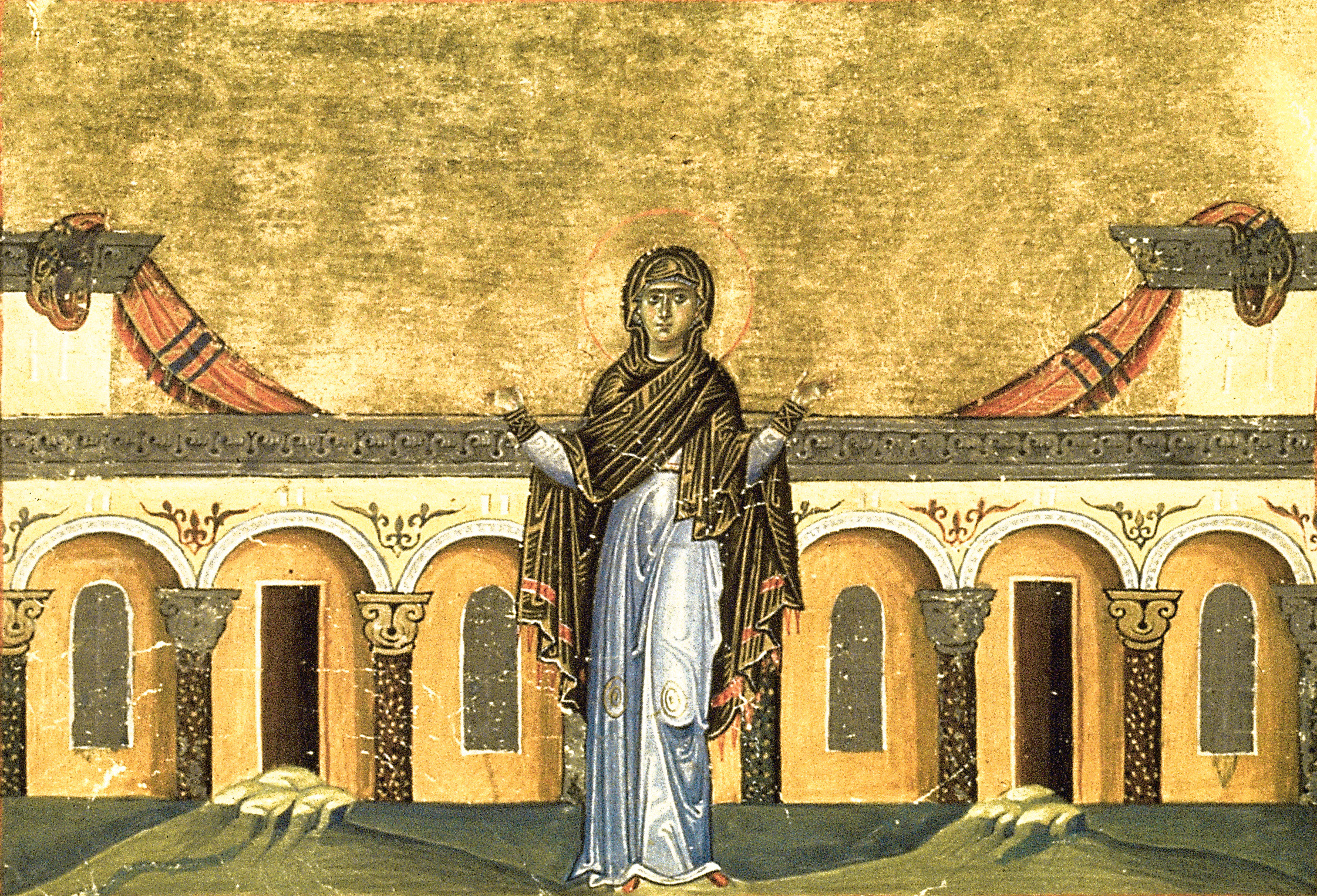
The movement also extended to women. The most famous Desert Mother was Syncletica of Alexandria. Originally from Macedonia, she was from a noble family whose fortune came from renting trade ships. After her parents died, she gave her fortune to the poor, cut her hair and went to live in a small cell outside the city of Alexandria, with her sister, who was blind. With time, other young women settled close to her cell, attracted by her teaching.
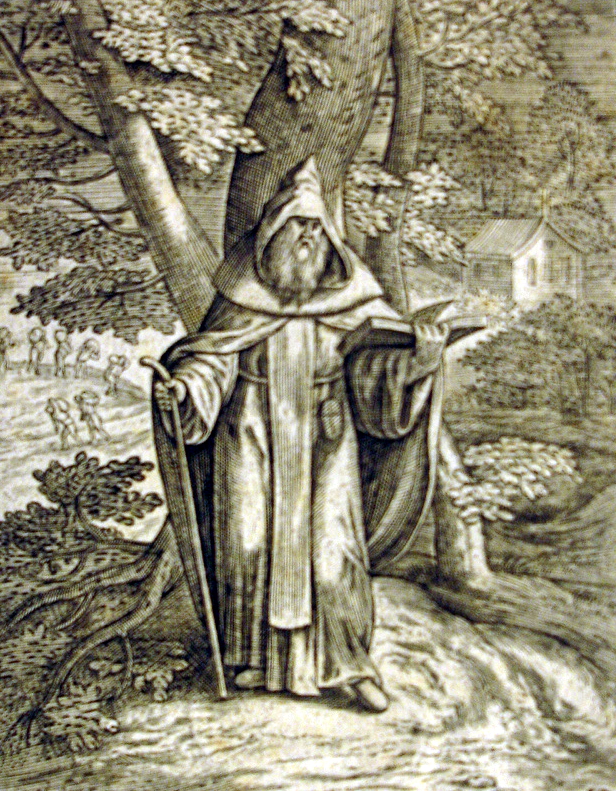
Paphnutius of Thebes, a disciple of Anthony the Great, lived as a monk in the desert for several years before becoming bishop of Thebes. A victim of persecution during the reign of Emperor Maximinus Daza, he was tortured for his faith: he lost his left eye and the tendon of his right foot was cut. He later took part in the Council of Nicaea, where he was honored by Emperor Constantine and by all the participants for the tortures he suffered for Christ. He also opposed the intention of some bishops to make celibacy mandatory for the whole Christian clergy, affirming the dignity of marriage and that celibacy was only the vocation of some, not of all.

The first Christian ascetics lived a solitary life (anchorites). At the beginning of the 4th Century, Pachomius the Great started founding communities where about a hundred monks lived together, under the leadership of a spiritual leader called the abbot. These monastic communities followed a strict discipline, with collective prayers and fasts at fixed times. The monks spent the rest of their time doing manual work (usually agriculture) and in silent meditation. The first monastery was established by Pachomius around 318. Women’s monasteries were also established, under the leadership of Theodora of Alexandria, who fled into the desert, dressed as a man, to join a monastic community. Others lived in small groups of 2-6 men or women, meeting with other groups weekly.
The last major figure of Egyptian monasticism was Macarius the Great. He was born in Lower Egypt around 300. As a young man, he went to live in the desert, making straw baskets to earn a living. Shortly after, a pregnant woman accused him of raping her. Macarius chose not to defend himself against this false accusation. When the time came for the woman to give birth, she had a very difficult labor, and could not give birth to her child before she confessed that Macarius was innocent. A crowd assembled to ask for his forgiveness, but Macarius fled into the Nitrian Desert. There, he founded a monastic center in Wadi el Natrun, a region which remains at the heart of monastic life in Egypt until today.
Next to the Christian Gospels, the monastic movement was also influenced by the ascetic practices of certain Greek philosophical schools like the Pythagorean, Cynics and Stoics, as well as by Manichaeism.
In Africa and beyond


From Egypt, monasticism spread into other regions. The most ancient monastery still in activity today is Saint-Catherine’s Monastery, founded in 565 at the feet of Mount Sinai, where Moses received from God the revelation of the Ten Commandments. This monastery is consecrated to Catherine of Alexandria, a young woman who died as a martyr at the beginning of the 4th Century. The Codex Sinaiticus, the oldest manuscript of the Christian Bible, is kept at Saint-Catherine’s Monastery.

In Syria, a new form of monasticism developed: Stylites, who lived on columns, using a basket attached to a rope to pull up food, and preaching to the crowds who came to see them. The founder of the movement, Simeon Stylites, lived on top of a column for 36 years. He is known for preaching Christianity to the Arab nomadic tribes of the Syrian desert.
In North Africa, monasteries were founded in the Libyan desert, and then in Numidia and Mauretania. Augustine of Hippo lived several years in a monastic community in his family house in Thagaste (Souk Ahras) before becoming a bishop. His sister was the abbess of a women’s convent in Hippo (Annaba). In the 5th Century, Fulgentius of Ruspe, who fought the Arian doctrine imposed by the Vandal occupiers, was a monk. In the 11th Century, Constantine the African, a Christian from Carthage and a medical doctor by training, became the abbot of a monastery in Italy and translated the works of the masters of Arabic medicine into Latin. He played a crucial role in the development of medieval European medicine. (Source)

Monasticism plays a very important role in the Egyptian Coptic Church until today, especially in Wadi el Natrun. The Coptic Pope Tawadros II was originally a monk in a monastery of Wadi el Natrun, just like his influential predecessor Shenouda III. The strength of monastic life certainly played an important role in the survival of the Coptic Church through the centuries of Islamic domination.

1 thought on “The Desert Fathers: the first Christian monks”