

Français – عربي – ⵜⴰⵎⴰⵣⵉⵖⵜ – English
Translation: Souliman El Abdellaoui
Alexandria, the Ptolemaic capital of Egypt and a vibrant hub of Greek culture, also boasted a significant Jewish population. This community, situated at the crossroads of Judaism and Hellenism, played a pivotal role in translating the Hebrew Bible into Greek. Subsequently, Alexandria emerged as a prominent Christian center, renowned for its famous ancient theological school.
The Jewish community of Alexandria
Origins
According to the Jewish historian Flavius Josephus, there have been Jews in Alexandria since its foundation.
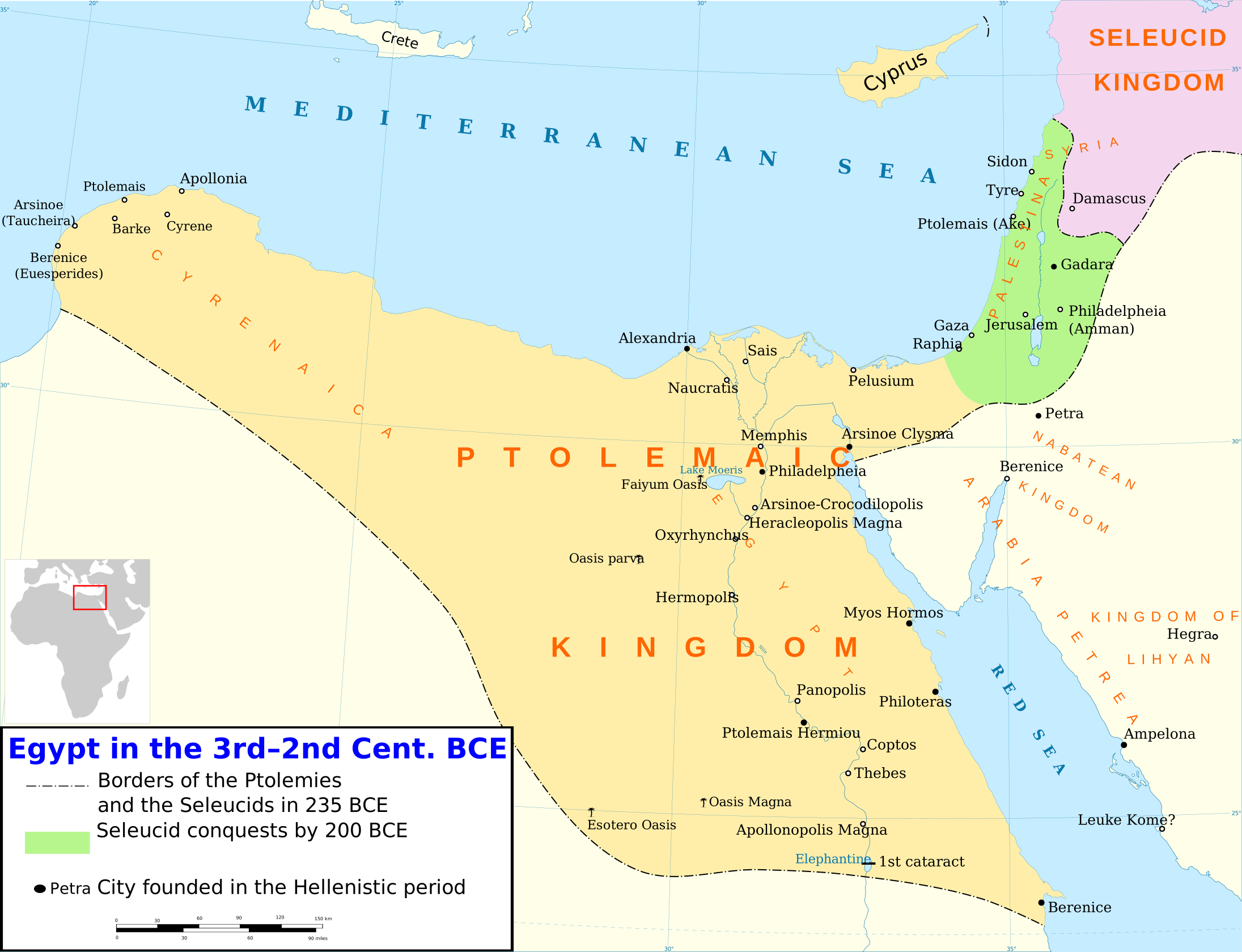
After Alexander the Great’s death, his Empire was divided among his generals. Palestine, known at the time as Yehoud Medinata (the Land of Judah), was contested between the Seleucid Empire (Syria) and the Ptolemaic Kingdom of Egypt, initially favoring the latter. Ptolemy I Soter deported Jews to Alexandria and throughout Egypt, including Cyrenaica; others followed as economic migrants.
The Ptolemies pursued a policy of religious and community tolerance. To ensure the Jewish community’s ability to practice their faith freely, a Jewish quarter was established within Alexandria. This provided a space where they could observe their religious laws without facing interference.
Alexandria’s Jewish community exerted significant influence on the city’s economic and social life. Jewish merchants and moneylenders played prominent roles in the city’s commerce, while the prestigious position of alabarch, responsible for overseeing tax collection, particularly customs duties at the port of Alexandria, was traditionally held by a member of the Jewish community.
In Roman times, Alexandrian Jews faced growing hostility from the rest of the city’s population, who regarded them as privileged isolationists.
The Septuagint: A Greek translation of the Hebrew Bible
The 3rd century BC witnessed a significant event in Jewish history: the translation of the Hebrew Bible into Greek. While tradition attributes this monumental undertaking to the behest of Ptolemy II Philadelphus for his renowned Library of Alexandria, it is more likely that it was primarily driven by the initiative of the Alexandrian Jewish community itself.

The legend surrounding the Septuagint translation is a fascinating tale. It describes a group of 72 scholars, six from each of the 12 tribes of Israel, who were sent from Jerusalem to translate the Hebrew Bible into Greek. Each scholar worked in isolation for 72 days, and miraculously, their 72 translations were identical. The Greek Bible came to be known as the Septuagint, referring to the 72 translators.
The Septuagint marks a fundamental theological break in Jewish theology: with the translation of its sacred writings into Greek, the vernacular of the Mediterranean world, Judaism moved from a tribal religion, centered on divine revelation granted to a single people, to a universal religion, whose message is addressed to all men.
The Septuagint was quickly adopted throughout the Jewish diaspora, which often no longer understood Hebrew, for reading in synagogues. It was also adopted by the Christian Church.
Jewish Alexandrian authors
Alexandria, as a place of interaction between Jewish faith and Greek culture, also produced several influential Jewish theologians and thinkers.

Philo of Alexandria, a prominent Jewish philosopher from a wealthy and influential Alexandrian family (his brother was the Alabarch), was born around 20 BC and died around 40 AD. Renowned for his extensive commentaries on the Torah, Philo pioneered an allegorical approach to sacred texts, seeking deeper spiritual meaning beyond their literal interpretation.
Philo’s philosophical thought represents a unique synthesis of Jewish theology and Greek philosophy, notably Platonic thought. In this regard, his work bears resemblance to that of Averroes (Ibn Rushd), who similarly sought to reconcile Islamic theology with Aristotelian philosophy. Philo viewed reason as a divine gift, conceiving of the “Logos” – divine reason – as the instrument through which creation came into being. He believed that philosophy, through the contemplation of the world and the exercise of reason, allows humans to gain a deeper understanding of this divine creation.
The Christian community of Alexandria
Origins

Christianity arrived in Alexandria in the early decades of the Christian era, during the time of the apostles. Christian tradition holds that Mark, the author of one of the Gospels, proclaimed the Christian message in his native Cyrene, and later in Alexandria. The Coptic Church of Egypt, now the largest Christian community in the Muslim world, traces its origins back to Mark’s preaching in Alexandria.
Jewish roots
The first recipients of Christian preaching were certainly the Jews of Alexandria. As throughout the Roman world, a high proportion of the first converts to Christianity were of Jewish origin.
Philo of Alexandria likely died before Christianity reached Alexandria. While some Christian sources claim his late-life conversion, this is improbable. However, his disciples may have joined the burgeoning Alexandrian Christian community, and the influential preacher Apollos, mentioned in the Bible, might have been among them.
The theological school of Alexandria
Alexandria, a prominent intellectual center within the Roman Empire, became home to a renowned Christian theological school. Here, aspiring Christian scholars delved into the interpretation of sacred texts and engaged with the profound ideas of Greek philosophy. Notably, these Alexandrian theologians embraced Philo of Alexandria’s allegorical approach to understanding scripture, seeking deeper spiritual meaning beyond the literal text.
The Alexandrian theological school, founded by Mark, gained significant prominence under the leadership of Pantaenus, a Stoic philosopher who embraced Christianity while residing in Alexandria. Before his passing, Pantene embarked on a missionary journey to India. His successor, Clement of Alexandria, authored a series of three influential works that reinterpreted Greek mythology and philosophy through a Christian lens.

Origen, the preeminent figure of the Alexandrian school and a pioneer of biblical exegesis, authored commentaries on nearly all biblical books. He expanded upon Philo’s allegorical interpretation, proposing three levels of meaning: literal (acknowledging both historical and fictional elements), moral (emphasizing practical guidance), and spiritual (revealing profound truths about God).
