

Français – عربي – ⵜⴰⵎⴰⵣⵉⵖⵜ – English
In the course of the several centuries of Roman occupation of North Africa, the region was split into several provinces. In this article, we will discover these provinces, from the East to the West.

Egypt
Egypt became a Roman province in 27 BCE. Its capital was Alexandria, the second-largest city in the Empire after Rome.
Cyrenaica
Cyrenaica was taken over by Rome in 96 BCE and received its first governor en 74. In 67, the region was attached to the Roman province of Crete and Cyrenaica, with Gortyne, in Crete, as its capital. In reality, Cyrenaica remained largely autonomous. The region finally became its own province in 296 CE. Its capital was first Cyrene, then Ptolemais after 365.
Tripolitania
Tripolitania came under Roman sovereignty in 105 BCE, after the Jugurthine War. The region was first part of the province of Africa. In 193 CE, Emperor Septimius Severus, who was born in Leptis Magna, made it its own province.
Africa
The Roman province of Africa, the first Roman possession in North Africa, was instituted in 146 BCE, after Carthage fell. Its first capital was Utica, until the new Roman city of Carthage was built.
Tripolitania was attached to the province of Africa in 105 BCE, until it became its own province in 193.
In 46 BCE, after the Roman civil war between Julius Caesar and Pompey, Caesar took over Eastern Numidia. The region became the Roman province of Africa Nova (New Africa), with Zama as its capital. Its first governor was the Roman historian Sallust, who took advantage of this function to research and write on the history of North Africa.
In 25, the provinces of Africa Vetus (Old Africa) and Africa Nova were merged, forming the province of Proconsular Africa.
In 40 CE, former Western Numidia was also attached to the province of Africa.
Numidia
Numidia was taken over by Rome in 40, as the remains of a previously far larger kingdom. It was first attached to Proconsular Africa, and became its own province in 193, at the same time as Tripolitania. Its capital was Cirta (Constantine). The Southern part of Numidia became a special military province, with Lambaesis (Tazoult) as its capital.
Mauretania
Mauretania became Roman in 40, after his last king, Ptolemy, died.
In 42, Roman Mauretania was divided into two provinces. Mauretania Caesariensis, with Caesarea (Cherchell) as its capital, was the former Numidian territory attached to Mauretania after the Jugurthine War. The Numidian influence was still strong there. Mauretania Tingitana was the former territory of King Baga, before Mauretania started to take over Numidian territory. Instead of Volubilis, the historical capital of Mauretania, the Romans chose Tingis (Tangier) as their provincial capital.
| What were the borders of Roman Mauretania? Officially, the Roman Empire took over all the former Kingdom of Mauretania. However, effective Roman control was actually limited to the North of modern-day Morocco. It is even likely that most Moors remained free from Roman domination. The border was probably somewhere between Rabat and Casablanca. Sala (Sale) was the last city indisputably under Roman administration. The Romans also built a port in Anfa (Casablanca), but is is uncertain to what extent they really held control over the city and its surroundings. |
After the reform of Diocletian
Emperor Diocletian deeply reformed the Empire’s administration, creating many new provinces and grouping them into dioceses.

The diocese of Egypt regrouped Egypt and Cyrenaica. Egypt was divided into four provinces, and Cyrenaica into two provinces: Libya Superior (historical Cyrenaica) and Libya Inferior (Marmarica, with Paraetonium (Marsa Matruh) as its capital).
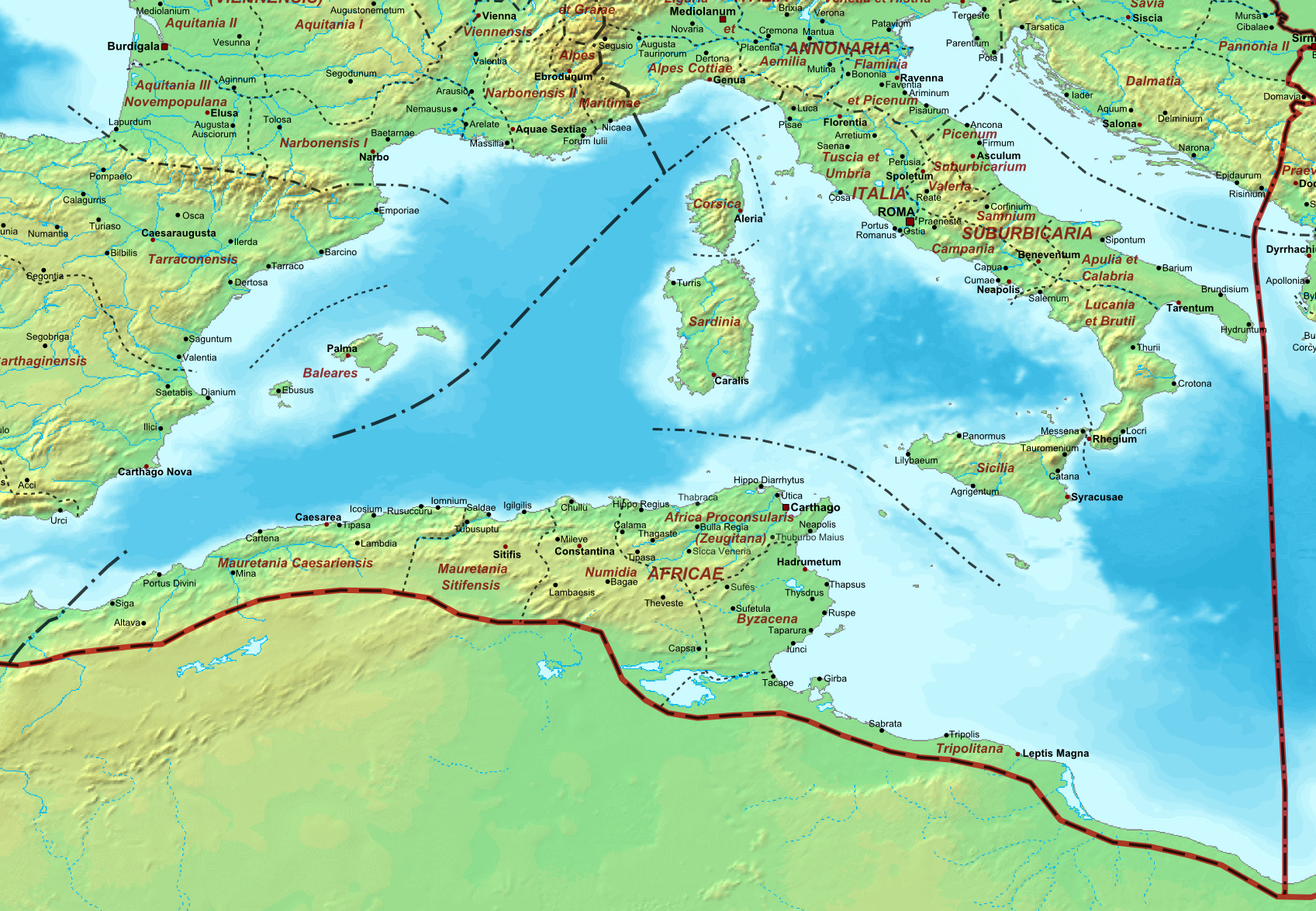
The diocese of Africa brought together Tripolitania, Africa, Numidia, and Mauretania Caesariensis. Mauretania Tingitana became part of the diocese of Hispania. Proconsular Africa was divided into two provinces: Zeugitana, to the North, and Byzacena, to the South, with Hadrumetum (Sousse) as its capital. Finally, Mauretania Sitifensis was split from Mauretania Caesariensis, with Sitifis (Setif) as its capital.
After Diocletian split the Roman Empire in 286, North Africa was also divided: Egypt and Cyrenaica became part of the Eastern Empire, while the rest of the region became part of the Western Empire. This change had little effect on the region, as the desert of Sirte formed a virtually uncrossable border anyway. Carthage became the second-largest city of the Western Empire, after Rome itself.
