Ce site présente l'histoire de l'Afrique du Nord avant les conquêtes arabes – This website presents the history of North Africa before the Arab conquests – يعرض هذا الموقع تاريخ شمال إفريقيا قبل الفتوحات العربية
Aurelius Victor, also known as Victor Afer, was a 4th-Cenury Roman African historian, considered as the main historian of this era. He wrote a monumental book on the history of Imperial Rome, from Emperor Augustus to the successors of Constantine.
Victor Afer writing – Image created by ChatGPT
Origins and early career
Sextus Aurelius Victor was born around 320, in a rural area of North Africa (maybe around Leptis Magna). He grew up in poverty and was the first in his family to learn to read and write. He studied in Carthage, then in Rome, and then started a career in the Roman administration and was sent to the Balkans, a region that was at the heart of the Roman civil system. As a civil servant, he witnessed the civil war of the 350s, on which he later wrote. His nickname, Victor Afer, refers to his African origins.
Manuscript, De Caesaribus, by Victor Afer
Around 360, he made himself known by publishing a historical book, De Caesaribus (On the Caesars), covering all the history of the Roman Empire, from its foundation by Augustus until the reign of Constantine, the first Emperor who adopted the new Christian religion, and his son Constantius II. His book quickly became a reference work on Roman history.
Victor Afer and Emperor Julian
Gold coin with the effigy of Emperor Julian
In 361, the new Emperor Julian, who admired his work, summoned Victor Afer to his court at Naissus (Niš, modern-day Serbia) – the birth city of Constantine. There, he named him governor of the province of Pannonia. Julian even built a bronze statue in Julius Afer’s honor in Naissus.
Emperor Julian’ ambition went well beyond promoting a talented historian: Julian, the nephew of Constantine, had turned his back on his Christian upbringing, and was seeking to reestablish the traditional Roman religion as the official religion of his Empire. For this reason, the Christian historians called him “Julian the Apostate”. Victor Afer was also a pagan, like Julian, while most of the Roman population was already Christian. By recruiting Victor Afer, Julian wanted to make him an ally in his ambitious vision: restoring Rome’s past glory, by reestablishing the worship of the gods of his ancestors.
Julian was killed in battle against the Persians after two years of reign. His plans of reestablishing Roman paganism failed. All Roman Emperors after him were Christian.
Later on
Victor Afer as City Prefect – Image created by ChatGPT
Victor Afer’s public career was still not over: he continued moving upward in the Roman administration, until he became consul. In 389, he was even named Prefect of the City of Rome. This is even more surprising as he was chosen by Theodosius the Great, an Emperor known for his hostility to pagans, who had made Christianity the official religion of his Empire!
All through his career, Victor Afer also continued working as a historian. His civil responsibilities made him a witness with privileged access so the political intrigues of his time, which he exposes and analyses in his works. Next to his main work, De Caesaribus, he also wrote De Viris Illustribus (On Illustrious Men), a collection of short biographies of important characters of Roman history. Another book, Origo Gentis Romanae (Origins of the Roman People), was attributed to him in the past, but this attribution is now contested.
While Victor Afer was a pagan, and highly critical of Constantine and the other Christian Emperors, his work was still very much appreciated by his Christian contemporaries. The Church Father Jerome of Strido wrote a letter requiring a copy of Victor Afer’s work.
Ammianus Marcellinus
Sadly, Victor Afer’s work is mostly lost: only a shortened edition of De Caesaribus is still extant. Although Ammianus Marcellinus, another historian who was contemporary to Victor Afer and knew him, is more famous nowadays, in his lifetime Victor Afer was considered the main historian for this eventful era of Roman history.
Several authors of Late Antiquity (5th-6th Centuries) played an especially important role in the preservation of the ancient Greco-Roman cultural heritage, especially classical literature, through the crises that shook the Roman world in this era. Those authors were highly popular in the Western world in the Middle Age, as until the original classical texts were rediscovered at the Renaissance, the wisdom of the ancient world was known only through them. Several of these authors, including Macrobius, were from Roman Africa, while others, like Boethius and Cassiodorus, had links with North Africa. This article is the summary of our series on the cultural bridge-builders.
The three main cultural bridge-builders: Macrobius, Boethius and Cassiodorus
Cassiodorus was a statesman, philosopher and theologian of Roman origin, who served at the court of the Ostrogothic Kingdom of Italy. As an official of King Theodoric the Great and his successor Athalaric, he was in charge of diplomatic relations with the Vandal Kingdom of Carthage. After the Byzantine reconquest of Italy, he settled in Constantinople, where he played a major role in popularizing Western Christian theologians like Augustine of Hippo in the Eastern regions of the ancient Roman world.
Origins and career
Magnus Aurelius Cassiodorus Senator was born around 490, in Scylletium (close to Catanzaro), Southern Italy. Senator was not a title, but part of his name. His family was of Syrian origin, and had held high responsibilities for several generations: his great-grandfather was a military officer in charge of defending Southern Italy against Vandal attacks; his grandfather had taken part in a Roman Embassy to Attila the Hun; and his father was a high official in the service of Odoacer, and then the Praetorian Prefect (commander of the personal guard) of Theodoric the Great.
At around 20 years of age, young Cassiodorus started a public career under his father’s auspices. He became questor, then consul, and then succeeded Boethius as magister officiorum (head of the government) in 523. Cassiodorus certainly knew his predecessor, and shared his ambition to preserve the classical Greco-Roman heritage. However, the official documents he wrote don’t mention the imprisonment and death of Boethius.
Gold coin with the effigy of Theodoric the Great
Cassiodorus was a Catholic Christian, like most inhabitants of Italy, while the Goths who had taken power in Italy were Arian. While Theodoric had previously been quite tolerant, during the last year of his reign, persecution against Catholics in his kingdom grew stronger, motivated by the persecution of Arians in the Byzantine Empire. In this context, Cassiodorus managed to maintain himself in the circles of power, thanks to his deep loyalty to the King and to his pragmatism in managing affairs of State.
Athalaric
Theodoric died in 526. His nephew and successor Athalaric was just a child. Cassiodorus remained in the service of the royal court. Due to his literary talents, he was often sollicited to write public documents. He was also a diplomat, in charge of diplomatic relations with the Vandal Kingdom of Carthage. He thus was a direct witness of Gelimer’s revolt against the Vandal King Hilderic and the following Byzantine reconquest of North Africa, events he mentions in his letters. During those years, he also collaborated with the Pope Agapetus I in establishing a library of Greek and Latin manuscripts in Rome.
In 533, Athalaric named Cassiodorus Praetorian Prefect for Italy, the highest function at his court. Athalaric died shortly after, of the consequences of his alcoholism. The rest of Cassiodorus’ career was characterized by the gradual reconquest of Italy by the Byzantines.
After his public career
Portrait of Cassiodorus
In 537, Cassiodorus gave up his responsibilities and left Italy for Constantinople. He spent two decades in the Imperial capital. During those years, he discovered a new vocation: bridging the gap between East and West, by helping the Greeks of the Byzantine Empire, the survivors of the former Western Roman Empire, and the new “barbarian” cultures, to better know and understand each other. While in Constantinople, he also developed his theological knowledge through the discovery of Eastern Christian theologians. He met Junillus Africanus, the Questor of the Palace of Emperor Justinian, who was originally North African. Junillus Africanus wrote a theological treatise inspired by an Eastern theological school, and Cassiodorus promoted his book in the West. At the same time, he also introduced the Eastern Christians in Constantinople to Western Christian theology – especially the Roman African Augustine of Hippo, whom he particularly admired.
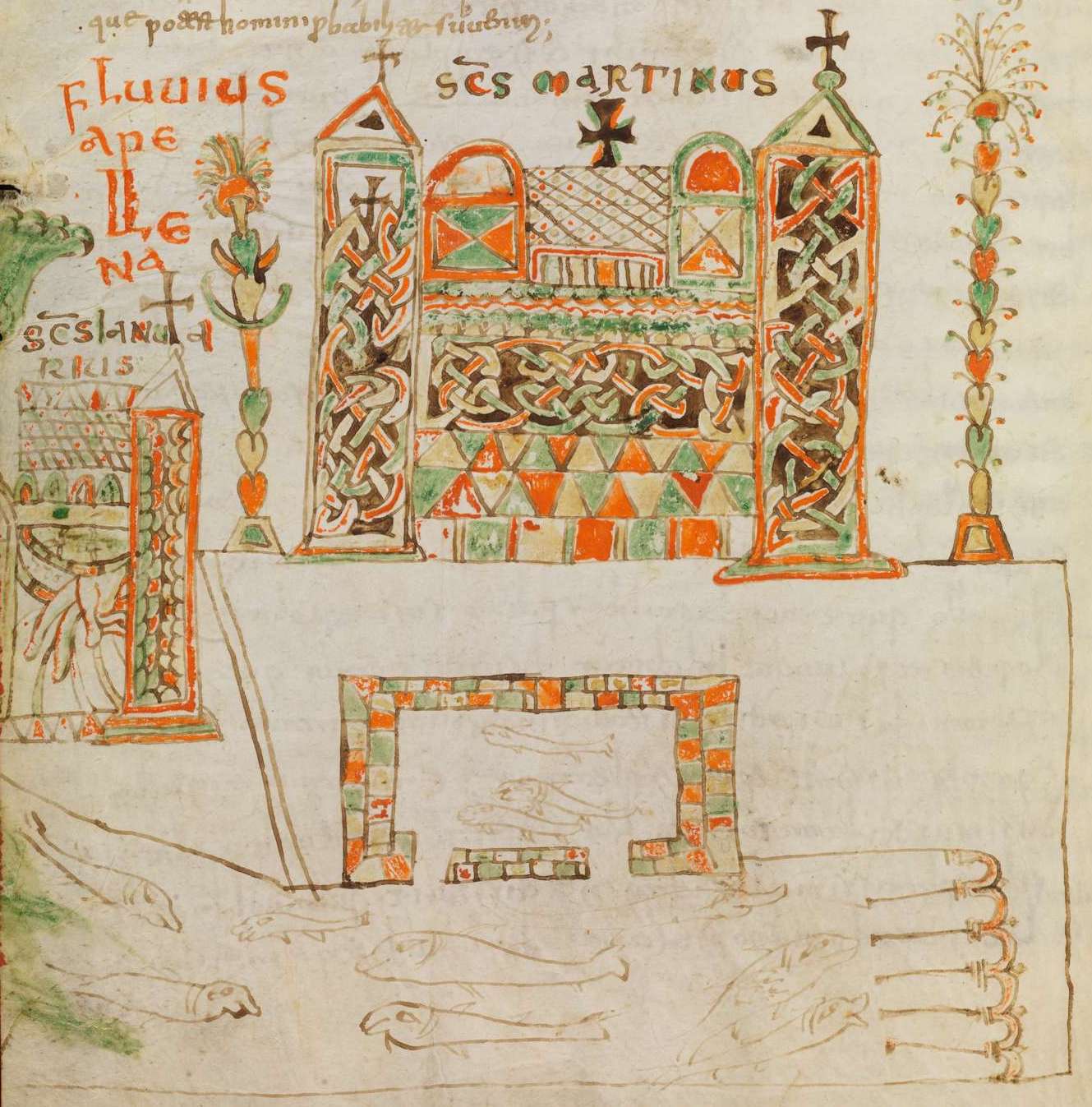
Representation of the Vivarium Monastery in a medieval manuscript of Cassiodorus
After his retirement, he returned to Italy, where he founded the Vivarium Monastery, on his family domain in Calabria (Southern Italy). The monks he welcomed mostly devoted themselves to copying manuscripts – both Greek and Latin, Christian and pagan. Cassiodorus died around 585, in his monastery, at over 90 years of age.
Works
During his public career at the court of the Gothic Kings, Cassiodorus wrote many official letters containing precious information on these turbulent times.
Jordanes’ Getica, our main source on the history of the Goths, is inspired by Cassiodorus
At the same time, he wrote a History of the Goths, probably the first historical book devoted to this people group. His book is lost, but its content is mostly preserved in Getica, written by Jordanes, a 6th-Century Gothic author. He also wrote a Chronica of world history, with an uninterrupted sequence of both Roman and Gothic sovereigns, in order to legitimize the Goths as heirs of the Roman Empire.
While in Constantinople, Cassiodorus mostly devoted himself to theology. He wrote an Exposition on the Psalms, a treatise On the Soul, and an Ecclesiastical History, on the history of the Church from 324 to 439.
After the foundation of the Vivarium Monastery, Cassiodorus wrote the Institutions of Divine and Secular Knowledge, to guide the monks in their studies. This work gives significant importance to the study of secular science and classical literature: just like Augustine of Hippo, Cassiodorus saw them as tools for a better understanding of the sacred texts.
Codex Amiatinus
Also for the Vivarium, Cassiodorus ordered a complete copy of the Vetus Latina, the ancient Latin translation of the Bible before the Vulgate. This manuscript, known as Codex Grandior, is lost, but it probably served as a model for the Codex Amiatinus, the best-preserved complete manuscript of the Vulgate, copied around 700, in Northern England, on over 500 animal skins.
Finally, he wrote a book On Liberal Arts, and another one On Orthography, a compilation of the work of eight grammarians.
Cassiodorus strongly believed in the importance of popular education, and played a major role in the spread of both Greco-Roman classical authors and Christian theological works. His role in the preservation of the ancient cultural heritage in the Middle Age is inestimable.
Boethius was a 6th-Century Roman philosopher and statesman, who played an important role in the translation of the Greek classics into Latin. Born in Italy, a few yeargs after the fall of the Roman Empire, he served in the administration of King Theodoric the Great, the founder of the Ostrogothic Kingdom of Italy. While he didn’t have North African origins, the events that occurred in the Vandal Kingdom of Carthage, a close ally to Theodoric, had a major impact on his life.
Life and works of Boethius
Anicius Manlius Severinus Boethius was born in Rome around 480, a few years after the fall of the last Roman Emperor Romulus Augustulus. He was from a rich and influential Roman family, that had lost much of its influence in the upheavals before the fall of the Roman Empire. After his father, who was a consul, died in his childhood, Boethius was raised by the Roman aristocrat Quintus Aurelius Memmius Symmachus, who initiated him to classical literature. Later on, he married Rusticiana, the daughter of his adoptive father.
In 493, the Germanic chief Odoacer, the new master of Italy since he deposed the last Roman Emperor, was defeated by the Gothic King Theodoric, who founded a Kingdom in Italy. Boethius was a teenager then. After he finished his studies, Boethius entered the service of Theodoric. He became a Senator, and then a consul.
Coin with the effigy of Theodoric the Great
Boethius was a Catholic Christian. While the Goths of King Theodoric were Arian, Theodoric himself, whose mother was Catholic, led a policy of religious tolerance, never hesitating to recruit Catholics of the former Roman elite, like Boethius, into his administration.
Boethius, while a devout Christian, was also strongly devoted to ancient Greece and its philosophical heritage. In order to harmonize Plato and Aristotle’s thought with Christian theology, he decided to translate the whole body of Greek classical literature into Latin. While others before him, like the Roman African Apuleius of Madaura, had already sought to translate the Greek texts, Boethius’ initiative was the first systematic effort to translate them all. This initiative was all the more necessary at a time when the inhabitants of the former Western Roman Empire were becoming less fluent in Greek. Next to his translations, Boethius also wrote commentaries of Aristotle and other Greek authors. He is considered as one of the main “cultural bridges” who contributed to the transmission of the ancient Greek heritage to medieval Europe.
Boethius (left) and his adoptive father Symmachus (right)
Boethius was not only a translator and a commentator: he also wrote his own works of philosophy, mathematics, music, and theology – including treaties defending the Catholic Christian faith and condemning Arianism. His most famous work, On the Consolation of Philosophy, was written while he was in prison, shortly before his execution. We will come back to this work later in this article.
His fall
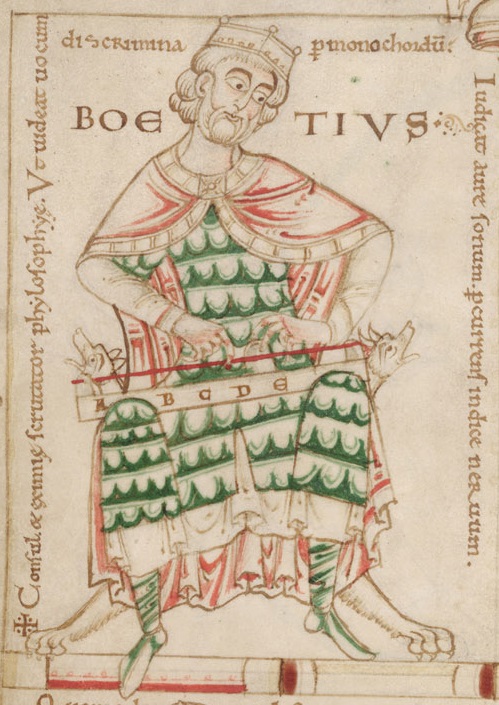
Manuscript showing Boethius teaching (above) and in prison (below)
A major part of Boethius’ public career was devoted to fighting corruption at the royal court. At the very beginning of his career, one of his first missions was leading the investigation on accusations against the commander of Theodoric’s guard, that he had embezzled the money of the guards’ pay for luxury objects given as presents to neighboring kings. Boethius’ integrity and firm commitment to fight all those who abused their power made him highly popular with the people, but also won him many enemies at the court.
In 522, Boethius’ two sons were named consuls together, a very rare honor, which Boethius considered his highest achievement. Shortly after, Boethius was named magister officiorum, head of the government. He was at the zenith of his career.
As head of the government, Boethius continued his fight against corruption. He undid a conspiracy fomented by Triguilla, the steward of the royal palace; opposed Cunigast, a Gothic minister who was “devouring the substance of the poor”; and cancelled a convoy of food from Campania to Rome, as it was threatening to worsen the famine in the region. Due to those initiatives, he had more enemies than ever before; but he still enjoyed the trust of King Theodoric.
Amalafrida, sister of Theodoric and Queen of Carthage – Image created by ChatGPT
The events that led to Boethius’ fall mostly took place in North Africa. The Vandal King Thrasamund, who was married to Theodoric’s sister Amalafrida, died in 523. Amalafrida led a revolt against his successor Hilderic, but she was captured and executed. In this context, Theodoric felt vulnerable, and Boethius’ enemies seized the opportunity to pit the King against him.
At the same time, after a schism between the Western and Eastern Church had finally been resolved, Western Catholics, including Boethius, aspired to renewed links with the Byzantine Empire. In this context, ex-consul Albinus was accused of treason, because of his correspondence with the Byzantine Emperor Justin I. Boethius, defending him, cried out: “The charge is false; but if Albinus did that, so also have I and the whole Senate with one accord done it; it is false, my Lord King.” Boethius was then accused of the same crime, and imprisoned. He wast executed in 524, at around 40 years of age.
Manuscript of the book On the Consolation of Philosophy
During his final imprisonment, Boethius wrote a book that is considered as his masterpiece: On the Consolation of Philosophy. The book is a dialogue between the author and “Dame Philosophy”, a personification of philosophy. At the beginning of the book, Boethius, locked in his cell, laments the injustice that befell him, when a woman comes to visit him. The woman encourages him not to let his happiness depend on circumstances, as the “wheel of fortune” always keeps turning, carrying everything away with it; while true happiness is found in seeking wisdom. The dialogue between Boethius and Dame Philosophy continues, on the ephemeral nature of worldly wealth, the divine origins of wisdom, the reasons why a good God allows evil to exist, and how those who suffer unjustly can find consolation in wisdom, while the evil will never find true happiness. On the Consolation of Philosophy is considered as the last major work of ancient philosophy.
After his death, Boethius was recognized as a martyr by the Catholic Church. He is buried in the Basilica San Pietro in Ciel d’Oro (Saint-Peter-of-the-Golden-Sky), in Pavia, Italy, the city where he was executed. His tomb can be seen in the cover picture of this article.
The collapse of the Western Roman Empire accelerated in the course of the 5th Century, until its final fall. Three factors directly linked to North Africa contributed to this decline: the Vandal invasion of Roman Africa, the sack of Rome by the Vandals, and the Roman defeat at the Battle of Cape Bon.
The beginning of the end
Emperor Honorius
Theodosius the Great, the last Emperor of the united Roman Empire, known mostly for establishing Christianity as the official religion of his Empire, died in 395. After his death, the Roman Empire was divided between his sons: Arcadius (395-408) in the East and Honorius (395-423) in the West. The two new Emperors were young and inexperienced, especially Honorius, who was only 10 years old when his father died. Stilicho, a general with Vandal origins, ensured the regency.
At the same time, the invasions of Roman territory by foreign populations, which started in the 3rd Century, were continuing. In 403, the Goths, led by their new King Alaric, invaded Italy. In 406, a confederation of Germanic tribes, led by the Vandals, crossed the Rhine, entered Gaul, and devastated the country. In 409, the Vandals settled in Spain. The Roman troops based in Britain came to fight the invaders on the continent, abandoning the island, which was permanently lost for Rome around 410.
Stilicho was executed in 408, for failing to repel the invaders. Heraclianus, the military officer in charge of his execution, was named governor of Africa. After Stilicho’s death, unrest broke out in the whole Empire, with mass massacres of the families of foederati – Barbarian warriors integrated into the Roman army, like Stilicho’s father. The survivors fled to Alaric, the King of the Goths, to seek his protection, thus enlarging the ranks of his army.
Sack of Rome by the Goths, 410
In 409, Alaric forced the Senate to proclaim a new Emperor, Priscus Attalus, instead of Honorius. Heraclianus, the governor of Africa, remained loyal to Honorius and cut the supply of African wheat to the city of Rome. A few months later, Priscus Attalus was overthrown by Alaric, after refusing to let Alaric lead a campaign against Heraclianus in Africa.
In 410, Alaric’s army sacked Rome: it was the first time the Imperial capital was taken by a foreign army. The Emperor’s sister Galla Placidia was kidnapped and forcibly married to Athaulf, Alaric’s successor.
The Empire strikes back
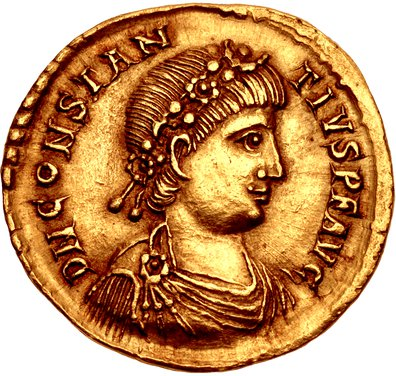
Gold coin with the effigy of Constantius III
The Roman general Constantius, after he was named commander of the Roman army in 411, led a military campaign in Gaul and Northern Spain, against the usurper Constantine, and then against the Goths. He managed to drive the Goths out of Gaul and to free Galla Placidia. To reward him, Emperor Honorius gave him Galla Placidia for wife, and then made him co-Emperor in 421, under the name Constantius III. He died a few months later.
Emperor Honorius died in 423. His successor, Valentinian III, was the son of Constantius III and Galla Placidia. As he was still a child, his mother Galla Placidia ensured the regency.
The Vandal invasion of Africa
The Vandal Kingdom
In 429, the Vandals, led by their king Gaiseric, profited from a conflict between Galla Placidia and the governor of Africa Bonifatius to invade North Africa, putting an end to over four centuries of Roman domination of the region. Ten years later, they conquered Carthage and established their capital there.
The loss of Africa, the bread-basket of the Empire, was a hard blow for the Romans. The Western Empire now only controlled Italy and Gaul. In 440, the Vandals also invaded Sicily.
Goths and Huns in Gaul
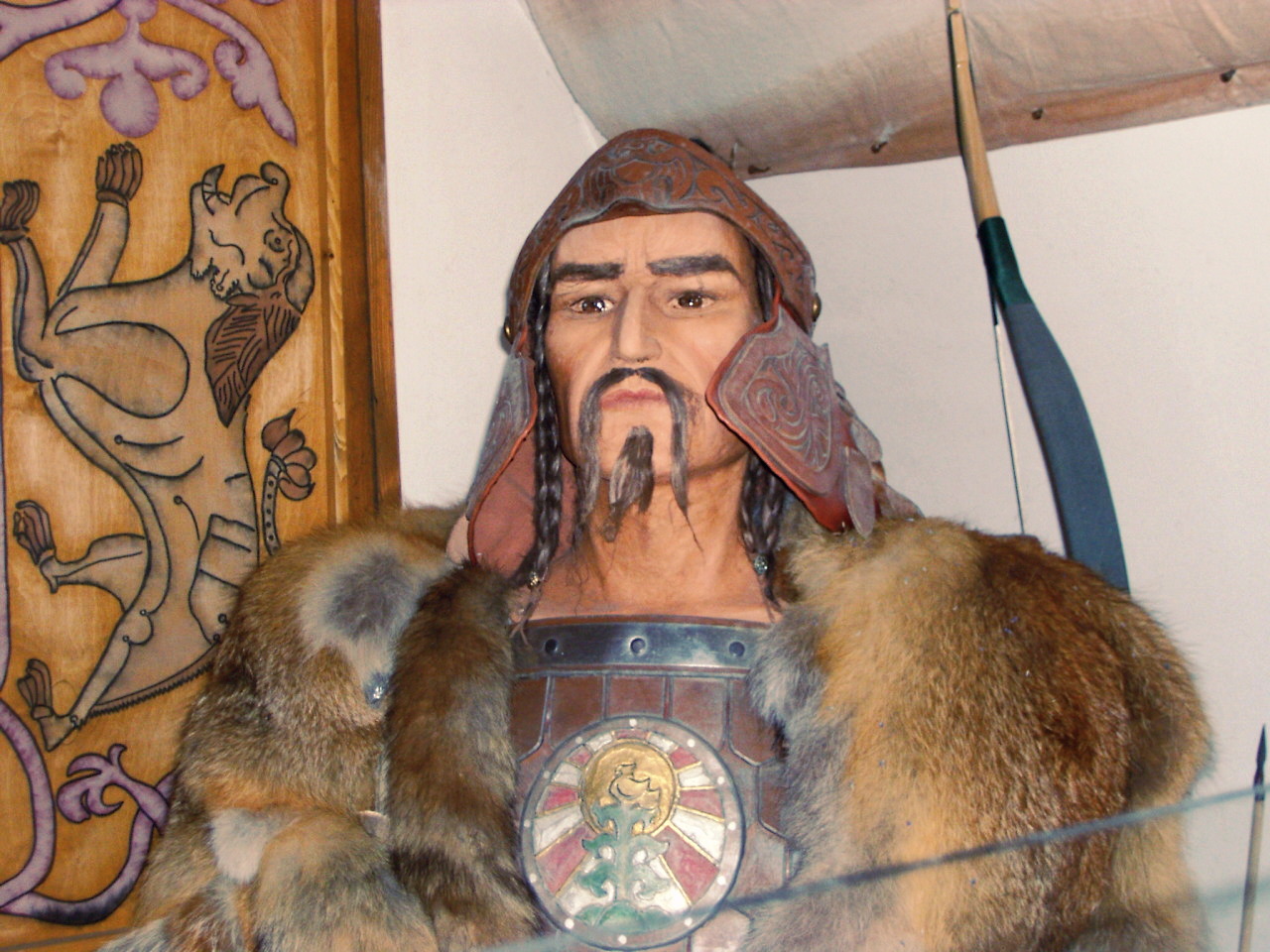
Attila the Hun
In 450, the Goths, led by their King Theodoric, invaded Gaul. Gaiseric, the King of the Vandals, sent messengers to Attila the Hun, to encourage him to attack Theodoric. While Attila’s ambition was to later invade Italy from Gaul, Gaiseric mostly wanted to use him to weaken his old enemy Theodoric.
Attila invaded Gaul and wrought much devastation there, forcing Theodoric to make an alliance with Rome. The Romans and Goths fought Attila’s army at the Battle of the Catalaunian Plains, in 451: Theodoric was killed in battle, and Attila forced to withdraw from Gaul, while the Romans won a semblance of victory.
Attila the Hun died suddenly in 453. After his death, Gaiseric became the main enemy of Rome.
The sack of Rome by the Vandals
Sack of Rome by Gaiseric
In 455, Emperor Valentinian III, who had promised his daugther Eudocia in marriage to Gaiseric’s son Huneric, was assassinated. His murderer forced Eudocia to marry his son. Gaiseric used this as a pretext to invade Rome and sack the city. He took Eudocia, together with her mother, as a prisoner to Carthage, where she was married to Huneric.
After the Vandals left, the new King of the Goths Theodoric II imposed Avitus, a Senator of Gaulish origin whom he was close to, as the new Emperor.
Majorian: Make Rome Great Again
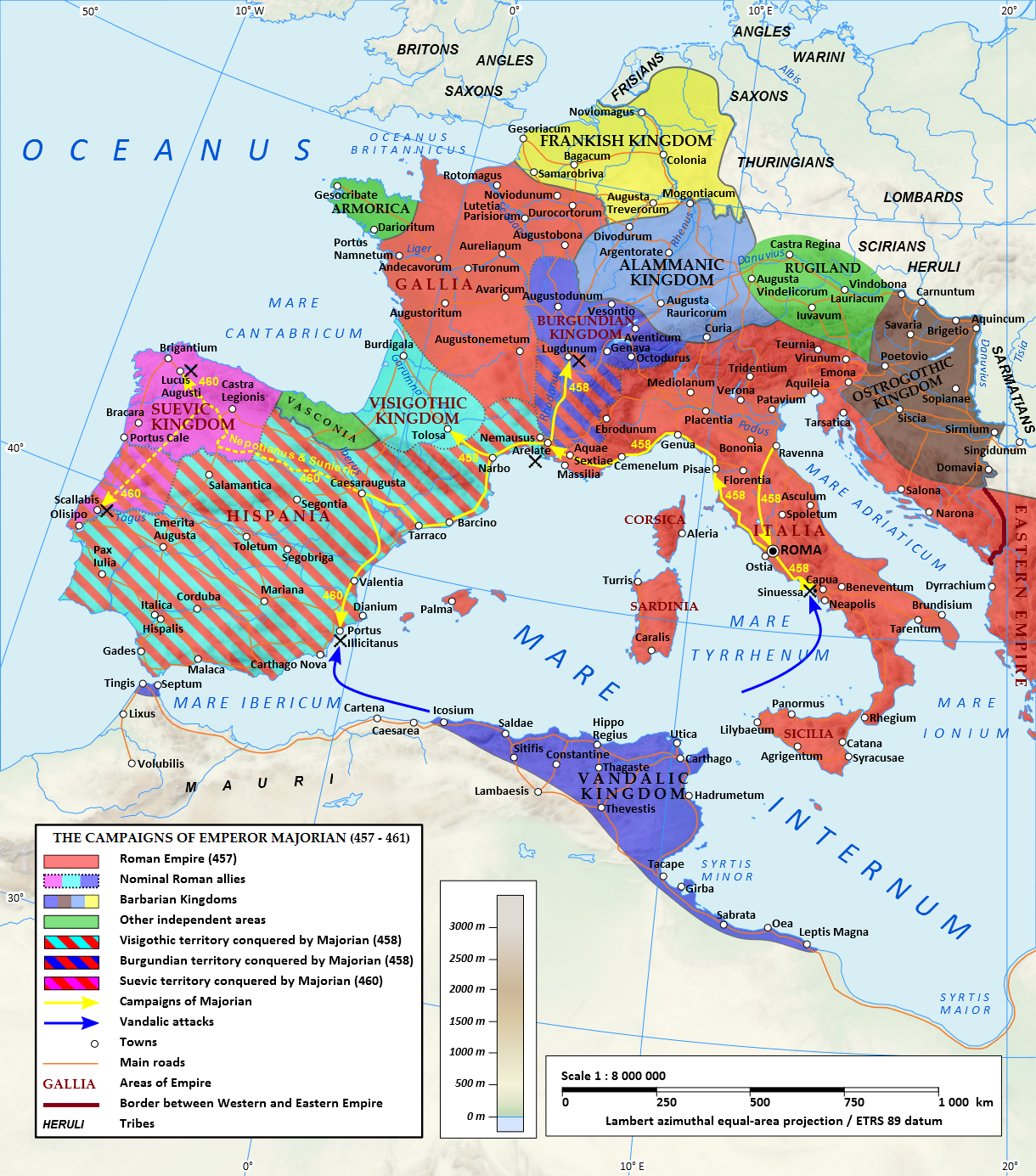
Territories reconquered by Majorian – Click to enlarge
In 456, the new Emperor Majorian decided to launch a vast military campaign to reconquer the territories lost by Rome. He started by driving the Burgundians out of Southern Gaul, and then attacked the Goths in Spain. He also sent his officer Marcellinus to take back Sicily from the Vandals.
Majorian wanted to use Spain as a base to attack the Vandals in Africa. However, during his campaign in Spain, the Vandals managed to destroy the ships he was preparing for the invasion. Without a fleet, Majorian was forced to cancel his plans. In 460, he concluded a peace agreement with the Vandal King Gaiseric and dissolved his troops.
Battle of Cape Bon
After the death of Majorian in 461, the new master of the Empire was the general Ricimer, who could not become Emperor himself due to his Germanic origins. The following Emperors, Libius Severus (461-465), Anthemius (467-472) and Olybrius (472), were named by Ricimer.
In 468, the Western and Eastern Emperors came together for a military campaign to drive the Vandals out of Africa. Their army was defeated at the Battle of Cape Bon: the Vandals filled their ships with flammable materials, and then set fire to their ships and projected them against the Roman fleet. Over half the Roman fleet was burned.
After this defeat, the Western Roman Empire only controlled Italy and Sicily, and its army was more weakened than ever.
His successor Glycerius (473-474) wasn’t recognized by the Eastern Emperor Leo I, who named Julius Nepos (474-475) Emperor instead of him. The last Emperor, Romulus Augustulus (475-476), who was put on the throne while he was a child, was deposed in September 476 by the Germanic chief Odoacer: the Western Roman Empire was no more.
In late Antiquity, the people of the Mediterranean world were wondering how to make sense of the ancient myths and legends that had been at the foundation of their culture for centuries, now that they were Christian and no longer believed in the gods of their ancestors. Fulgentius, a North African author of the Vandal era, wrote several books in which he suggests an allegorical reading of Greco-Roman myths, drawing a moral and spiritual message from them.
A hidden message behind myths of another age
The world of ancient mythology is a supernatural world, full of magic, fantastic creatures, talking animals and men changed into animals or into stone. Also, in the mythological universe, the gods who live among men have very human passions: they are murderers, rapists, adulterers, thieves, liars, and commit all sort of crimes. The most reasonable men of the time, especially the philosophers, have always been embarrassed by the absurdity and immorality of these myths. To provide an explanation, they tried to discern a deeper meaning behind those imaginary stories.
Neoplatonic philosophers were especially active in reexamining the ancient myths at the light of their more sophisticated understanding of the world, to find a hidden sense behind their words.
Odysseus and Circe
Their method is best explained by an example. In Homer’s Odyssey, the hero Odysseus and his companions land on the island of the sorceress Circe. When Odysseus’ companions, in their hunger, precipitate themselves on Circe’s table, she changes them all into pigs. Odysseus, on his way to save his companions, meets the god Hermes, who gives him a magical plant, together with instructions of how to triumph of the sorceress. The magical plant protects Odysseus against Circe’s magic. In the end, Circe agrees to return his companions to their human form. For the Neoplatonics, the change of Odysseus’ companions into pigs represents human degradation: when we give in to our primary impulses, to corrupting sensual pleasures, we become like wild animals. Odysseus, on the other hand, is protected by the knowledge of the wise, which gives him the strength to resist the destructive magic of the sorceress.
Ymagines Fulgencii: medieval images inspired by Fulgentius the Mythographer
Allegorical reading of myths became even more prominent in the Christian era. It allowed the Christians in the Greco-Roman world to reclaim possession of the old pagan myths, in which they discovered moral lessons, teaching them how to live a virtuous life, and even spiritual lessons, on God and his plan for them. One of the most prominent authors who developed this Christian allegorical reading of mythological texts was the North African Fulgentius the Mythographer.
Who was Fulgentius the Mythographer?
Fabius Planciades Fulgentius was a North African Christian author, who lived and wrote in the Vandal era, from the 5th to the 6th Centuries CE. Very little is known of his life, not even where in North Africa he lived. His writing style in Latin, his knowledge of Greek and his mastery of classical authors and popular cults indicate he was probably a trained rhetorician or grammarian. He understood the Libyc language and could read the Libyc alphabet, which shows he probably had Amazigh origins. The prologue of his Mythologies mentions that he was married.
Fulgentius of Ruspe
Since the Middle Age, certain scribes identified Fulgentius the Mythographer with Fulgentius of Ruspe, a North African bishop who lived in the same era, and was the leader of the North African Christian resistance against Vandal Arianism. However, this identification is contested by modern specialists.
Fulgentius the Mythographer’s work is traditionally dated from the late 5th and early 6th Century. However, a passage of his work resembles a verse of Corippus, another North African author who wrote around 550, after the Byzantine reconquest. Some specialists believe that he quotes Corippus, which would mean that he wrote after him. Others believe he is older than Corippus, and the resemblance is a pure coincidence. If he indeed does quote Corippus, this would prove that Fulgentius the Mythographer cannot be identified with Fulgentius of Ruspe, as the latter died in 527.
Fulgentius the Mythographer’s work was very popular all through the Middle Age, and had a strong influence on medieval Christian mythographers.
Fulgentius the Mythographer’s works
The most well-known work of Fulgentius the Mythographer are his Mythologies, a series of three books, with 50 chapters altogether. Each chapter tells a myth, and then interprets it allegorically, drawing a moral and spiritual message from it. For his interpretation, he uses etymologies of character names, which are often highly doubtful; but this was common at the time. In his prologue, the author explains that he wanted to strip the classical Greek myths of all their fictitious elements, in order to reveal the obscure truths they contain. While he had a Christian motivation, the lessons he draws from the myths are quite general and can be applied to any public.
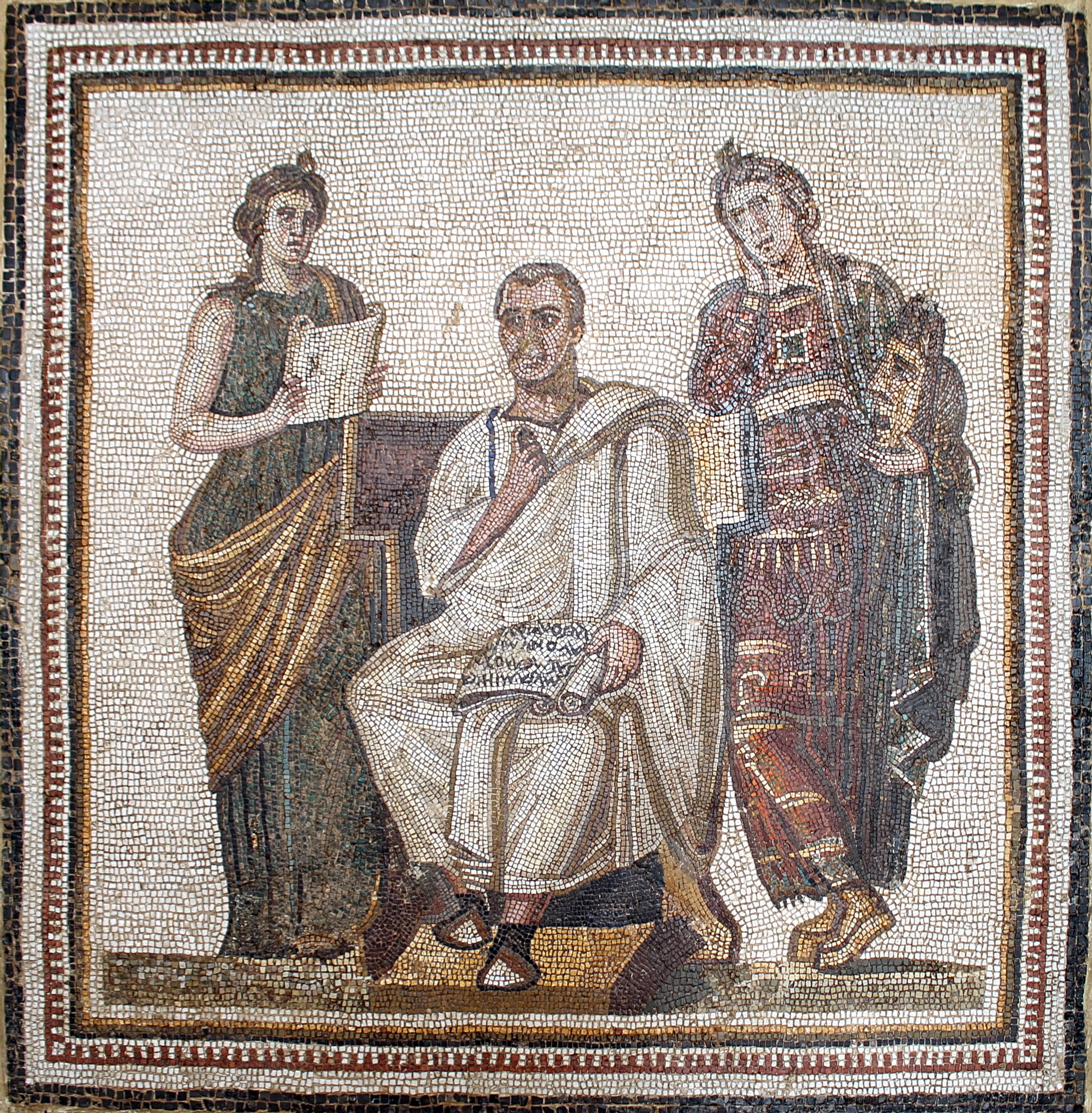
In another work, Fulgentius the Mythographer exposes an allegorical reading of the Aeneid of Virgil, which he sees as an allegory of all human life. In this book, he ghost of Virgil appears to the author, together with the Muses (goddesses of art), to explain the truths contained in the Aeneid. Virgil addresses the author on a condescending tone, and makes fun of the readers’ tendency to read his poem literally, without grasping the deeper meaning behind his words. Allegorical interpretations of Virgil were already common (including one by the Roman African grammarian Aelius Donatus), but Fulgentius the Mythographer was the first one to do this in a Christian perspective.
Fulgentius the Mythographer also wrote an Explanation of obsolete words, which gives an explanation of 62 ancient Latin words appearing in classical literature, as well as a historical book, On the Ages of the World and Men.
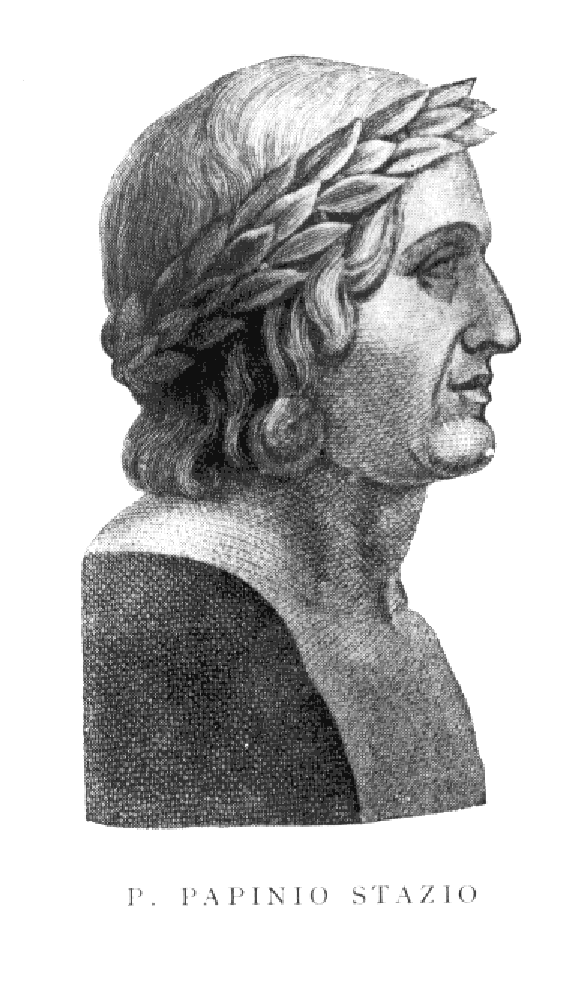
Statius
Finally, an allegorical reading of the Thebaid, a poem by the 1st-Century Roman poet Statius, was also attributed to Fulgentius the Mythographer, probably by mistake: this work was written later, during the Middle Age. Its author imitates Fulgentius the Mythographer’s writing style. Statius was a contemporary of the first Christians, and a medieval tradition without any historical base, mentioned in Dante’s Divine Comedy, claims that he secretly converted to Christianity, and that his works contains a hidden Christian message.
Priscian of Caesarea was a 6th-Century grammarian. Born in Caesarea (Cherchell), Mauretania, he taught Latin grammar in Constantinople, the new Imperial capital.
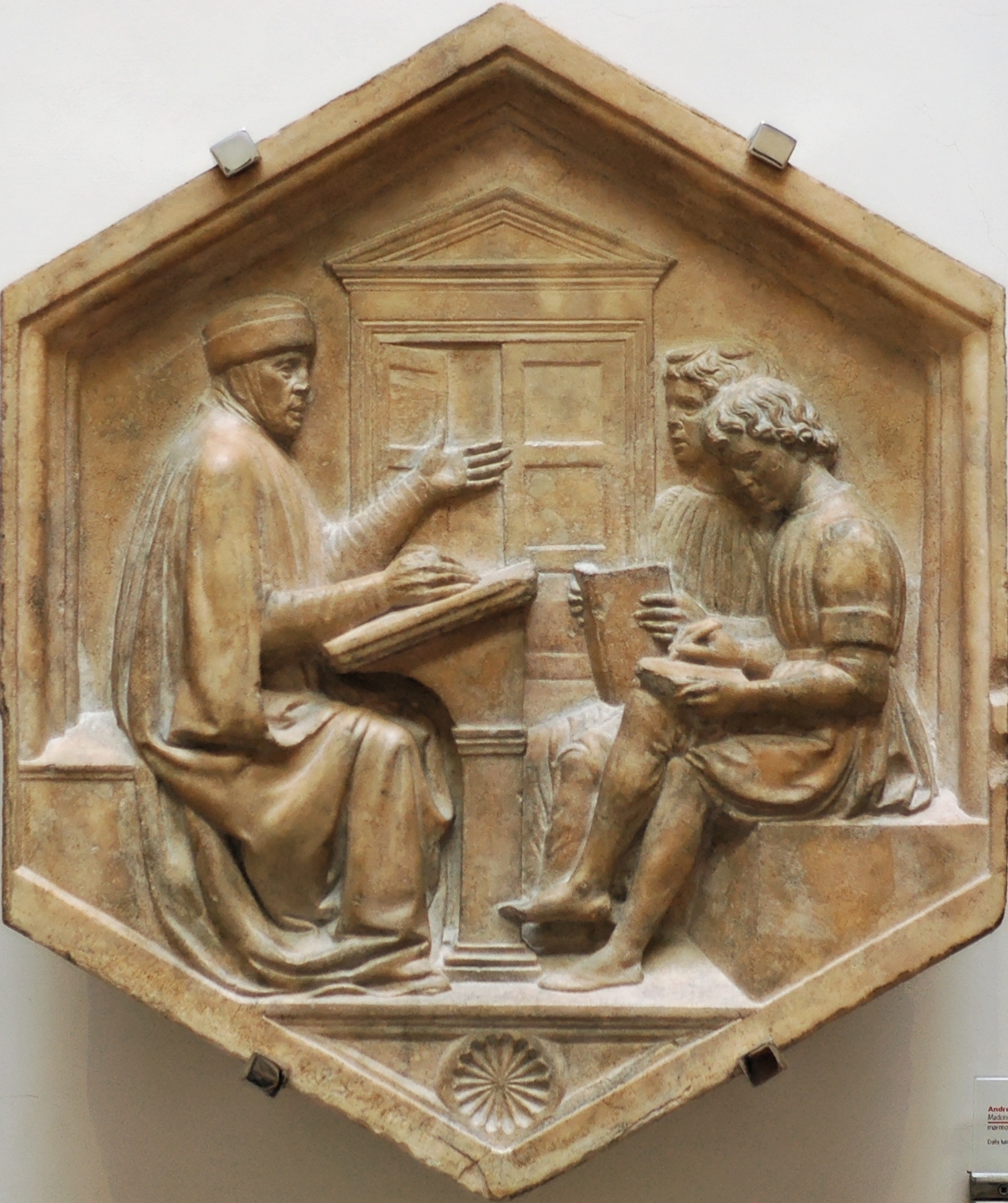
Priscian of Caesarea, relief, bell tower of Florence, Italy, by Luca della Robbia
Priscian was born around 470, in Caesarea (Cherchell), Mauretania. He was probably of Greek origin. Although he was a Christian, his works contain many references to ancient Greek mythology.
Emperor Anastasius, Priscian’s mecene
At the time, North Africa was occupied by the Vandals. As a young man, Priscian fled his native region and settled in Constantinople, the capital of the Byzantine Empire, where he taught grammar. Anastasius, the Byzantine Emperor at the time (491-518), led a policy of welcoming Romans who had been uprooted by the fall of the Western Roman Empire. Priscian wrote a panegyric of Anastasius, praising his good will towards those refugees.
The most well-known of Priscian’s works was his Institutes of grammar, a systematic exposition of Latin grammar, in 18 books. In this work, Priscian uses quotes of Latin authors as examples of the grammatical rules he exposes. Those quotes preserved fragments of authors whose work would otherwise be lost.
The Institutes of grammar were used during all the Middle Age to teach Latin, together with the Ars Grammatica, written by Aelius Donatus, another North African grammarian: Aelius Donatus was used as an introduction, while Priscian, whose work was more detailed, served for deeper study.
Roman domination over North Africa, which lasted over four centuries, ended with the Vandal conquest of the region. The loss of Africa, the Empire’s bread-basket, was a hard blow for the Romans, who tried several times to take back the region. In 468, the Western and Eastern Roman Emperors came together for a military campaign against the Vandals. Their defeat at the Battle of Cape Bon was the last Roman attempt to reconquer Africa.
Context
Gold coin with the effigy of Majorian
During the reign of Emperor Majorian (457-461), the Roman Empire reconquered Spain. Majorian wanted to continue by taking back North Africa from the Vandals, but failed. His officer Marcellinus managed to reconquer Sicily.
In 467, the Vandal King Gaiseric tried to invade the Peloponnese. With the Vandal fleet spreading further and further East, the Romans feared an attack against Alexandria. The Eastern Emperor Leo I, who had previously been hesitant to support the Western Empire against the Vandals, finally decided to intervene.
The Roman offensive
The Western Emperor Anthemius, the Eastern Emperor Leo I, and Marcellinus, a military officer who controlled a semi-autonomous territory in Illyria, came together in Sicily, to prepare a vast common offensive against Carthage.
Gold coin with the effigy of Basiliscus
The Romans decided to attack the Vandals on three fronts : Basiliscus, the commander of the Eastern Roman army, would attack Carthage by sea with the major part of the troops; Marcellinus would attack Sardinia from Sicily, and then join Basiliscus; while Heraclius, the governor of Egypt, would attack Carthage from the East, via Libya.
Marcellinus conquered Sardinia, while Heraclius took control of Tripolitania. Basiliscus’ fleet anchored close to Cape Bon and waited for Marcellinus. However, a large part of Marcellinus’ fleet, led by Ricimer, a general with Germanic origins, refused to leave. Ricimer might have deliberately tried to sabotage the operation.
The Roman landing on Cape Bon was one of the largest military operations of this kind in ancient history: over 50.000 fighters and a thousand ships participated.
The Vandal King Gaiseric asked for a truce to negotiate. During this time, the Vandals filled their ships with flammable materials, and then, at night, they set fire to their ships and projected them against the Roman fleet, which was taken by surprise. Over half the Roman fleet was burned.
Later on
Basiliscus and Marcellinus fled to Sicily with the survivors of their army, while Heraclius fled across the Libyan desert. In Sicily, Marcellinus was assassinated by Ricimer.
Julius Nepos, the nephew of Marcellinus, became Western Emperor from 474 to 475. Basiliscus became Eastern Emperor in 475-476.
Olybrius, one of the last Roman Emperors, was allied by marriage to Gaiseric, the Vandal King of Carthage. He tried to take power several times with Vandal support, and finally reigned for a few months in 472.
Gold coin with the effigy of Olybrius
Anicius Olybrius was born in Rome, in an ancient noble family. He married Placidia, the daughter of Emperor Valentinian III, shortly before the sack of Rome by the Vandals. It is also possible that Olybrius and Placidia were only engaged and got married after Placidia returned to Rome.
In 455, Placidia was taken as a prisoner to Carthage by the Vandals, together with her sister Eudocia, who was married to Huneric, the son of the Vandal King Gaiseric. Placidia was freed in 461.
After the death of Emperor Majorian in 461, the new master of the Empire was general Ricimer, who could not become Emperor himself because of his Germanic origins. Olybrius claimed the Imperial throne. He was supported by Gaiseric, who hoped that his reign would be favorable to Vandal interests. However, Ricimer chose another Emperor, Libius Severus. Olybrius became consul in 464.
Reverse of a gold coin with the effigy of Olybrius: Christian cross surrounded by laurels
After Libius Severus died in 465, Olybrius claimed the throne again, still with Gaiseric’s support, but Anthemius was chosen instead of him. Olybrius finally succeeded in his third attempt to become Emperor, after Anthemius died in 472. Ricimer, who controlled the nomination of all Emperors since Majorian, died shortly after Olybrius’ accession to the throne.
Olybrius, through his marriage to Placidia, was the heir of the Theodosian dynasty, the last great Roman Imperial dynasty. His reign was short and uneventful. He had the reputation of being a devout Christian. The fact that the coins with his effigy show him without a spear of helmet seems to show that he didn’t have a strong interest for military affairs. Olybrius died of dropsy after four months on the throne.
The French word “olibrius”, which means a pompous and ridiculous person, comes from this Emperor’s historical reputation, due to his short reign, without any significant events.
Roman rule over North Africa, which had lasted more than four centuries, collapsed when the Vandals invaded the region. About thirty years later, a new Emperor, Majorian, led a campaign that allowed him to retake control of Spain. He then wanted to reconquer North Africa, but he lacked the means to do so.
Background
Gold coin bearing the image of Avitus
After the Vandals sacked Rome in 455, the Roman Empire was weaker than ever. The Gothic king Theodoric II imposed Avitus, a senator of Gallic origin who was close to him, as the new Emperor. During Avitus’s reign, the Goths invaded Spain, officially to bring the region back under Roman rule, but in reality for their own benefit. Abandoned by Theodoric, Avitus was killed in 456, after a year on the throne.
Majorian: Make Rome Great Again
Territories reconquered by Majorian – click to zoom
General Majorian, who proclaimed himself Emperor, decided to launch a vast campaign to reconquer the territories Rome had lost. He began by driving the Burgundians out of southern Gaul, then turned on the Goths in Spain. Within three years, he had retaken control of most of Spain. He also sent his officer Marcellinus to recapture Sicily from the Vandals.
Majorian wanted to use Spain as a base from which to attack the Vandals in Africa. But during his Spanish campaign, the Vandals managed to destroy the ships he was preparing for the invasion. Deprived of his fleet, Majorian was forced to cancel his plans. In 460, he concluded a peace treaty with the Vandal king Gaiseric and disbanded his troops.
On his return to Italy, Majorian was captured by Ricimer, a Roman general of Germanic origin. He was assassinated in 461.
Aftermath
Seal of Ricimer
For the following years, Ricimer, who could not become Emperor himself because of his Germanic origins, was the true master of the Empire, until his death in 472. The Emperors who reigned during these years were mere puppets. One of them, Olybrius, was linked by marriage to the Vandal king Gaiseric.