

Français – عربي – ⵜⴰⵎⴰⵣⵉⵖⵜ – English
The collapse of the Western Roman Empire accelerated in the course of the 5th Century, until its final fall. Three factors directly linked to North Africa contributed to this decline: the Vandal invasion of Roman Africa, the sack of Rome by the Vandals, and the Roman defeat at the Battle of Cape Bon.
The beginning of the end

Theodosius the Great, the last Emperor of the united Roman Empire, known mostly for establishing Christianity as the official religion of his Empire, died in 395. After his death, the Roman Empire was divided between his sons: Arcadius (395-408) in the East and Honorius (395-423) in the West. The two new Emperors were young and inexperienced, especially Honorius, who was only 10 years old when his father died. Stilicho, a general with Vandal origins, ensured the regency.
At the same time, the invasions of Roman territory by foreign populations, which started in the 3rd Century, were continuing. In 403, the Goths, led by their new King Alaric, invaded Italy. In 406, a confederation of Germanic tribes, led by the Vandals, crossed the Rhine, entered Gaul, and devastated the country. In 409, the Vandals settled in Spain. The Roman troops based in Britain came to fight the invaders on the continent, abandoning the island, which was permanently lost for Rome around 410.
Stilicho was executed in 408, for failing to repel the invaders. Heraclianus, the military officer in charge of his execution, was named governor of Africa. After Stilicho’s death, unrest broke out in the whole Empire, with mass massacres of the families of foederati – Barbarian warriors integrated into the Roman army, like Stilicho’s father. The survivors fled to Alaric, the King of the Goths, to seek his protection, thus enlarging the ranks of his army.

In 409, Alaric forced the Senate to proclaim a new Emperor, Priscus Attalus, instead of Honorius. Heraclianus, the governor of Africa, remained loyal to Honorius and cut the supply of African wheat to the city of Rome. A few months later, Priscus Attalus was overthrown by Alaric, after refusing to let Alaric lead a campaign against Heraclianus in Africa.
In 410, Alaric’s army sacked Rome: it was the first time the Imperial capital was taken by a foreign army. The Emperor’s sister Galla Placidia was kidnapped and forcibly married to Athaulf, Alaric’s successor.
The Empire strikes back
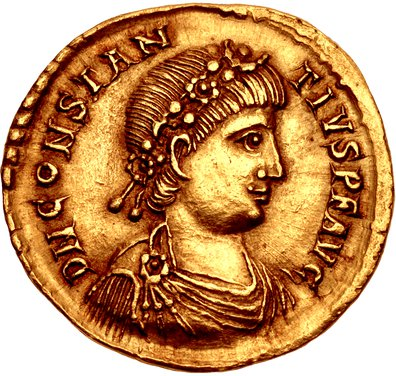
The Roman general Constantius, after he was named commander of the Roman army in 411, led a military campaign in Gaul and Northern Spain, against the usurper Constantine, and then against the Goths. He managed to drive the Goths out of Gaul and to free Galla Placidia. To reward him, Emperor Honorius gave him Galla Placidia for wife, and then made him co-Emperor in 421, under the name Constantius III. He died a few months later.
Emperor Honorius died in 423. His successor, Valentinian III, was the son of Constantius III and Galla Placidia. As he was still a child, his mother Galla Placidia ensured the regency.
The Vandal invasion of Africa

In 429, the Vandals, led by their king Gaiseric, profited from a conflict between Galla Placidia and the governor of Africa Bonifatius to invade North Africa, putting an end to over four centuries of Roman domination of the region. Ten years later, they conquered Carthage and established their capital there.
The loss of Africa, the bread-basket of the Empire, was a hard blow for the Romans. The Western Empire now only controlled Italy and Gaul. In 440, the Vandals also invaded Sicily.
Goths and Huns in Gaul
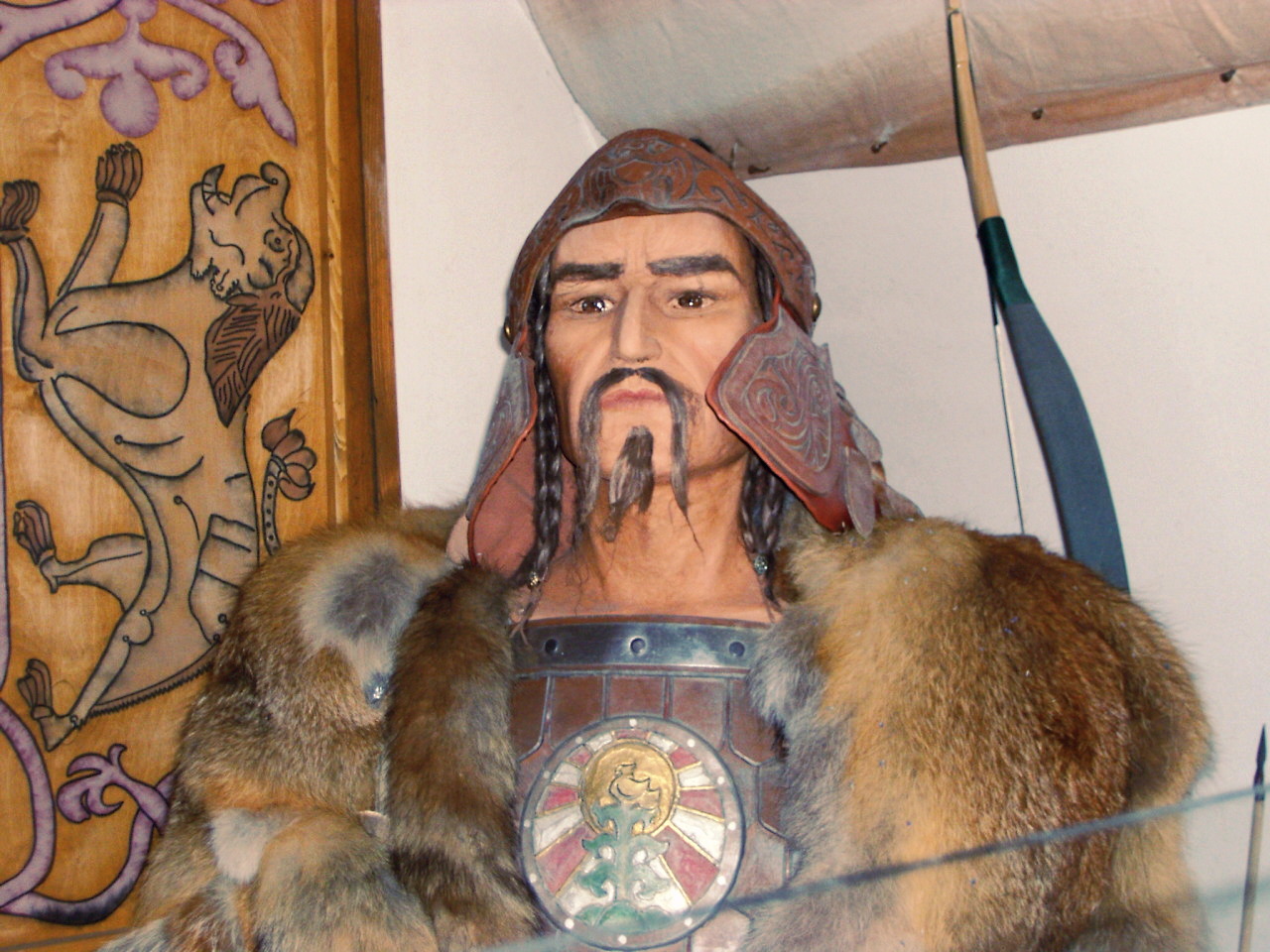
In 450, the Goths, led by their King Theodoric, invaded Gaul. Gaiseric, the King of the Vandals, sent messengers to Attila the Hun, to encourage him to attack Theodoric. While Attila’s ambition was to later invade Italy from Gaul, Gaiseric mostly wanted to use him to weaken his old enemy Theodoric.
Attila invaded Gaul and wrought much devastation there, forcing Theodoric to make an alliance with Rome. The Romans and Goths fought Attila’s army at the Battle of the Catalaunian Plains, in 451: Theodoric was killed in battle, and Attila forced to withdraw from Gaul, while the Romans won a semblance of victory.
Attila the Hun died suddenly in 453. After his death, Gaiseric became the main enemy of Rome.
The sack of Rome by the Vandals

In 455, Emperor Valentinian III, who had promised his daugther Eudocia in marriage to Gaiseric’s son Huneric, was assassinated. His murderer forced Eudocia to marry his son. Gaiseric used this as a pretext to invade Rome and sack the city. He took Eudocia, together with her mother, as a prisoner to Carthage, where she was married to Huneric.
After the Vandals left, the new King of the Goths Theodoric II imposed Avitus, a Senator of Gaulish origin whom he was close to, as the new Emperor.
Majorian: Make Rome Great Again
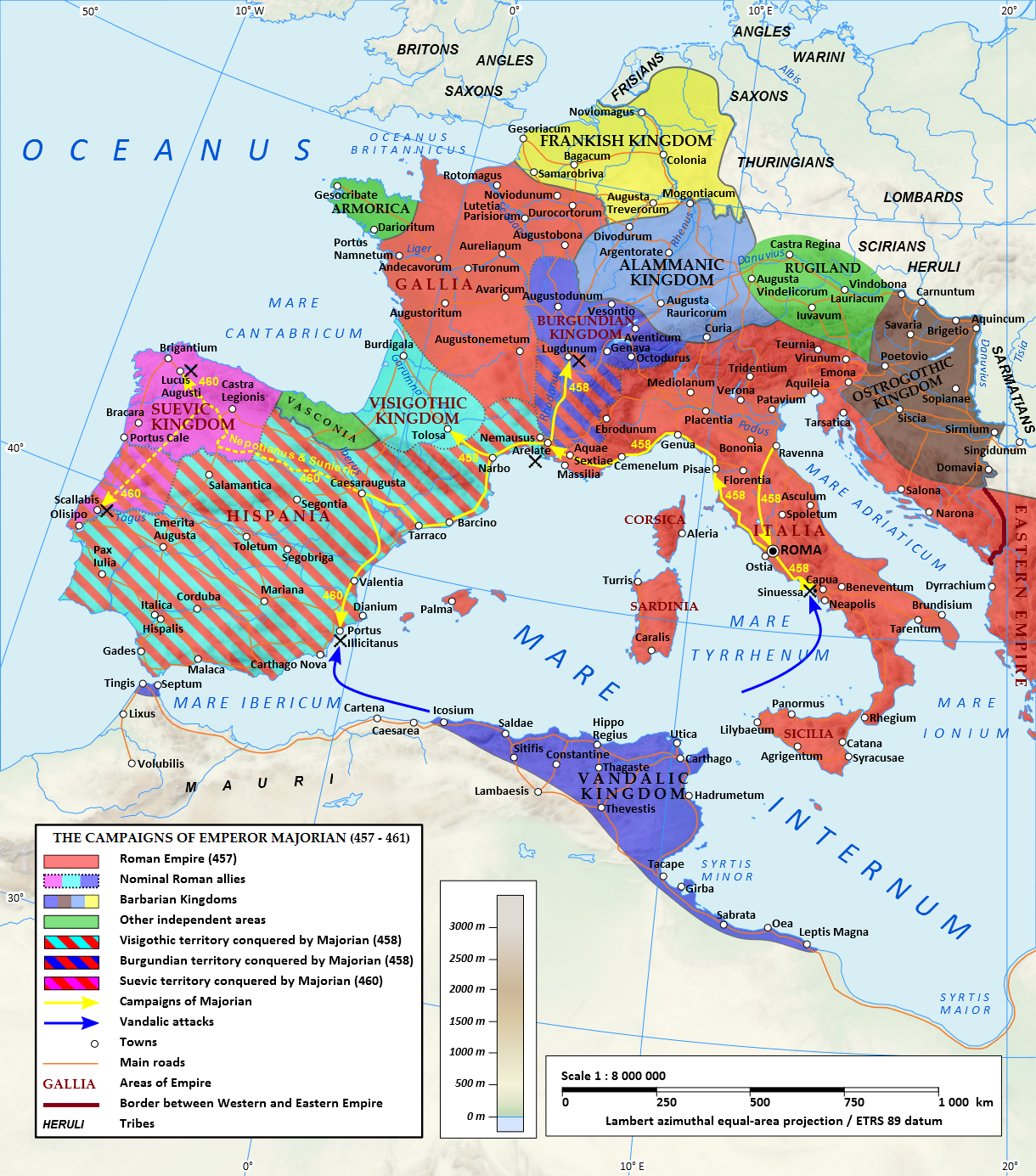
In 456, the new Emperor Majorian decided to launch a vast military campaign to reconquer the territories lost by Rome. He started by driving the Burgundians out of Southern Gaul, and then attacked the Goths in Spain. He also sent his officer Marcellinus to take back Sicily from the Vandals.
Majorian wanted to use Spain as a base to attack the Vandals in Africa. However, during his campaign in Spain, the Vandals managed to destroy the ships he was preparing for the invasion. Without a fleet, Majorian was forced to cancel his plans. In 460, he concluded a peace agreement with the Vandal King Gaiseric and dissolved his troops.
Battle of Cape Bon
After the death of Majorian in 461, the new master of the Empire was the general Ricimer, who could not become Emperor himself due to his Germanic origins. The following Emperors, Libius Severus (461-465), Anthemius (467-472) and Olybrius (472), were named by Ricimer.

In 468, the Western and Eastern Emperors came together for a military campaign to drive the Vandals out of Africa. Their army was defeated at the Battle of Cape Bon: the Vandals filled their ships with flammable materials, and then set fire to their ships and projected them against the Roman fleet. Over half the Roman fleet was burned.
After this defeat, the Western Roman Empire only controlled Italy and Sicily, and its army was more weakened than ever.
The last Emperors

Emperor Olybrius, who reigned for a few months in 472, was allied by marriage to the Vandals.
His successor Glycerius (473-474) wasn’t recognized by the Eastern Emperor Leo I, who named Julius Nepos (474-475) Emperor instead of him. The last Emperor, Romulus Augustulus (475-476), who was put on the throne while he was a child, was deposed in September 476 by the Germanic chief Odoacer: the Western Roman Empire was no more.
| What about the Eastern Empire? After the Vandal invasion, the Eastern Emperor Theodosius II sent his general Aspar to Africa, to support governor Bonifatius in his fight against the Vandals. After this, the Eastern Empire was too busy fighting the Huns to keep intervening in Africa. Even after the sack of Rome by the Vandals, Emperor Marcian didn’t try to defend the city. Marcian, who served as officer under Aspar, had been taken prisoner by the Vandals in Africa. A legend says that he was freed by Gaiseric, who predicted that he would become Emperor, and made him promise not to attack the Vandals. Things changed after Gaiseric attacked the Peloponnese in 467: the Eastern Roman Emperor Leo I, who was worried to see the Vandal fleet spreading further and further East, finally decided to intervene. His army was defeated the following year, at the Battle of Cape Bon. After this defeat, the coffers of the Empire were empty, which prevented Leo I and his successors from continuing to support the Western Empire. After the fall of the Western Roman Empire, the Eastern Roman Empire became the Byzantine Empire. In 533, the Byzantine general Belisarius, sent by Emperor Justinian, drove the Vandals out of North Africa. The Byzantines then dominated the area until the Arab conquest. |
