

Français – عربي – ⵜⴰⵎⴰⵣⵉⵖⵜ – English
When Alexander the Great, the King of Macedonia who would become one of the greatest conquerors in history, took control of Egypt, he decided to built on the Egyptian coast a new city that would carry his name: Alexandria. During the centuries after his death, under the Greek Ptolemaic dynasty, Alexandria would become the most influential Greek city.
The Greeks and Egypt | Greece had very ancient and deep ties with Egypt. Many prominent Greek thinkers, including Pythagoras, purportedly sojourned in Egypt. A Greek colony in Egypt, Naucratis, served as interaction point between the Greek and Egyptian civilisations. |
The founding of Alexandria
After young King Alexander III of Macedonia inherited from his father of a Kingdom that already dominated most of Greece, he started working on his lifetime’s ambition: conquering the Persian Empire.
When he entered Egypt, the Egyptians welcomed him triumphantly, and made him sit on the throne of the Pharaohs. In April 331, he founded a new city: Alexandria. His ambition was for this city to become the capital of his Empire, and a bridge between his native Greece and the old and prestigious Egyptian nation. He left Alexandria after a few months, never to return during his lifetime, but he would be buried there after his death.

During the following years, he kept pushing his conquests further and further. The Empire of Alexander the Great was the largest Empire in the ancient world; but it would be very short-lived: it was divided between his generals after he died at only 32 years old.
Alexandria, capital of the Ptolemy
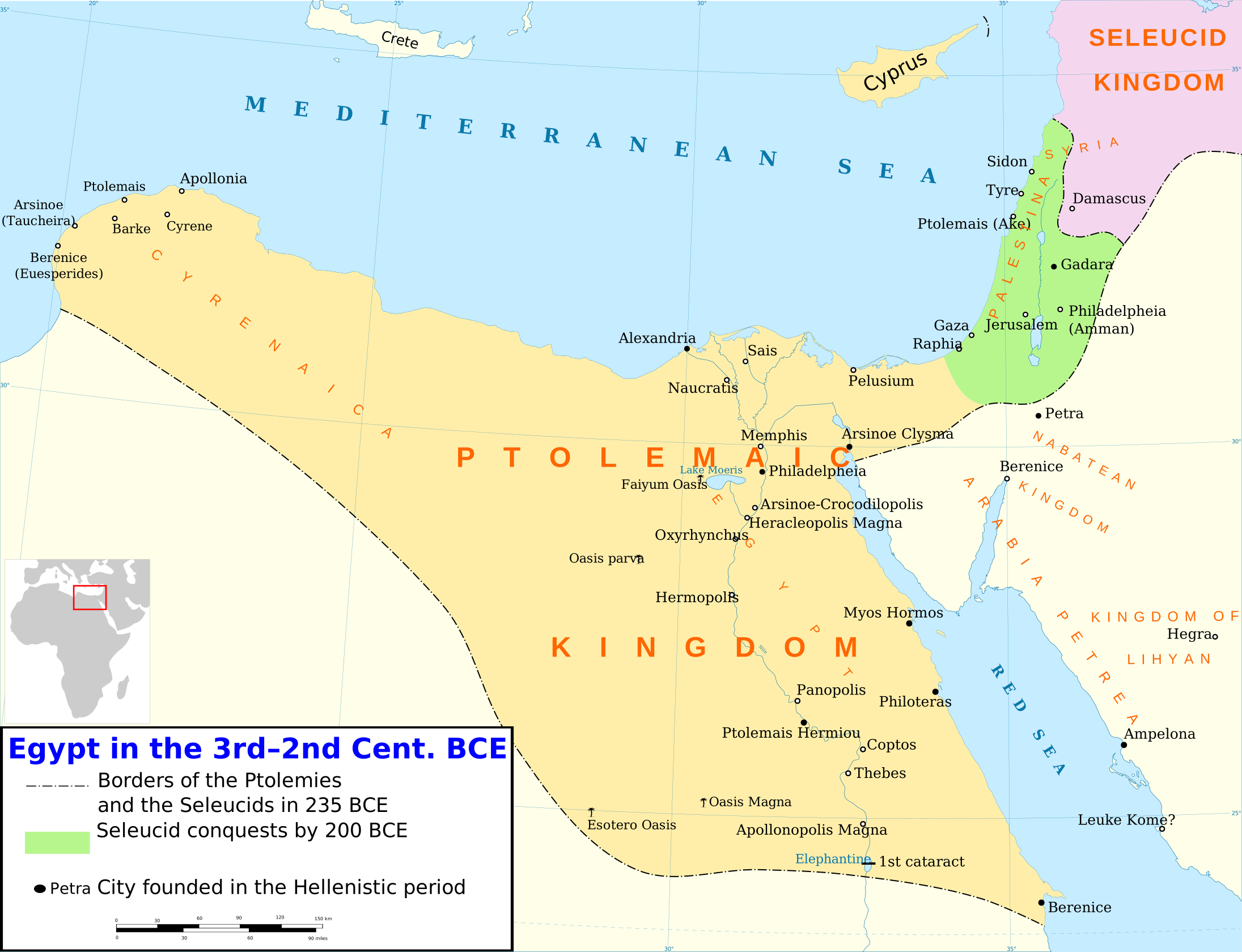
One of these generals, Ptolemy, took control of Egypt and Cyrenaica. To establish his legitimacy, he seized the body of Alexander the Great, and built him a tomb in Alexandria. Then, he proclaimed himself Pharaoh of Egypt, under the name of Ptolemy I Soter, and founded the Ptolemaic dynasty.
The Ptolemy became the real authors of Alexandria’s development. Ptolemy I Soter and his son Ptolemy II Philadelphus built the famous Lighthouse of Alexandria, one of the seven marvels of the ancient world, as well as the Heptastadion, a causeway to connect the island of Pharos to the continent.

Ptolemy II Philadelphus also built the Library of Alexandria, the largest in the ancient world. Prominent scientists, like the mathematician Euclides, the geographer Eratosthenes or the astronomer Claudius Ptolemy, worked there, while poets like Callimachus of Cyrene and Apollonios of Rhodes wrote masterpieces of Greek poetry. Ptolemy II also charged the Egyptian priest Manetho with writing a History of Egypt, in Greek language. Thanks to the Ptolemaic patronage of arts and science, Alexandria would become the cultural capital of the Greek world, contributing to the Greek linguistic and cultural influence in the whole Mediterranean basin.

The Ptolemy, claiming to be the heirs of the ancient Pharaohs, worked hard at maintaining the Egyptian traditions, while reconciling them with their Greek heritage. Ptolemy III Euergetes built the Serapeum, the largest temple in Alexandria, to the god Serapis, who was proclaimed protector of the city. The syncretistic worship of Serapis was the best example of the synthesis between Greek and Egyptian religion promoted by the Ptolemy.
Next to the Greeks and Egyptians, Alexandria also had a strong Jewish community. The Alexandrian Jews translated their sacred Scriptures into Greek. Philo, the most influential Alexandrian Jewish author, adopted the methods of Greek philosophy for the interpretation of the sacred Scriptures. Later on, Alexandria would also become an influential Christian center, and the home of the most prominent Christian theological school.
In the space of a century, Alexandria became the largest city in the Mediterranean basin. It also profited from the decline of Tyre, after its destruction by Alexander the Great, to impose itself as a new commercial port. The city would remain the capital of the Ptolemy, until Egypt was incorporated into the Roman Empire. Even during the Roman era, Alexandria was still the second-largest city of the Empire, after Rome.
