

Français – عربي – ⵜⴰⵎⴰⵣⵉⵖⵜ – English
During the first centuries of the Christian era, North Africa, from its large, cosmopolitan cities to its most remote rural areas, proved to be an especially fertile ground for the Christian Gospel. Three of the greatest Christian figures of this time were North African. In this article, we will discover the life of Augustine of Hippo, the greatest theologian of the Latin church, nicknamed the “Doctor of grace”.
His life
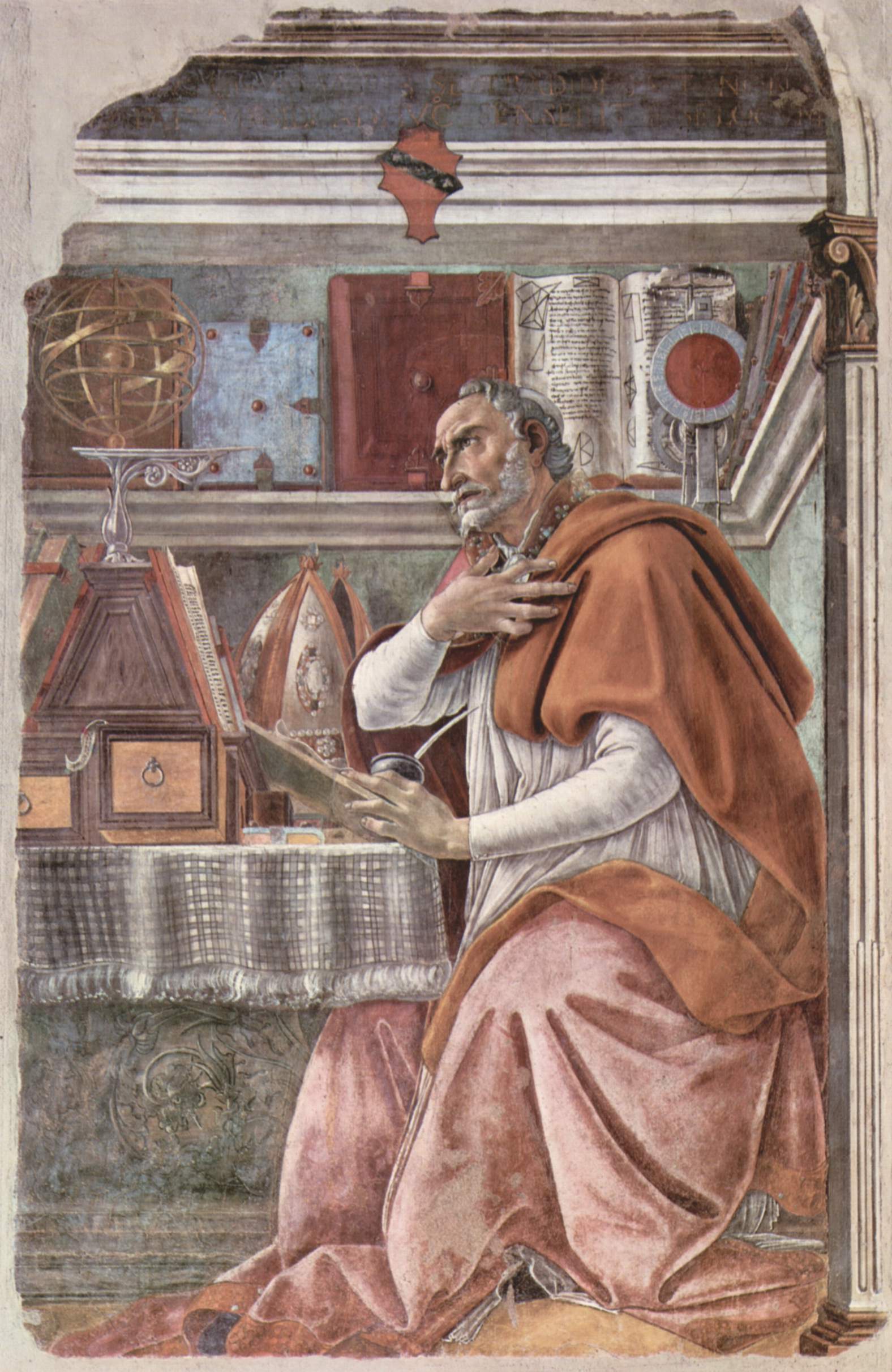
Aurelius Augustinus Hipponensis was born on 13 November 354, in Thagaste (Souk Ahras), Roman Numidia. His father Patricius, a decurion (junior officer) in the Roman army, owned a modest domain in Thagaste. His mother Monica was of Amazigh background and was a fervent Christian, while his father was a pagan.
Concerning Augustine’s ethnic background, it is generally acknowledged that his father was Roman and his mother Amazigh. His mother’s name, Monica, comes from the Amazigh language, and is the only common modern name with Amazigh roots. While Augustine’s family was strongly Romanized, he still spoke proudly of his African origins and his links with other Roman African authors, like Apuleius or Marius Victorinus. His first language was probably Latin, but he was also fluent in Lybic (Tamazight). He never became fluent in Greek, because of a difficult relationship with his Greek teacher when he was young.

At 11 years of age, his father sent him to study in Madaura (M’daourouch), where he discovered Latin literature. At the age of 17, he went to study rhetoric in Carthage. Despite his mother’s warnings, he started keeping bad company and living a dissolute life. In 372, he had a son, Adeodatus (gift of God). The child’s mother, who lived in Carthage, remained his lover for over 15 years, but he never married her.
While studying in Carthage, he read Cicero’s dialogue Hortensius, and this reading gave birth to a deep love for philosophy. Around the same time, he converted to Manichaeism, a new Eastern religion. He remained a Manichean for 10 years, before abandoning this doctrine.
In 373, he returned to Thagaste and taught rhetoric there for one year. Then, he opened his own rhetoric school in Carthage. In 383, he moved to Rome, where he was hoping to find the best rhetoricians, but he was disappointed by his students’ lack of seriousness. While in Rome, he gradually turned away from Manichaeism.
Shortly after arriving in Rome, he met Symmachus, the city prefect. In 384, he was chosen as a professor of rhetoric at the imperial court, which was based in Milan at the time. At 30 years of age, he now occupied the most prestigious academic function in the Roman world.
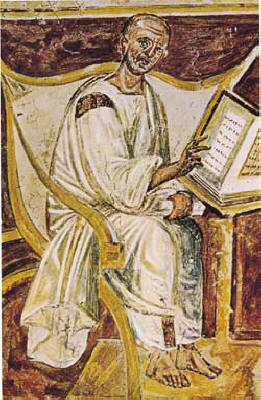
In Milan, he discovered Neoplatonism by reading Plotinus and Porphyry’s works, translated into Latin by his African countryman Marius Victorinus. He visited Ambrosius, the Christian bishop of Milan, after hearing of his reputation as a great speaker. The two men became so close that after his father died, Augustine would come to consider Ambrosius as a new father. His study of the neoplatonic philosophy and his friendship with Ambrosius led him to a serious interest in Christianity for the first time, although he had know this faith all his life, as his mother was a Christian.
Augustine’s family, who followed him to Milan, were now pushing him to find a respectable wife. For this, he first needed to separate from his lover, with whom he had a child. This separation broke his heart: while he couldn’t marry her officially due to her being of a lower social status, he saw their relationship as equivalent to marriage.
In August 386, he had a spiritual experience that led him to convert to Christianity: after hearing a child’s voice saying: “Take and read”, he opened his biblical manuscripts and read a verse of Saint-Paul’s epistle to the Romans: “Let us behave decently, as in the daytime, not in carousing and drunkenness, not in sexual immorality and debauchery, not in dissension and jealousy. Rather, clothe yourselves with the Lord Jesus Christ, and do not think about how to gratify the desires of the flesh.” He immediately committed himself to Christ.

Augustine and his son Adeodatus were baptized together at Easter of the following year, in 387. His mother, who had never stopped praying for her son’s conversion, was very happy.
After his conversion, Augustine gave up his job as a rhetorician to dedicate himself to preaching. He also decided to cancel his wedding projects and remain celibate.
In 387, after his baptism, Augustine and his family decided to return to Africa. His mother Monica died on their way back. Not long after they arrived in Thagaste, his son Adeodatus also died. Augustine, who was very much affected, sold the family domain and gave away the money to the poor. He only kept the house, and lived there with a group of Christian friends, as a spiritual community.

In 391, Augustine was ordained priest in Hippo (Annaba). He wanted to put his philosophical and rhetorical knowledge to use for deeper study and better preaching of the sacred texts. In 395, he became bishop of Hippo. He remained in this city for the rest of his life.
Shortly before Augustine’s death, the Vandals arrived in North Africa. In spring 430, they besieged Hippo. Augustine fell ill and died during the siege. He spent his last few days in prayer. After his death, the Vandals took the city and burned it completely, except for Augustine’s church and library, which they left intact. Saint-Augustine’s Basilica, in Annaba, was built in 1881, close to the remains of his church.
Works

Apart for Christ and the apostles themselves, noone else had such a strong impact on the Christian church as the North African Augustine of Hippo.
He started writing immediately after his conversion. After he returned to Africa, he wrote several books criticizing the Manicheans, to fight this new religion’s growing influence. As the bishop of Hippo, he had a series of public debates with the city’s Manichean community. He also wrote a book to refute Faustus of Milevis, the leader of the Manicheans in Africa, whom he had known in Carthage back when he was a Manichean himself.
His two main works are The Confessions and The City of God.
The Confessions, written around the year 400, is the story of his life. In this book, he examines his spiritual journey, until his conversion. This book can be considered as the first autobiography in history. Its particularity, however, is that it addresses God directly: to him the author confesses his life, his faults, his wanderings, and the lessons he learned from it all.
The City of God is by far Augustine’s most influential writing. This work in 22 books, written over a period of 14 years, describes his view of an ideal Christian society, based on divine law. Even more than in his other works, he abundantly quotes Greek-Roman classical authors, in order to show how the Christian teaching surpasses them all.
He also wrote biblical commentaries, doctrinal books (On Christian doctrine), philosophical books, and polemical books against various Christian heresies and against the Jews.
Finally, he is famous just as much for his sermons as for his written works: he preached around 6.000 sermons in his lifetime, 500 of them are still available today.
The Egyptian film director Samir Seif produced the movie Augustine: son of her tears, on the life of Augustine, in partnership with the Algerian Ministry of Culture. The title is a reference to the tears of Augustine’s mother when she was praying for her son’s conversion. The main role is played by the Algerian actor Imad Benchenni. We are sharing this movie here.

1 thought on “The three great North African Christian figures: Augustine of Hippo, the Doctor of Grace”