Christianity in North Africa, The three great North African Christian figures

The three great North African Christian figures: Augustine of Hippo, the Doctor of Grace

Français – عربي – ⵜⴰⵎⴰⵣⵉⵖⵜ – English

During the first centuries of the Christian era, North Africa, from its large, cosmopolitan cities to its most remote rural areas, proved to be an especially fertile ground for the Christian Gospel. Three of the greatest Christian figures of this time were North African. In this article, we will discover the life of Augustine of Hippo, the greatest theologian of the Latin church, nicknamed the “Doctor of grace”.

His life
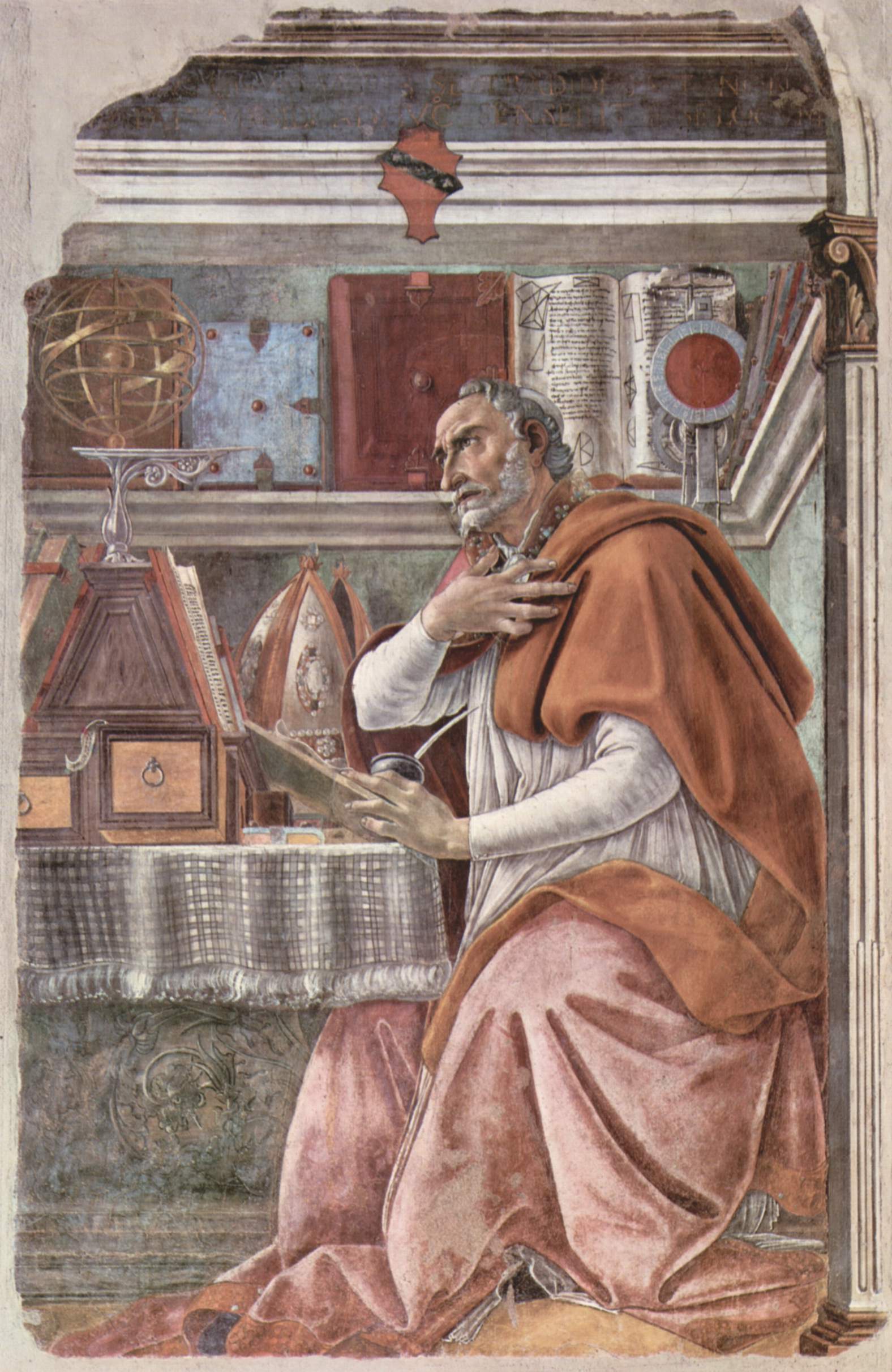
Augustine of Hippo

Aurelius Augustinus Hipponensis was born on 13 November 354, in Thagaste (Souk Ahras), Roman Numidia. His father Patricius, a decurion (junior officer) in the Roman army, owned a modest domain in Thagaste. His mother Monica was of Amazigh background and was a fervent Christian, while his father was a pagan.

Concerning Augustine’s ethnic background, it is generally acknowledged that his father was Roman and his mother Amazigh. His mother’s name, Monica, comes from the Amazigh language, and is the only common modern name with Amazigh roots. While Augustine’s family was strongly Romanized, he still spoke proudly of his African origins and his links with other Roman African authors, like Apuleius or Marius Victorinus. His first language was probably Latin, but he was also fluent in Lybic (Tamazight). He never became fluent in Greek, because of a difficult relationship with his Greek teacher when he was young.

Young Augustine at school, by Niccolo di Pietro

At 11 years of age, his father sent him to study in Madaura (M’daourouch), where he discovered Latin literature. At the age of 17, he went to study rhetoric in Carthage. Despite his mother’s warnings, he started keeping bad company and living a dissolute life. In 372, he had a son, Adeodatus (gift of God). The child’s mother, who lived in Carthage, remained his lover for over 15 years, but he never married her.

While studying in Carthage, he read Cicero’s dialogue Hortensius, and this reading gave birth to a deep love for philosophy. Around the same time, he converted to Manichaeism, a new Eastern religion. He remained a Manichean for 10 years, before abandoning this doctrine.

In 373, he returned to Thagaste and taught rhetoric there for one year. Then, he opened his own rhetoric school in Carthage. In 383, he moved to Rome, where he was hoping to find the best rhetoricians, but he was disappointed by his students’ lack of seriousness. While in Rome, he gradually turned away from Manichaeism.

Shortly after arriving in Rome, he met Symmachus, the city prefect. In 384, he was chosen as a professor of rhetoric at the imperial court, which was based in Milan at the time. At 30 years of age, he now occupied the most prestigious academic function in the Roman world.
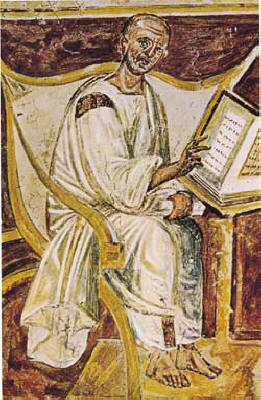
Oldest known portrait of Augustine, 6th Century, Rome

In Milan, he discovered Neoplatonism by reading Plotinus and Porphyry’s works, translated into Latin by his African countryman Marius Victorinus. He visited Ambrosius, the Christian bishop of Milan, after hearing of his reputation as a great speaker. The two men became so close that after his father died, Augustine would come to consider Ambrosius as a new father. His study of the neoplatonic philosophy and his friendship with Ambrosius led him to a serious interest in Christianity for the first time, although he had know this faith all his life, as his mother was a Christian.

Augustine’s family, who followed him to Milan, were now pushing him to find a respectable wife. For this, he first needed to separate from his lover, with whom he had a child. This separation broke his heart: while he couldn’t marry her officially due to her being of a lower social status, he saw their relationship as equivalent to marriage.

In August 386, he had a spiritual experience that led him to convert to Christianity: after hearing a child’s voice saying: “Take and read”, he opened his biblical manuscripts and read a verse of Saint-Paul’s epistle to the Romans: “Let us behave decently, as in the daytime, not in carousing and drunkenness, not in sexual immorality and debauchery, not in dissension and jealousy. Rather, clothe yourselves with the Lord Jesus Christ, and do not think about how to gratify the desires of the flesh.” He immediately committed himself to Christ.

Baptism of Augustine, by Benozzo Gozzoli

Augustine and his son Adeodatus were baptized together at Easter of the following year, in 387. His mother, who had never stopped praying for her son’s conversion, was very happy.

After his conversion, Augustine gave up his job as a rhetorician to dedicate himself to preaching. He also decided to cancel his wedding projects and remain celibate.

In 387, after his baptism, Augustine and his family decided to return to Africa. His mother Monica died on their way back. Not long after they arrived in Thagaste, his son Adeodatus also died. Augustine, who was very much affected, sold the family domain and gave away the money to the poor. He only kept the house, and lived there with a group of Christian friends, as a spiritual community.

Saint-Augustine Basilica, Annaba

In 391, Augustine was ordained priest in Hippo (Annaba). He wanted to put his philosophical and rhetorical knowledge to use for deeper study and better preaching of the sacred texts. In 395, he became bishop of Hippo. He remained in this city for the rest of his life.

Shortly before Augustine’s death, the Vandals arrived in North Africa. In spring 430, they besieged Hippo. Augustine fell ill and died during the siege. He spent his last few days in prayer. After his death, the Vandals took the city and burned it completely, except for Augustine’s church and library, which they left intact. Saint-Augustine’s Basilica, in Annaba, was built in 1881, close to the remains of his church.

Works

Manuscript of The City of God

Apart for Christ and the apostles themselves, noone else had such a strong impact on the Christian church as the North African Augustine of Hippo.

He started writing immediately after his conversion. After he returned to Africa, he wrote several books criticizing the Manicheans, to fight this new religion’s growing influence. As the bishop of Hippo, he had a series of public debates with the city’s Manichean community. He also wrote a book to refute Faustus of Milevis, the leader of the Manicheans in Africa, whom he had known in Carthage back when he was a Manichean himself.

His two main works are The Confessions and The City of God.
Manuscript of The Confessions

The Confessions, written around the year 400, is the story of his life. In this book, he examines his spiritual journey, until his conversion. This book can be considered as the first autobiography in history. Its particularity, however, is that it addresses God directly: to him the author confesses his life, his faults, his wanderings, and the lessons he learned from it all.

The City of God is by far Augustine’s most influential writing. This work in 22 books, written over a period of 14 years, describes his view of an ideal Christian society, based on divine law. Even more than in his other works, he abundantly quotes Greek-Roman classical authors, in order to show how the Christian teaching surpasses them all.

He also wrote biblical commentaries, doctrinal books (On Christian doctrine), philosophical books, and polemical books against various Christian heresies and against the Jews.

Finally, he is famous just as much for his sermons as for his written works: he preached around 6.000 sermons in his lifetime, 500 of them are still available today.

The Egyptian film director Samir Seif produced the movie Augustine: son of her tears, on the life of Augustine, in partnership with the Algerian Ministry of Culture. The title is a reference to the tears of Augustine’s mother when she was praying for her son’s conversion. The main role is played by the Algerian actor Imad Benchenni. We are sharing this movie here.

Christianity in North Africa, The three great North African Christian figures

The three great North African Christian figures: Cyprian, bishop of Carthage

Français – عربي – ⵜⴰⵎⴰⵣⵉⵖⵜ – English

During the first centuries of the Christian era, North Africa, from its large, cosmopolitan cities to its most remote rural areas, proved to be an especially fertile ground for the Christian Gospel. Three of the greatest Christian figures of this time were North African. In this article, we will discover the life of Cyprian, the greatest bishop of Carthage.

Cyprian of Carthage

Thascius Caecilius Cyprianus was born in Carthage, around 210, in a wealthy family of Amazigh origins. As a young man, he studied law, became a lawyer, and taught rhetoric. Before his conversion, he was known as an influential member of a Carthaginian legal fraternity.

He became a Christian around 35 years of age. After his baptism, he sold his house and gave the money to the poor, following church teaching for rich believers. His friends were so impressed by this that they bought back the house and returned it to him.

Two years after his conversion, around 248, the bishop of Carthage died and Cyprian was chosen to succeed him. He originally refused, as he saw himself as unworthy of this responsibility, but then finally accepted. While he was very popular with the faithful, the Carthaginian clergy disapproved the nomination of a recent convert, who hadn’t served with them for many years. They would continue to oppose him during his episcopate. Despite this, Cyprian became one of the most influential bishops of his time.

Shortly after his nomination, persecution broke out: the new Emperor Decius ordered all his subjects to sacrifice to the Roman gods, leaving Christians the choice between denying their faith or martyrdom. Cyprian went into hiding, while still writing letters encouraging the believers to stand firm in their faith. When accused of being a coward, he argued that he hadn’t fled to save his own life, but so that the believers would not remain without a shepherd in the middle of persecution.

After each wave of persecution, the Christian church was faced with a difficult decision: what should be done of the lapsi (“fallen”), the believers who had given in to pressure and denied their faith, but who now regretted it and wished to be restored by the church? To find an agreement, Cyprian decided to convene a church council, bringing together all the bishops in Roman Africa to discuss this issue. The council chose a middle way between the more lenient party, who wished to immediately restore the lapsi as soon as they repented, and the intransigent party, who refused any possibility of restoration: the lapsi would need to undergo a longer or shorter time of penance, during which their bishop would follow up with them, to make sure that they were sincere. This decision allowed Cyprian and the other bishops to manage each situation on a case by case basis. Cyprian specifically insisted on the distinction between those who recanted to save their life, their family, or to escape torture, and those who sacrificed to the idols of their own free will, while they were not in danger. The council also ruled that those who repented and were restored would never again be allowed to have responsibilities in the church.

At this time, groups of Christians who disagreed with Cyprian, on the lapsi or on other issues, started meeting outside the official church. For Cyprian, those schismatics broke the unity of the Church and thus separated themselves from the truth, as he wrote in one of his main books, On the unity of the Church : “Nobody can have God as a father if he does not also have the Church as a mother.” For this reason, he chose to re-baptize believers who left those independent churches to join the established church, because he believed that baptisms administered outside the established church were invalid. On this issue, he got in conflict with bishop Stephen of Rome, who held the view that those believers were already baptized and thus could be immediately admitted into the established church. Cyprian defended his position firmly, both out of doctrinal conviction and because he refused to let another bishop impinge on his prerogatives.

Cyprian’s position on this issue is based on his understanding of the Church as a sacred institution established by Christ himself, from which one could not separate oneself without incurring God’s wrath. He did not distinguish the universal Church, composed of all believers worldwide, and the institutional church, with its bishops and administrative structures. Cyprian’s teaching remains fundamental to Catholic theology today.

Cyprian also played a major role in church institutionalization: while before, Christian churches were rather informal assemblies where every member could contribute according to his gifts, Cyprian put in place a hierarchy and structured administration, strongly inspired from Roman administration, with at its head the bishop, seen as Christ’s representative. However, Cyprian strongly believed in the autonomy of the church in every city and region: he saw all bishops as equals and believed none of them had authority over others, not even the bishop of a great city like Carthage over other African bishops. His conflict with Stephen of Rome shows that he would have refused any claim by the bishop of the imperial capital to the status of universal bishop.

Apart from persecution, Cyprian’s episcopate was marked by another major crisis: the plague. While the population of Carthage and the whole Empire was decimated, Cyprian and the Christians in the city were helping the sick, whether they were Christian or not. Cyprian also wrote a book, On mortality, to explain why God allows men to be hit by such epidemics. Cyprian’s behavior during the plague contributed a lot to his popularity.

St-Cyprian Basilica, in Carthage, was built on the site where Cyprian was martyred

By the end of 256, persecution started again. Cyprian appeared before the Roman proconsul, and refused to deny his faith by sacrificing to idols. He was exiled to Curubis (Korba), from where he continued to encourage and comfort the faithful. After one year, he was allowed to return to Carthage, only to be imprisoned in his own house. Finally, after a new imperial edict ordering the execution of all Christian bishops was published, he was condemned to be beheaded, and publicly executed on 14 September 258. A large crowd had come together for his execution, to honor him. Before he died, he gave 25 gold coins to his executioner.

Christianity in North Africa, The three great North African Christian figures

The three great North African Christian figures: Tertullian, the father of the Latin church

Français – عربي – ⵜⴰⵎⴰⵣⵉⵖⵜ – English

During the first centuries of the Christian era, North Africa, from its large, cosmopolitan cities to its most remote rural areas, proved to be an especially fertile ground for the Christian Gospel. Three of the greatest Christian figures of this time were North African. In this article, we will discover the life of Tertullian of Carthage, the first Latin Christian writer.

Quintus Septimius Florens Tertullianus was born around 155 in Carthage. His nomen (family name) Septimius shows that he was from the gens Septimia, a prominent Romanized African family, which means he was distantly related to the Emperor Septimius Severus. His father was a centurion in the Roman army. His ethnic background is debated: while he describes himself as “Punic among the Romans”, many Amazigh in the area of Carthage had adopted the Punic language and culture. Anyway, while his family was Romanized and he studied in Latin, he was not of Roman blood.

Tertullian studied Roman law in Carthage, to become a lawyer and a rhetorician. At this time, Roman Africa was famous for its great rhetoricians.

He became a Christian around 197-198, at about 40 years of age. The circumstances of his conversion are unknown, but the way he refers to it in his writings shows that it was sudden and radical. Two of his books are addressed to his wife, who was also a Christian, maybe already before him.

After his conversion, he decided to put his talents as a writer and rhetorician at the service of his faith. He wrote over 30 books, both for a pagan public, as a defense of Christianity (Apologetica, To the nations), and to a Christian public, on doctrinal questions (Concerning baptism, Concerning prayer) and moral issues (Concerning spectacles, Concerning modesty), as well as refutations of various heresies (Against Marcion, Against Valentinian). His fiery writing style reflects his passionate character. He was the first Christian writer to write in the Latin language. He also was the first to use the term “Trinity”.

Close to the end of his life, Tertullian was drawn to the teaching of Montanism, a Christian movement that was later considered heretical. His later works show a strict moral rigor, characteristic of the Montanists. Among other things, he was against the remarriage of widows, as he believed it was adultery against the dead spouse. More surprising: in his book On the veiling of the virgins, he mentions the full-face veil, which was already carried by Arab women at his time, several centuries before Islam1. Tertullien, far from finding this strange, admires them, and seems almost to encourage Christian women to imitate them! Of course this teaching was not at all typical of Christianity at this time: Tertullian’s opinion was very marginal.

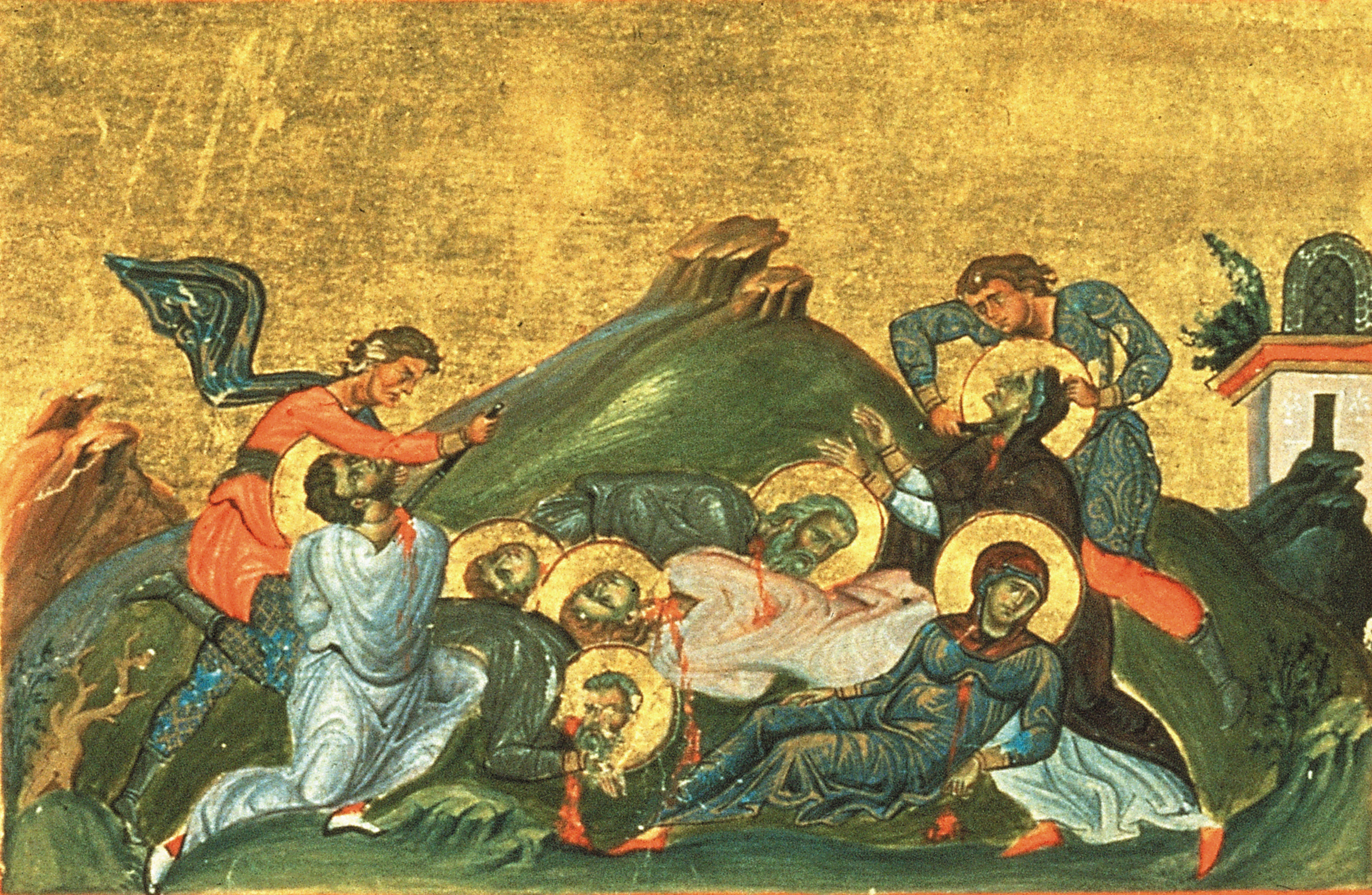
Martyrdom of Perpetua and Felicity

Tertullian’s most famous quote is: “The blood of the martyrs is the seed of the church.” Tertullian witnessed the death of many Christian men and women, some of them in Carthage, who were ready to sacrifice their life rather than denying their faith. He also saw how their unshakable faith impressed all those who saw them and won new souls to their faith.

  1. “Arabia’s heathen females will be your judges, who cover not only the head, but the face also, so entirely, that they are content, with one eye free, to enjoy rather half the light than to prostitute the entire face. A female would rather see than be seen. And for this reason a certain Roman queen [Messalina, wife of Roman emperor Claudius] said that they were most unhappy, in that they could more easily fall in love than be fallen in love with; whereas they are rather happy in their immunity from that second (and indeed more frequent) infelicity, that females are more apt to be fallen in love with than to fall in love. And the modesty of heathen discipline, indeed, is more simple, and, so to say, more barbaric.” (On the veiling of virgins, chapter 17) ↩︎