

Français – عربي – ⵜⴰⵎⴰⵣⵉⵖⵜ – English
During the first centuries of the Christian era, North Africa, from its large, cosmopolitan cities to its most remote rural areas, proved to be an especially fertile ground for the Christian Gospel. Three of the greatest Christian figures of this time were North African. In this article, we will discover the life of Tertullian of Carthage, the first Latin Christian writer.

Quintus Septimius Florens Tertullianus was born around 155 in Carthage. His nomen (family name) Septimius shows that he was from the gens Septimia, a prominent Romanized African family, which means he was distantly related to the Emperor Septimius Severus. His father was a centurion in the Roman army. His ethnic background is debated: while he describes himself as “Punic among the Romans”, many Amazigh in the area of Carthage had adopted the Punic language and culture. Anyway, while his family was Romanized and he studied in Latin, he was not of Roman blood.
Tertullian studied Roman law in Carthage, to become a lawyer and a rhetorician. At this time, Roman Africa was famous for its great rhetoricians.
He became a Christian around 197-198, at about 40 years of age. The circumstances of his conversion are unknown, but the way he refers to it in his writings shows that it was sudden and radical. Two of his books are addressed to his wife, who was also a Christian, maybe already before him.
After his conversion, he decided to put his talents as a writer and rhetorician at the service of his faith. He wrote over 30 books, both for a pagan public, as a defense of Christianity (Apologetica, To the nations), and to a Christian public, on doctrinal questions (Concerning baptism, Concerning prayer) and moral issues (Concerning spectacles, Concerning modesty), as well as refutations of various heresies (Against Marcion, Against Valentinian). His fiery writing style reflects his passionate character. He was the first Christian writer to write in the Latin language. He also was the first to use the term “Trinity”.
Close to the end of his life, Tertullian was drawn to the teaching of Montanism, a Christian movement that was later considered heretical. His later works show a strict moral rigor, characteristic of the Montanists. Among other things, he was against the remarriage of widows, as he believed it was adultery against the dead spouse. More surprising: in his book On the veiling of the virgins, he mentions the full-face veil, which was already carried by Arab women at his time, several centuries before Islam1. Tertullien, far from finding this strange, admires them, and seems almost to encourage Christian women to imitate them! Of course this teaching was not at all typical of Christianity at this time: Tertullian’s opinion was very marginal.
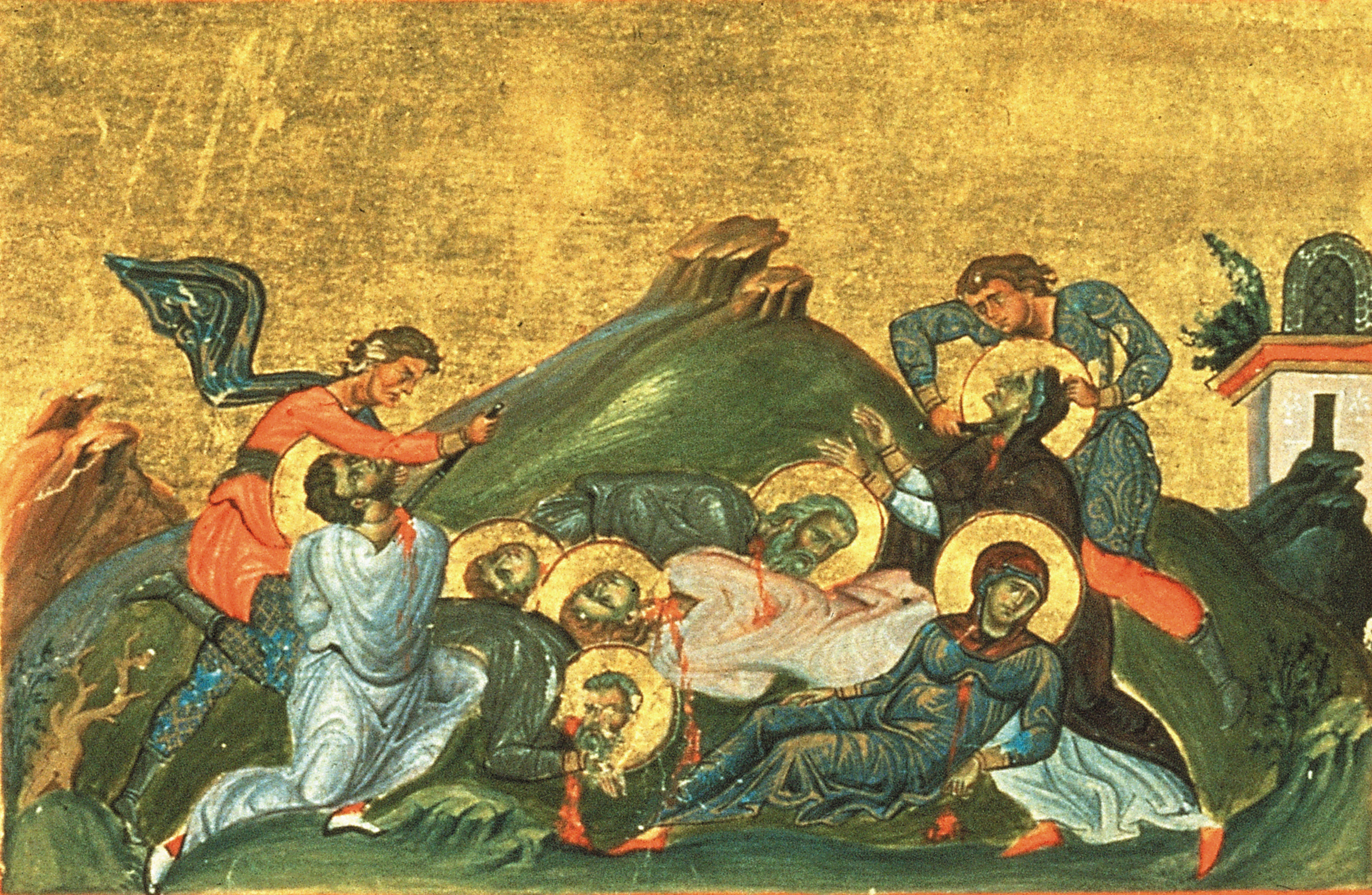
Tertullian’s most famous quote is: “The blood of the martyrs is the seed of the church.” Tertullian witnessed the death of many Christian men and women, some of them in Carthage, who were ready to sacrifice their life rather than denying their faith. He also saw how their unshakable faith impressed all those who saw them and won new souls to their faith.
- “Arabia’s heathen females will be your judges, who cover not only the head, but the face also, so entirely, that they are content, with one eye free, to enjoy rather half the light than to prostitute the entire face. A female would rather see than be seen. And for this reason a certain Roman queen [Messalina, wife of Roman emperor Claudius] said that they were most unhappy, in that they could more easily fall in love than be fallen in love with; whereas they are rather happy in their immunity from that second (and indeed more frequent) infelicity, that females are more apt to be fallen in love with than to fall in love. And the modesty of heathen discipline, indeed, is more simple, and, so to say, more barbaric.” (On the veiling of virgins, chapter 17) ↩︎
