

Français – عربي – ⵜⴰⵎⴰⵣⵉⵖⵜ – English
Following the Roman conquest of North Africa, many figures of North African origin, from families of the Romanized Amazigh elite, assumed responsibilities in the imperial administration. Close to the end of the 2nd Century, one of them, Septimius Severus, became the first Roman Emperor of African origin.
Origins and youth
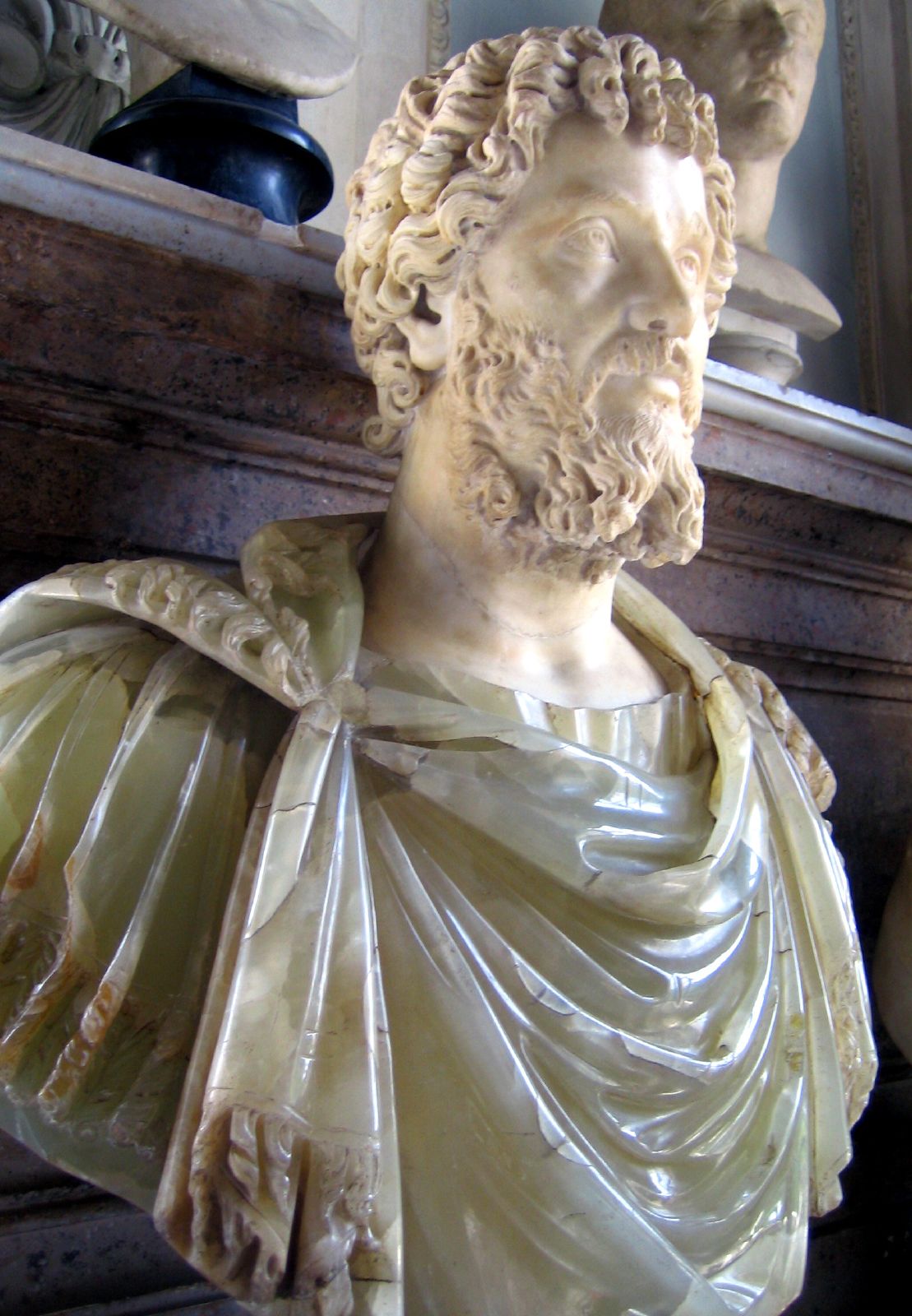
Septimius Severus was born on 11 April 145, in Leptis Magna, Roman Libya. His father had Amazigh origins, while his mother was from a noble Roman family that had settled in Africa. Septimius Severus grew up in Leptis Magna, speaking Punic, Latin and Greek fluently.
In 162, young Septimius Severus went to pursue a career in Rome, where cousins of his father had already served as consuls. On the recommendation of one of them, Emperor Marcus Aurelius granted him the senatorial rank, enabling him to start his Cursus honorum, the course required for a young man wishing to have responsibilities in the Imperial administration. He became State prosecutor (Advocatus fisci).

In 166, he returned to Leptis Magna, and waited there until he reached the minimum age of 25 required to be a Quaestor. Back in Rome in 169, he became a Quaestor and was elected Senator. In 173, his cousin was named governor of Roman Africa, and made him his legate, a prestigious military function. He later returned to Rome, where he became Tribune of the Plebs.
Around 175, he got married to Paccia Marciana, a woman from Leptis Magna, who died in 186. He then married Julia Domna, a Syrian woman from the royal dynasty of Emesa (Homs), who would become his Empress. Meanwhile, he pursued his career in the army and became governor of several provinces, including Gaul, where his son Caracalla was born.
Rise to power

In December 192, Emperor Commodus was assassinated. His successeur, the influential Senator Pertinax, was the political patron of Septimius Severus, who promoted his career by recommending him for various administrative posts. Pertinax was also killed after reigning for three months. The Praetorian Guard then decided to sell the Imperial throne to the rich Senator Didius Julianus. The army was scandalized to see the throne sold to the highest bidder, and revolted. In the chaos that followed, several soldiers claimed the Imperial throne.
When Septimius Severus heard that Pertinax had been killed, he decided to avenge him. He marched on Rome at the head of his troops, took control of the city without opposition and had Didius Julianus executed. He then made an alliance with Albinus, the governor of Roman Britain (who also had African origins), against his other military rivals. Once he was firmly established on his throne, he had Albinus killed, and became the sole master of Rome.
Septimius Severus was not only the first Roman Emperor of African origin, but also the first Emperor who hailed from the provinces, and not from Rome itself.
Reign of Septimius Severus

During the reign of Septimius Severus, Roman African power in the Imperial administration was at its highest. The Emperor favored the emergence of a new Roman African elite by naming many Africans to important positions. He also made Tripolitania, his native region, a full Roman province, and conferred the status of Roman colony to the city of Utica. Finally, he build several prestigious monuments in Leptis Magna.
Septimius Severus is described by several Christian authors as a ferocious persecutor of the Christians in his Empire. While the Christians’ plight did get worse during his reign, with several persecutions, those were mostly initiated by local authorities, not an Empire-wide policy. The African Christian writer Tertullian of Carthage claims that Septimius Severus had a Christian medical doctor at his court, and that the nurse of his sons was a Christian. The Christian civil servant Julius Africanus served under his administration without getting into trouble for his faith.
Conquests
During his reign, Septimius Severus led several military campaigns to conquer new territories. When he died, the Roman Empire’s territory had reached the largest extent in all its history. However, most of his conquests would soon be lost again.
In 197, Septimius Severus launched a military campaign against the Persian Empire. He took control of Ctesiphon, the Persian capital, and pillaged and annexed the Northern half of Mesopotamia, extending the Roman borders further East than ever before. The kings of Osroene and Armenia paid him tribute and became his vassals.

After his victory against the Persians, Septimius Severus wanted to secure the Southern border of his Empire, in his native Africa, which was facing recurring attacks by Amazigh tribes. In 202, he conquered Garama, the capital of the Garamantes, and took control of their territory. He also enlarged the territory of Roman Numidia by conquering new territories. Finally, he fortified the whole Southern border.
In 208, Septimius Severus traveled to Britain, aiming to conquer Caledonia (modern-day Scotland) and become the first Roman Emperor to take control of the whole island. He won several victories and would certainly have succeeded if he hadn’t fallen ill in the middle of his campaign. He died in 211, in Britain.
Succession
After Septimius Severus’ death, his sons Caracalla and Geta succeeded him. While Septimius Severus wanted them to reign together, they showed themselves unable to share power. Finally, Caracalla had Geta assassinated and reigned alone.
