

Français – عربي – ⵜⴰⵎⴰⵣⵉⵖⵜ – English
Julius Africanus was a Roman African soldier, diplomat and writer, who professed the Christian religion, and served in the administration of the Roman Emperor Septimius Severus and his successors. While he served under pagan Roman Emperors, his skills were so valuable for his masters that he was never troubled for his faith.
Life of Julius Africanus

Sextus Julius Africanus was born around 160, in Aelia Capitolina, the new Roman city built on the site of Jerusalem. At the time, after the Romans had expelled the Jews from Palestine, new populations from all over the Empire were moving there. Julius Africanus’ family, who hailed from Roman Africa, were part of this migration.
As a young man, Julius Africanus joined the Roman army. As a military officer, he took part in Emperor Septimius Severus‘ campaign against the Persians. Septimius Severus, who was of North African origin himself, wished to promote a new Roman-African elite, of which Julius Africanus was a member.
At some point in his life, we don’t know exactly when, Julius Africanus converted to Christianity, a religion that was still a small minority at the time. After his conversion, he moved to Alexandria, to study at the Christian theological school there. Julius Africanus represents a new Christian elite, who had received an excellent education and showed perfect knowledge of their Greek-Roman cultural heritage. While he served under Emperors who were known for their hostility toward Christianity, he was never troubled for his faith.

In 212, the new Emperor Caracalla entrusted him the most important mission of his lifetime: he named him Ambassador to the Kingdom of Osrhoene. King Abgar VIII of Osrhoene had just died, and his son and successor Abgar IX had grown up as a hostage in Rome. The main role of the Roman Ambassador was to give account to Rome on the new king’s loyalty. Also, since Abgar VIII’s conversion around 200, Osrhoene had become the first officially Christian nation in history, over a century before Rome. This certainly influenced the Emperor’s choice of the Christian Julius Africanus as his Ambassador.
During his time in Edessa (Şanlıurfa, modern-day Turkey), the capital of Osrhoene, Julius Africanus could devote himself fully to his passion: scientific and literary research. The city was a major Syriac cultural center, as well as a major Christian theological center. There, Julius Africanus met Bardaisan, the first known Syriac-language writer, who wrote both philosophical and historical books. He also traveled further, to Persia.
In 213, Abgar IX was ordered to Rome and killed by Caracalla, allowing the Roman Empire to take over Osrhoene. Julius Africanus moved to Palestine, where he devoted himself to writing.
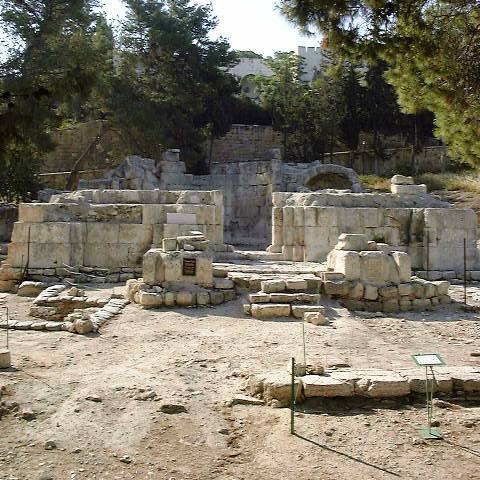
Little is known of his life after leaving Edessa. We don’t know if he took part in Caracalla’s military campaign against the Persians, in 218. He wrote a letter to the Christian theologian Origen of Alexandria, in which we calls him “my son”. He led an embassy of citizens of the city of Emmaus, where he was living, to the Emperor Elagabalus (218-222), in order to ask for the restoration of their city; the city would indeed be restored, and renamed Nicopolis. One of his works, the Kestoi, is dedicated to Emperor Severus Alexander (222-235). Under his reign, he apparently opened a public library at the Pantheon in Rome. He died during the reign of Emperor Gordian (238-244).
Works
Julius Africanus was fluent in Greek, Latin, Punic, Hebrew, and Syriac. He wrote in Greek.
His writings are mostly historical. He wrote a chronicle of world history, from its creation; the first universal chronicle, covering the history of all mankind, while previous chroniclers all wrote about one specific people group. He also was the first writer on history in a Christian perspective, and he strongly influenced Christian historians after him.

Julius Africanus’ Chronicle includes a list of winners of the Olympic Games, over almost 1.000 years of time, from the First (776 BCE) to the 249th Olympiad (217 CE). This is the only known full list of winners of the Olympic Games still available today.
Another important work are the Kestoi, an encyclopedia of all knowledge, in many diverse fields, from agriculture to natural science to military strategy. In this book, the parts on the art of war are especially surprising: to him, the ends justify the means, and the only thing that counts is a method’s efficiency, not its morality. He condones methods like poisoning wells and scorched earth policies to achieve victory. The violence of the methods he describes might be the reason why latter Christian authors, who were shocked by what he wrote, didn’t use the Kestoi much.
