Ce site présente l'histoire de l'Afrique du Nord avant les conquêtes arabes – This website presents the history of North Africa before the Arab conquests – يعرض هذا الموقع تاريخ شمال إفريقيا قبل الفتوحات العربية
Category: From Antiquity to Middle Age: cultural bridgebuilders
Several authors of Late Antiquity (5th-6th Centuries) played an especially important role in the preservation of the ancient Greco-Roman cultural heritage, especially classical literature, through the crises that shook the Roman world in this era. Those authors were highly popular in the Western world in the Middle Age, as until the original classical texts were rediscovered at the Renaissance, the wisdom of the ancient world was known only through them. Several of these authors, including Macrobius, were from Roman Africa, while others, like Boethius and Cassiodorus, had links with North Africa. This article is the summary of our series on the cultural bridge-builders.
The three main cultural bridge-builders: Macrobius, Boethius and Cassiodorus
Cassiodorus was a statesman, philosopher and theologian of Roman origin, who served at the court of the Ostrogothic Kingdom of Italy. As an official of King Theodoric the Great and his successor Athalaric, he was in charge of diplomatic relations with the Vandal Kingdom of Carthage. After the Byzantine reconquest of Italy, he settled in Constantinople, where he played a major role in popularizing Western Christian theologians like Augustine of Hippo in the Eastern regions of the ancient Roman world.
Origins and career
Magnus Aurelius Cassiodorus Senator was born around 490, in Scylletium (close to Catanzaro), Southern Italy. Senator was not a title, but part of his name. His family was of Syrian origin, and had held high responsibilities for several generations: his great-grandfather was a military officer in charge of defending Southern Italy against Vandal attacks; his grandfather had taken part in a Roman Embassy to Attila the Hun; and his father was a high official in the service of Odoacer, and then the Praetorian Prefect (commander of the personal guard) of Theodoric the Great.
At around 20 years of age, young Cassiodorus started a public career under his father’s auspices. He became questor, then consul, and then succeeded Boethius as magister officiorum (head of the government) in 523. Cassiodorus certainly knew his predecessor, and shared his ambition to preserve the classical Greco-Roman heritage. However, the official documents he wrote don’t mention the imprisonment and death of Boethius.
Gold coin with the effigy of Theodoric the Great
Cassiodorus was a Catholic Christian, like most inhabitants of Italy, while the Goths who had taken power in Italy were Arian. While Theodoric had previously been quite tolerant, during the last year of his reign, persecution against Catholics in his kingdom grew stronger, motivated by the persecution of Arians in the Byzantine Empire. In this context, Cassiodorus managed to maintain himself in the circles of power, thanks to his deep loyalty to the King and to his pragmatism in managing affairs of State.
Athalaric
Theodoric died in 526. His nephew and successor Athalaric was just a child. Cassiodorus remained in the service of the royal court. Due to his literary talents, he was often sollicited to write public documents. He was also a diplomat, in charge of diplomatic relations with the Vandal Kingdom of Carthage. He thus was a direct witness of Gelimer’s revolt against the Vandal King Hilderic and the following Byzantine reconquest of North Africa, events he mentions in his letters. During those years, he also collaborated with the Pope Agapetus I in establishing a library of Greek and Latin manuscripts in Rome.
In 533, Athalaric named Cassiodorus Praetorian Prefect for Italy, the highest function at his court. Athalaric died shortly after, of the consequences of his alcoholism. The rest of Cassiodorus’ career was characterized by the gradual reconquest of Italy by the Byzantines.
After his public career
Portrait of Cassiodorus
In 537, Cassiodorus gave up his responsibilities and left Italy for Constantinople. He spent two decades in the Imperial capital. During those years, he discovered a new vocation: bridging the gap between East and West, by helping the Greeks of the Byzantine Empire, the survivors of the former Western Roman Empire, and the new “barbarian” cultures, to better know and understand each other. While in Constantinople, he also developed his theological knowledge through the discovery of Eastern Christian theologians. He met Junillus Africanus, the Questor of the Palace of Emperor Justinian, who was originally North African. Junillus Africanus wrote a theological treatise inspired by an Eastern theological school, and Cassiodorus promoted his book in the West. At the same time, he also introduced the Eastern Christians in Constantinople to Western Christian theology – especially the Roman African Augustine of Hippo, whom he particularly admired.
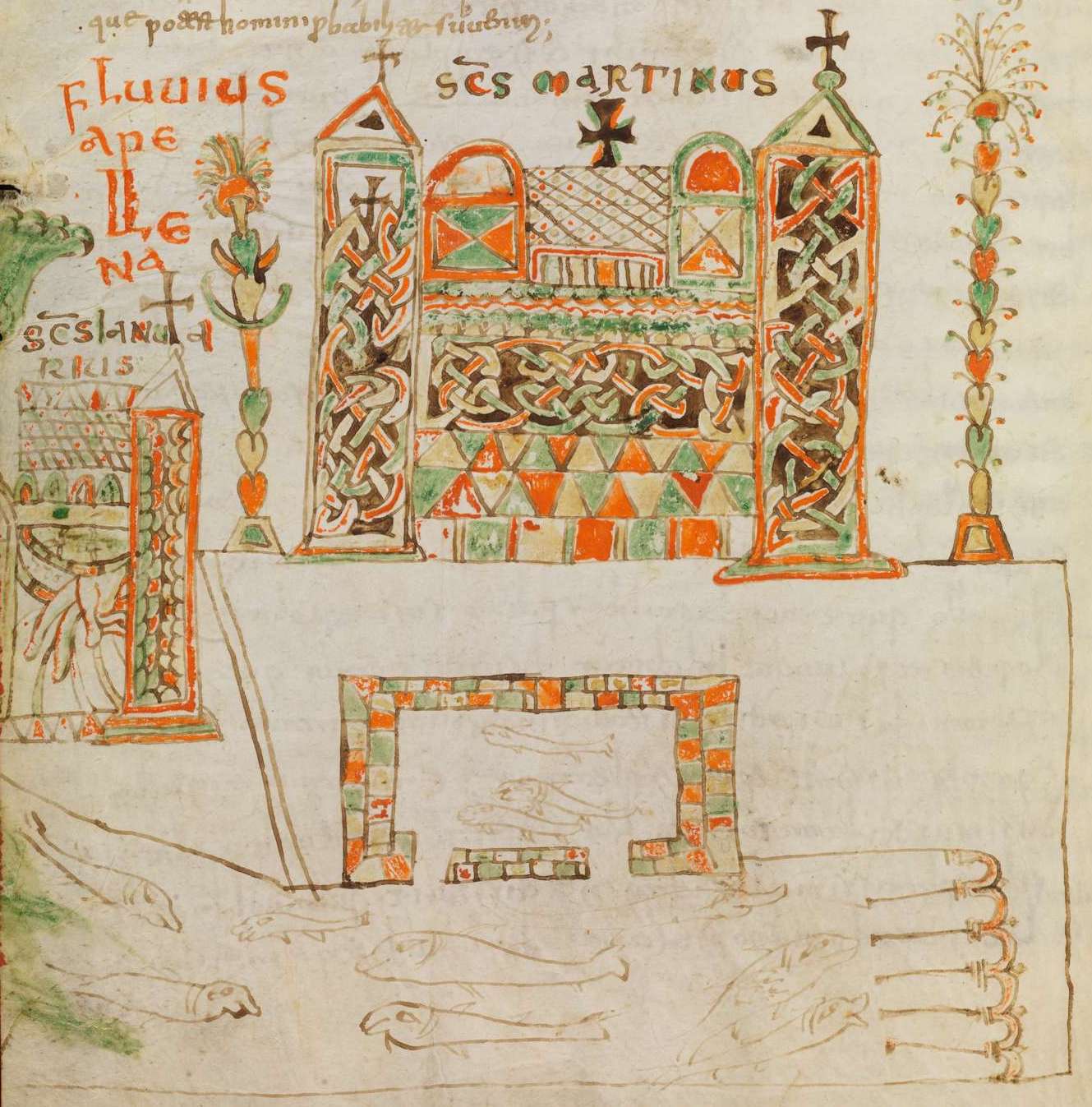
Representation of the Vivarium Monastery in a medieval manuscript of Cassiodorus
After his retirement, he returned to Italy, where he founded the Vivarium Monastery, on his family domain in Calabria (Southern Italy). The monks he welcomed mostly devoted themselves to copying manuscripts – both Greek and Latin, Christian and pagan. Cassiodorus died around 585, in his monastery, at over 90 years of age.
Works
During his public career at the court of the Gothic Kings, Cassiodorus wrote many official letters containing precious information on these turbulent times.
Jordanes’ Getica, our main source on the history of the Goths, is inspired by Cassiodorus
At the same time, he wrote a History of the Goths, probably the first historical book devoted to this people group. His book is lost, but its content is mostly preserved in Getica, written by Jordanes, a 6th-Century Gothic author. He also wrote a Chronica of world history, with an uninterrupted sequence of both Roman and Gothic sovereigns, in order to legitimize the Goths as heirs of the Roman Empire.
While in Constantinople, Cassiodorus mostly devoted himself to theology. He wrote an Exposition on the Psalms, a treatise On the Soul, and an Ecclesiastical History, on the history of the Church from 324 to 439.
After the foundation of the Vivarium Monastery, Cassiodorus wrote the Institutions of Divine and Secular Knowledge, to guide the monks in their studies. This work gives significant importance to the study of secular science and classical literature: just like Augustine of Hippo, Cassiodorus saw them as tools for a better understanding of the sacred texts.
Codex Amiatinus
Also for the Vivarium, Cassiodorus ordered a complete copy of the Vetus Latina, the ancient Latin translation of the Bible before the Vulgate. This manuscript, known as Codex Grandior, is lost, but it probably served as a model for the Codex Amiatinus, the best-preserved complete manuscript of the Vulgate, copied around 700, in Northern England, on over 500 animal skins.
Finally, he wrote a book On Liberal Arts, and another one On Orthography, a compilation of the work of eight grammarians.
Cassiodorus strongly believed in the importance of popular education, and played a major role in the spread of both Greco-Roman classical authors and Christian theological works. His role in the preservation of the ancient cultural heritage in the Middle Age is inestimable.
Boethius was a 6th-Century Roman philosopher and statesman, who played an important role in the translation of the Greek classics into Latin. Born in Italy, a few yeargs after the fall of the Roman Empire, he served in the administration of King Theodoric the Great, the founder of the Ostrogothic Kingdom of Italy. While he didn’t have North African origins, the events that occurred in the Vandal Kingdom of Carthage, a close ally to Theodoric, had a major impact on his life.
Life and works of Boethius
Anicius Manlius Severinus Boethius was born in Rome around 480, a few years after the fall of the last Roman Emperor Romulus Augustulus. He was from a rich and influential Roman family, that had lost much of its influence in the upheavals before the fall of the Roman Empire. After his father, who was a consul, died in his childhood, Boethius was raised by the Roman aristocrat Quintus Aurelius Memmius Symmachus, who initiated him to classical literature. Later on, he married Rusticiana, the daughter of his adoptive father.
In 493, the Germanic chief Odoacer, the new master of Italy since he deposed the last Roman Emperor, was defeated by the Gothic King Theodoric, who founded a Kingdom in Italy. Boethius was a teenager then. After he finished his studies, Boethius entered the service of Theodoric. He became a Senator, and then a consul.
Coin with the effigy of Theodoric the Great
Boethius was a Catholic Christian. While the Goths of King Theodoric were Arian, Theodoric himself, whose mother was Catholic, led a policy of religious tolerance, never hesitating to recruit Catholics of the former Roman elite, like Boethius, into his administration.
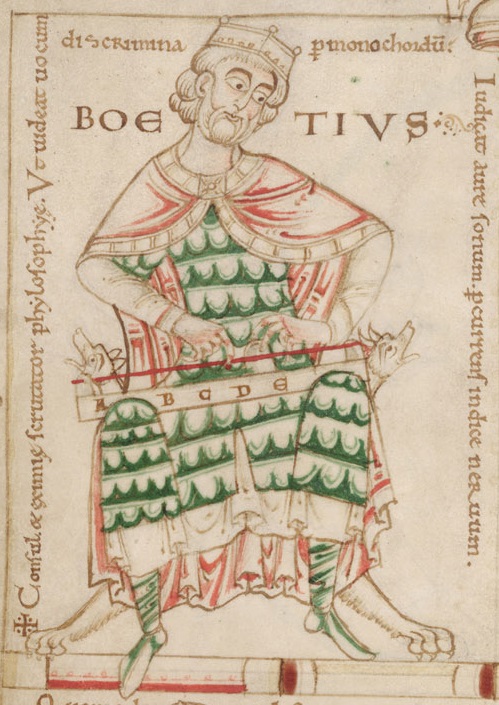
Boethius, while a devout Christian, was also strongly devoted to ancient Greece and its philosophical heritage. In order to harmonize Plato and Aristotle’s thought with Christian theology, he decided to translate the whole body of Greek classical literature into Latin. While others before him, like the Roman African Apuleius of Madaura, had already sought to translate the Greek texts, Boethius’ initiative was the first systematic effort to translate them all. This initiative was all the more necessary at a time when the inhabitants of the former Western Roman Empire were becoming less fluent in Greek. Next to his translations, Boethius also wrote commentaries of Aristotle and other Greek authors. He is considered as one of the main “cultural bridges” who contributed to the transmission of the ancient Greek heritage to medieval Europe.
Boethius (left) and his adoptive father Symmachus (right)
Boethius was not only a translator and a commentator: he also wrote his own works of philosophy, mathematics, music, and theology – including treaties defending the Catholic Christian faith and condemning Arianism. His most famous work, On the Consolation of Philosophy, was written while he was in prison, shortly before his execution. We will come back to this work later in this article.
His fall
Manuscript showing Boethius teaching (above) and in prison (below)
A major part of Boethius’ public career was devoted to fighting corruption at the royal court. At the very beginning of his career, one of his first missions was leading the investigation on accusations against the commander of Theodoric’s guard, that he had embezzled the money of the guards’ pay for luxury objects given as presents to neighboring kings. Boethius’ integrity and firm commitment to fight all those who abused their power made him highly popular with the people, but also won him many enemies at the court.
In 522, Boethius’ two sons were named consuls together, a very rare honor, which Boethius considered his highest achievement. Shortly after, Boethius was named magister officiorum, head of the government. He was at the zenith of his career.
As head of the government, Boethius continued his fight against corruption. He undid a conspiracy fomented by Triguilla, the steward of the royal palace; opposed Cunigast, a Gothic minister who was “devouring the substance of the poor”; and cancelled a convoy of food from Campania to Rome, as it was threatening to worsen the famine in the region. Due to those initiatives, he had more enemies than ever before; but he still enjoyed the trust of King Theodoric.
Amalafrida, sister of Theodoric and Queen of Carthage – Image created by ChatGPT
The events that led to Boethius’ fall mostly took place in North Africa. The Vandal King Thrasamund, who was married to Theodoric’s sister Amalafrida, died in 523. Amalafrida led a revolt against his successor Hilderic, but she was captured and executed. In this context, Theodoric felt vulnerable, and Boethius’ enemies seized the opportunity to pit the King against him.
At the same time, after a schism between the Western and Eastern Church had finally been resolved, Western Catholics, including Boethius, aspired to renewed links with the Byzantine Empire. In this context, ex-consul Albinus was accused of treason, because of his correspondence with the Byzantine Emperor Justin I. Boethius, defending him, cried out: “The charge is false; but if Albinus did that, so also have I and the whole Senate with one accord done it; it is false, my Lord King.” Boethius was then accused of the same crime, and imprisoned. He wast executed in 524, at around 40 years of age.
Manuscript of the book On the Consolation of Philosophy
During his final imprisonment, Boethius wrote a book that is considered as his masterpiece: On the Consolation of Philosophy. The book is a dialogue between the author and “Dame Philosophy”, a personification of philosophy. At the beginning of the book, Boethius, locked in his cell, laments the injustice that befell him, when a woman comes to visit him. The woman encourages him not to let his happiness depend on circumstances, as the “wheel of fortune” always keeps turning, carrying everything away with it; while true happiness is found in seeking wisdom. The dialogue between Boethius and Dame Philosophy continues, on the ephemeral nature of worldly wealth, the divine origins of wisdom, the reasons why a good God allows evil to exist, and how those who suffer unjustly can find consolation in wisdom, while the evil will never find true happiness. On the Consolation of Philosophy is considered as the last major work of ancient philosophy.
After his death, Boethius was recognized as a martyr by the Catholic Church. He is buried in the Basilica San Pietro in Ciel d’Oro (Saint-Peter-of-the-Golden-Sky), in Pavia, Italy, the city where he was executed. His tomb can be seen in the cover picture of this article.
In late Antiquity, the people of the Mediterranean world were wondering how to make sense of the ancient myths and legends that had been at the foundation of their culture for centuries, now that they were Christian and no longer believed in the gods of their ancestors. Fulgentius, a North African author of the Vandal era, wrote several books in which he suggests an allegorical reading of Greco-Roman myths, drawing a moral and spiritual message from them.
A hidden message behind myths of another age
The world of ancient mythology is a supernatural world, full of magic, fantastic creatures, talking animals and men changed into animals or into stone. Also, in the mythological universe, the gods who live among men have very human passions: they are murderers, rapists, adulterers, thieves, liars, and commit all sort of crimes. The most reasonable men of the time, especially the philosophers, have always been embarrassed by the absurdity and immorality of these myths. To provide an explanation, they tried to discern a deeper meaning behind those imaginary stories.
Neoplatonic philosophers were especially active in reexamining the ancient myths at the light of their more sophisticated understanding of the world, to find a hidden sense behind their words.
Odysseus and Circe
Their method is best explained by an example. In Homer’s Odyssey, the hero Odysseus and his companions land on the island of the sorceress Circe. When Odysseus’ companions, in their hunger, precipitate themselves on Circe’s table, she changes them all into pigs. Odysseus, on his way to save his companions, meets the god Hermes, who gives him a magical plant, together with instructions of how to triumph of the sorceress. The magical plant protects Odysseus against Circe’s magic. In the end, Circe agrees to return his companions to their human form. For the Neoplatonics, the change of Odysseus’ companions into pigs represents human degradation: when we give in to our primary impulses, to corrupting sensual pleasures, we become like wild animals. Odysseus, on the other hand, is protected by the knowledge of the wise, which gives him the strength to resist the destructive magic of the sorceress.
Ymagines Fulgencii: medieval images inspired by Fulgentius the Mythographer
Allegorical reading of myths became even more prominent in the Christian era. It allowed the Christians in the Greco-Roman world to reclaim possession of the old pagan myths, in which they discovered moral lessons, teaching them how to live a virtuous life, and even spiritual lessons, on God and his plan for them. One of the most prominent authors who developed this Christian allegorical reading of mythological texts was the North African Fulgentius the Mythographer.
Who was Fulgentius the Mythographer?
Fabius Planciades Fulgentius was a North African Christian author, who lived and wrote in the Vandal era, from the 5th to the 6th Centuries CE. Very little is known of his life, not even where in North Africa he lived. His writing style in Latin, his knowledge of Greek and his mastery of classical authors and popular cults indicate he was probably a trained rhetorician or grammarian. He understood the Libyc language and could read the Libyc alphabet, which shows he probably had Amazigh origins. The prologue of his Mythologies mentions that he was married.
Fulgentius of Ruspe
Since the Middle Age, certain scribes identified Fulgentius the Mythographer with Fulgentius of Ruspe, a North African bishop who lived in the same era, and was the leader of the North African Christian resistance against Vandal Arianism. However, this identification is contested by modern specialists.
Fulgentius the Mythographer’s work is traditionally dated from the late 5th and early 6th Century. However, a passage of his work resembles a verse of Corippus, another North African author who wrote around 550, after the Byzantine reconquest. Some specialists believe that he quotes Corippus, which would mean that he wrote after him. Others believe he is older than Corippus, and the resemblance is a pure coincidence. If he indeed does quote Corippus, this would prove that Fulgentius the Mythographer cannot be identified with Fulgentius of Ruspe, as the latter died in 527.
Fulgentius the Mythographer’s work was very popular all through the Middle Age, and had a strong influence on medieval Christian mythographers.
Fulgentius the Mythographer’s works
The most well-known work of Fulgentius the Mythographer are his Mythologies, a series of three books, with 50 chapters altogether. Each chapter tells a myth, and then interprets it allegorically, drawing a moral and spiritual message from it. For his interpretation, he uses etymologies of character names, which are often highly doubtful; but this was common at the time. In his prologue, the author explains that he wanted to strip the classical Greek myths of all their fictitious elements, in order to reveal the obscure truths they contain. While he had a Christian motivation, the lessons he draws from the myths are quite general and can be applied to any public.
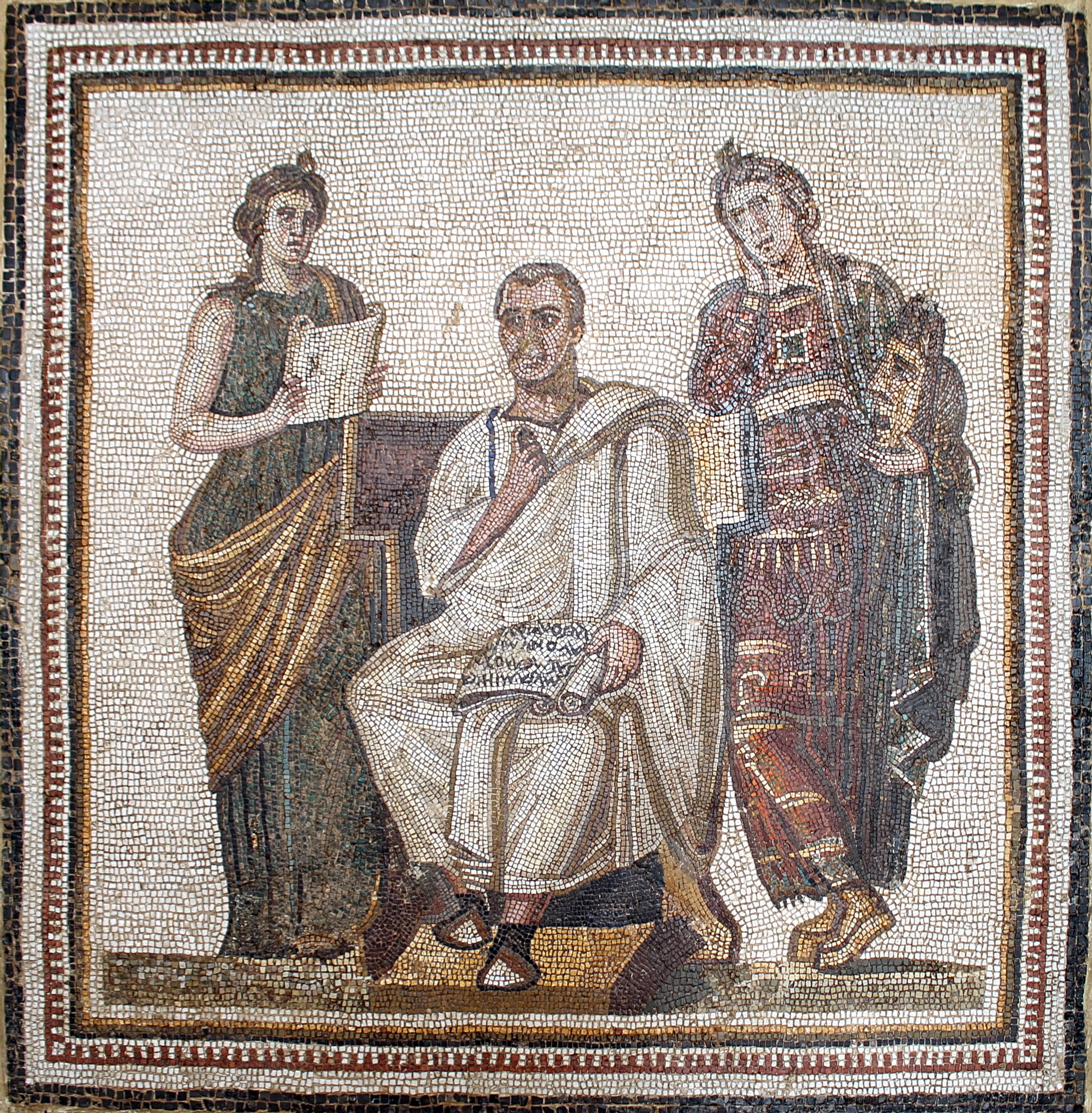
In another work, Fulgentius the Mythographer exposes an allegorical reading of the Aeneid of Virgil, which he sees as an allegory of all human life. In this book, he ghost of Virgil appears to the author, together with the Muses (goddesses of art), to explain the truths contained in the Aeneid. Virgil addresses the author on a condescending tone, and makes fun of the readers’ tendency to read his poem literally, without grasping the deeper meaning behind his words. Allegorical interpretations of Virgil were already common (including one by the Roman African grammarian Aelius Donatus), but Fulgentius the Mythographer was the first one to do this in a Christian perspective.
Fulgentius the Mythographer also wrote an Explanation of obsolete words, which gives an explanation of 62 ancient Latin words appearing in classical literature, as well as a historical book, On the Ages of the World and Men.
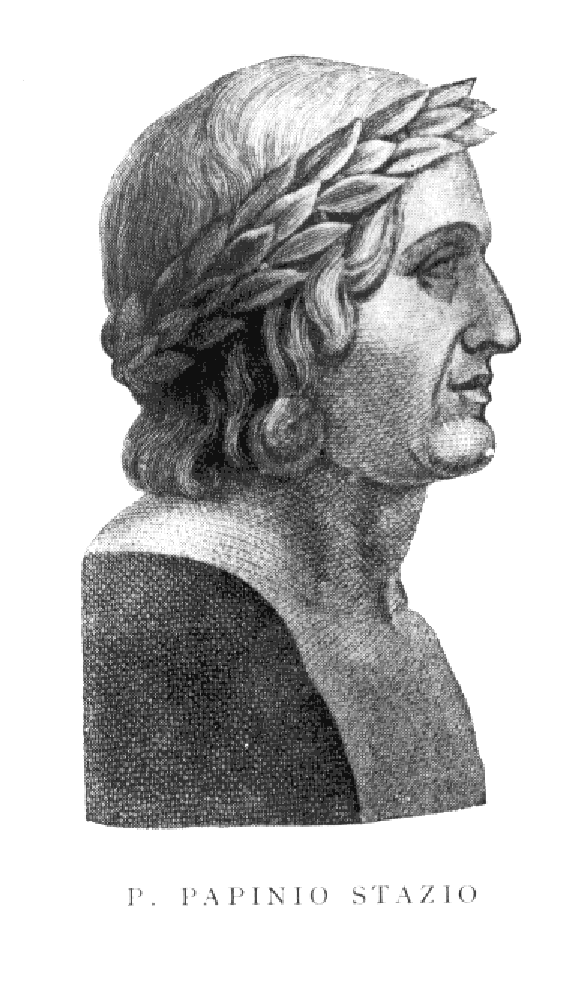
Statius
Finally, an allegorical reading of the Thebaid, a poem by the 1st-Century Roman poet Statius, was also attributed to Fulgentius the Mythographer, probably by mistake: this work was written later, during the Middle Age. Its author imitates Fulgentius the Mythographer’s writing style. Statius was a contemporary of the first Christians, and a medieval tradition without any historical base, mentioned in Dante’s Divine Comedy, claims that he secretly converted to Christianity, and that his works contains a hidden Christian message.
Priscian of Caesarea was a 6th-Century grammarian. Born in Caesarea (Cherchell), Mauretania, he taught Latin grammar in Constantinople, the new Imperial capital.
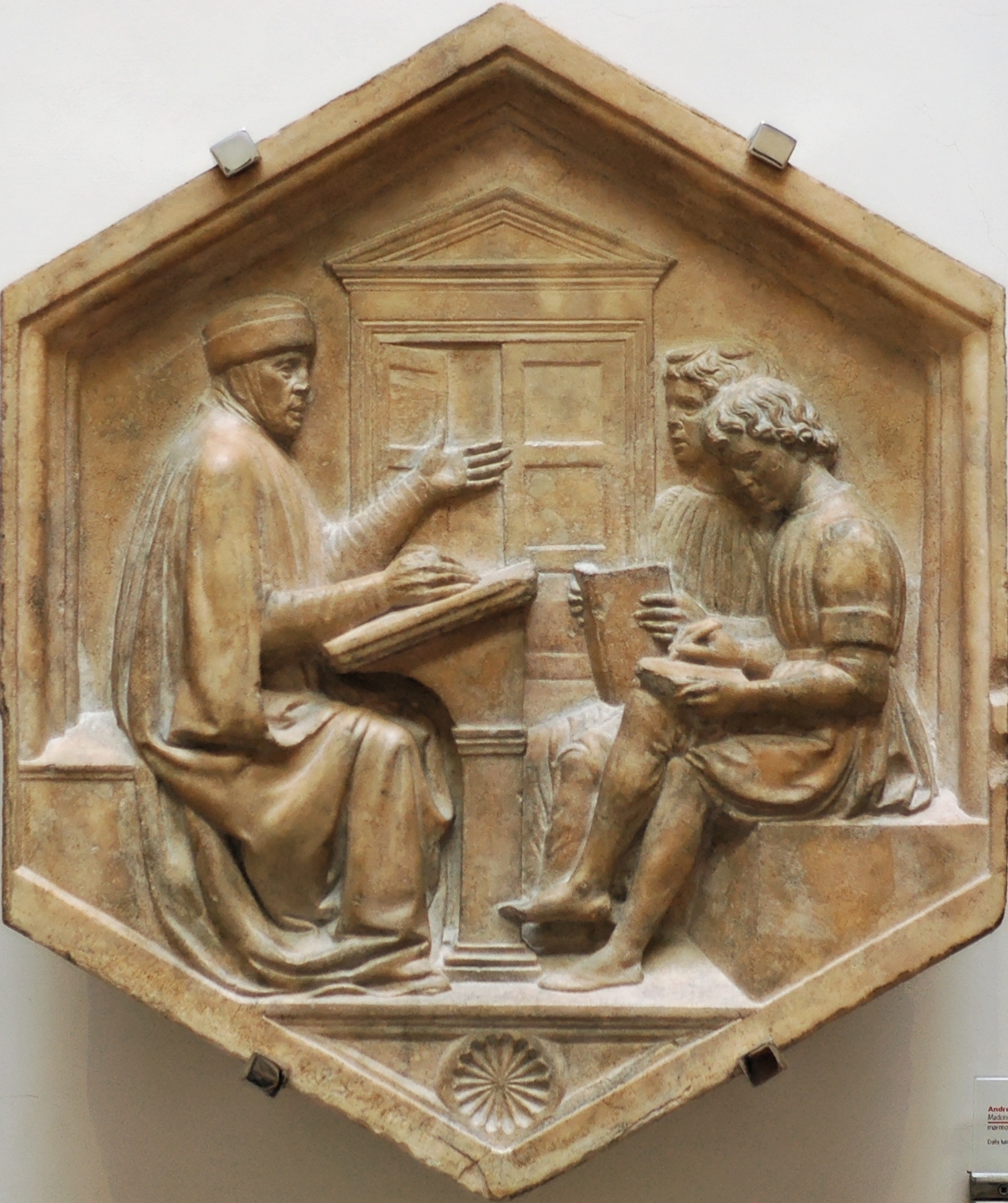
Priscian of Caesarea, relief, bell tower of Florence, Italy, by Luca della Robbia
Priscian was born around 470, in Caesarea (Cherchell), Mauretania. He was probably of Greek origin. Although he was a Christian, his works contain many references to ancient Greek mythology.
Emperor Anastasius, Priscian’s mecene
At the time, North Africa was occupied by the Vandals. As a young man, Priscian fled his native region and settled in Constantinople, the capital of the Byzantine Empire, where he taught grammar. Anastasius, the Byzantine Emperor at the time (491-518), led a policy of welcoming Romans who had been uprooted by the fall of the Western Roman Empire. Priscian wrote a panegyric of Anastasius, praising his good will towards those refugees.
The most well-known of Priscian’s works was his Institutes of grammar, a systematic exposition of Latin grammar, in 18 books. In this work, Priscian uses quotes of Latin authors as examples of the grammatical rules he exposes. Those quotes preserved fragments of authors whose work would otherwise be lost.
The Institutes of grammar were used during all the Middle Age to teach Latin, together with the Ars Grammatica, written by Aelius Donatus, another North African grammarian: Aelius Donatus was used as an introduction, while Priscian, whose work was more detailed, served for deeper study.
Aelius Donatus was a 4th-Century North African grammarian. His works on Latin grammar played an important role in the teaching of Latin in the Middle Age.
Statue of Aelius Donatus, Schöner Brunnen (Beautiful Fountain), Nürnberg, Germany
Aelius Donatus was born around 310-320, in Roman Africa, maybe Tipasa. He made his career in Rome, as a grammarian and rhetorician, from 354 to 363. After he retired, he devoted himself to writing. He was close to the philosopher Marius Victorinus, who was also from Roman Africa. He died around 380.
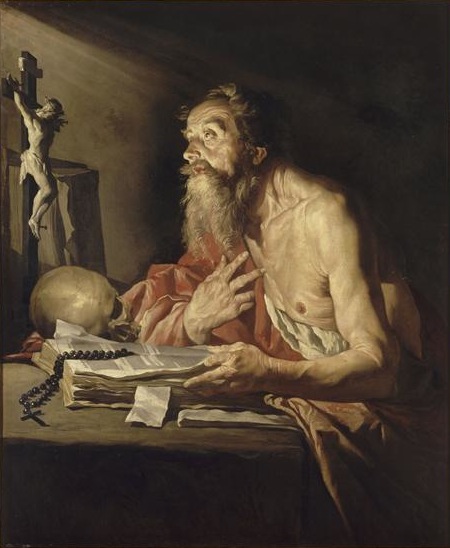
Jerome of Stridon, a disciple of Aelius Donatus
Aelius Donatus’ career spans the time when Christianity gradually supplanted classical paganism as the majority religion in the Roman world. North Africa was one of the most strongly Christian regions in the Empire, and Aelius Donatus was certainly in contact with Christians since his youth. Unlike his friend Marius Victorinus, who converted to Christianity in his old age, Aelius Donatus remained pagan all his life. This didn’t prevent him from influencing the Christian Church: he was the preceptor of the Church Father Jerome of Stridon, who is known mostly for his masterful translation of the Christian Bible into Latin – a task for which Aelius Donatus’ grammar lessons were certainly very useful.
The small booklets, mostly grammar books, printed with wooden blocks before the invention of the industrial printing press by Gutenberg, were called “donats” after Aelius Donatus
Aelius Donatus’ most famous work was his Ars Grammatica, a grammatical treatise that became the most largely used Latin grammar book for over a thousand years, playing a major role in the standardization of the Latin language. The Ars Grammatica was taught in schools, in parallel with the works of Priscian, another later grammarian, who was also North African.
Next to his grammatical works, Aelius Donatus wrote a commentary of the playwright Terence, another Roman African author. His commentary highlights the links between Terence and the Greek playwright Menander. He was also the author of a biography of the poet Virgil, and of a commentary of the Aeneid. Another more famous commentary of the Aeneid, often attributed to him, was actually written by another author, Tiberius Claudius Donatus, who lived around 50 years later, but drew inspiration from Aelius Donatus’ work.
Martianus Capella was a Neoplatonic author of the early Fifth Century, hailing from Madauros (M’Daourouch) in Roman Africa. His work established the concept of the “seven liberal arts,” which profoundly influenced the educational system throughout the Middle Ages.
Born in Madauros, Numidia, Martianus Capella shared his birthplace with another influential Romano-African writer: Apuleius, the author of the first Latin novel. Martianus Capella authored his texts in the early fifth century, following the sack of Rome by the Visigoth king Alaric I in 410, an event he explicitly mentions, but prior to the Vandal conquest of North Africa in 429.
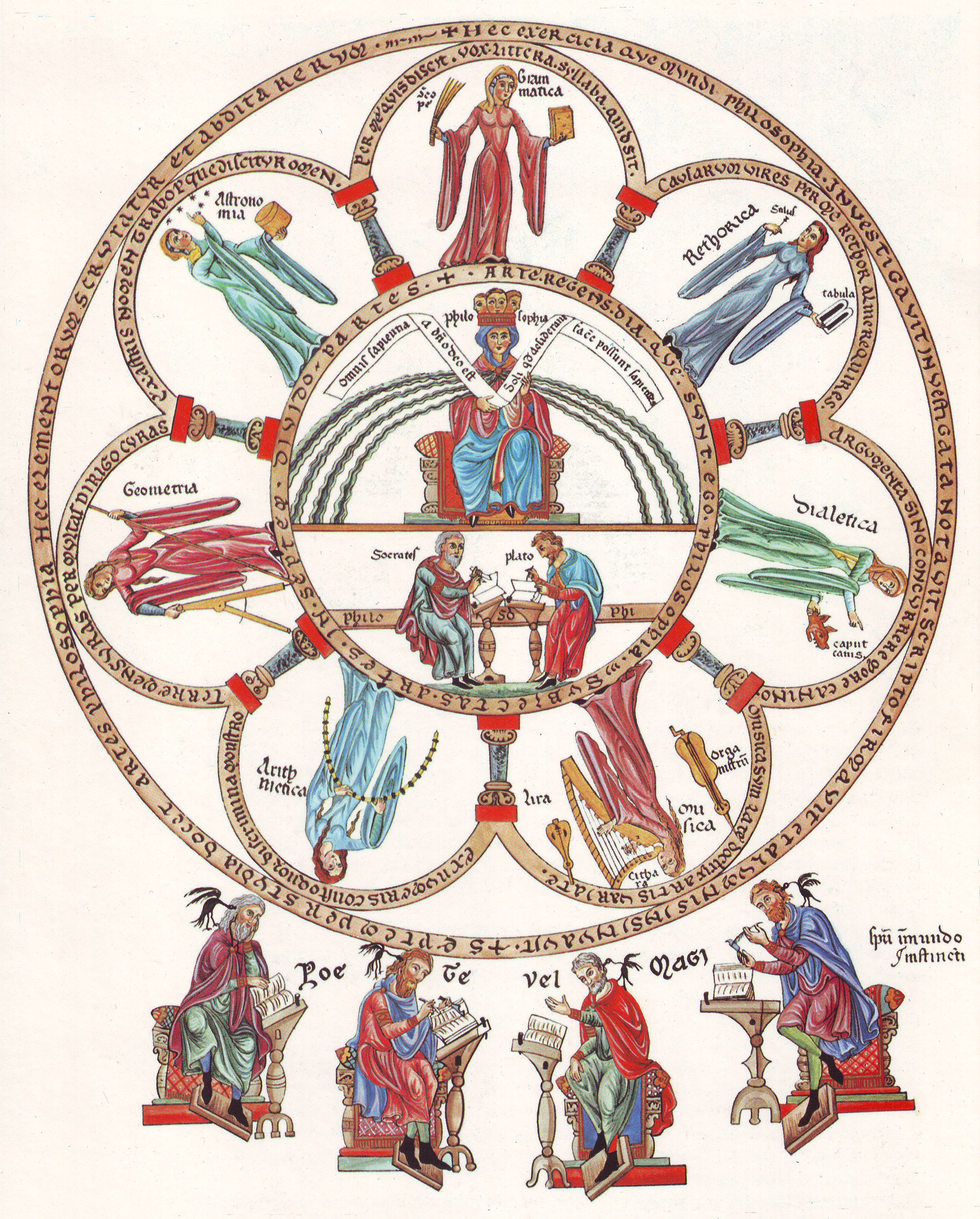
His main work, On the Marriage of Philology and Mercury, is an allegorical tale. The book recounts the union between Mercury, the god of commerce, and Philology, the personification of the love of letters and scholarship, whom the gods elevate to the status of a goddess. As a wedding gift, the couple receives seven young maidens who are destined to serve Philology. Upon being introduced, each maiden delivers an exposition on the core principles of the science she represents.
Martianus Capella wrote during a period when the Roman Empire had been largely Christianized. The fact that he drew inspiration from mythology does not necessarily dictate that he was a pagan, as Christian authors similarly extracted allegories of human wisdom from the mythological universe. However, the complete absence of Christian references gives the distinct impression that the author was indeed pagan, rather than Christian, a characteristic that did not hinder his work from achieving immense popularity within the medieval Christian world.
Martianus Capella’s writings remained highly popular over the ensuing centuries and left a deep imprint on the Middle Ages, particularly within the realms of education and pedagogy. Under this classical educational framework, the seven “liberal arts” were eventually divided into the trivium (rhetoric, grammar, and logic) and the quadrivium (astronomy, arithmetic, geometry, and music).
Macrobius was a 5th-Century Latin writer from North Africa. He is considered as one of the main “bridge” authors whose works enabled the transmission of the cultural heritage of Antiquity to the following centuries, through the crises that shook the Roman world during his time.
Macrobius presents his works to his son
Macrobius Ambrosius Theodosius was born around 400 and wrote at the beginning of the 5th Century. Almost nothing is known of his life, not even where he was born or where he lived during his career as a writer. He wrote that he was born “under a foreign sky”, that is, for the Romans, outside Italy. The fact that he was more familiar with Latin than Greek, as well as other internal clues in his work, led most specialists to believe he was probably from Roman Africa. Macrobius was a pagan, living in a Roman Empire that already had a large Christian majority. He was probably related to Symmachus, the prefect of Rome, who was the leader of the pagan resistance to the Empire’s Christianization. He had a son, Eustathius, to whom he dedicates his works.
Macrobius wrote two books that are still available today. His main work, Commentary on the Dream of Scipio, was one of the most-quoted books during the Middle Ages, and one of the main sources on Neoplatonic thought at this time. In Cicero’s Dream of Scipio, the great Roman general appears to his grandson Scipio Aemilianus, to reveal him his future destiny and that of his country, show him the rewards that await virtuous men after their death, and give him a description of how the universe functions and man’s role in this universe. Macrobius comments this dream, and exposes several Neoplatonic theories on the origins and the signification of dreams, the mystical properties of numbers, the nature of the soul, astronomy, and music. Among other things, he writes that the sun is twice as big as the earth. His main sources are the Neoplatonic philosophers Plotinus and Porphyry.
His other major work, the Saturnalia, are an account of the discussions in the house of a rich aristocrat, on a vast diversity of historical, mythological, and grammatical topics. He quotes the opinion of older authors, like Virgil and Cicero, on those topics.
Macrobius, together with the 6th-Century authors Boethius and Cassiodorus, is considered as one of the authors of Late Antiquity whose works enabled the transmission of the Greek-Roman cultural heritage into the Middle Ages.