

Français – عربي – ⵜⴰⵎⴰⵣⵉⵖⵜ – English
Boethius was a 6th-Century Roman philosopher and statesman, who played an important role in the translation of the Greek classics into Latin. Born in Italy, a few yeargs after the fall of the Roman Empire, he served in the administration of King Theodoric the Great, the founder of the Ostrogothic Kingdom of Italy. While he didn’t have North African origins, the events that occurred in the Vandal Kingdom of Carthage, a close ally to Theodoric, had a major impact on his life.
Life and works of Boethius
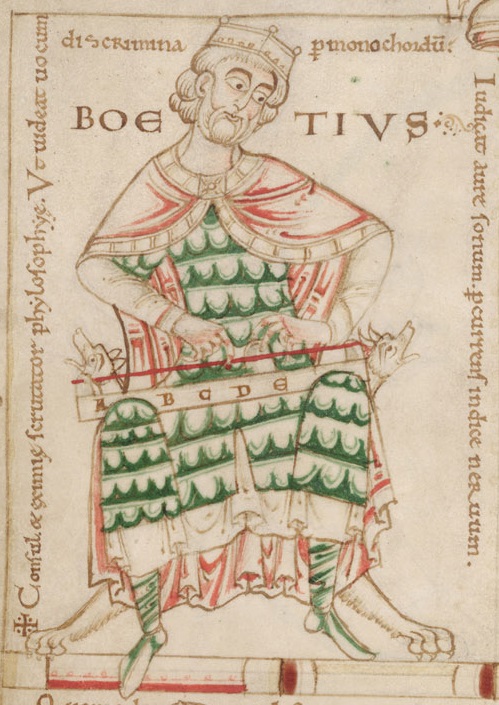
Anicius Manlius Severinus Boethius was born in Rome around 480, a few years after the fall of the last Roman Emperor Romulus Augustulus. He was from a rich and influential Roman family, that had lost much of its influence in the upheavals before the fall of the Roman Empire. After his father, who was a consul, died in his childhood, Boethius was raised by the Roman aristocrat Quintus Aurelius Memmius Symmachus, who initiated him to classical literature. Later on, he married Rusticiana, the daughter of his adoptive father.
In 493, the Germanic chief Odoacer, the new master of Italy since he deposed the last Roman Emperor, was defeated by the Gothic King Theodoric, who founded a Kingdom in Italy. Boethius was a teenager then. After he finished his studies, Boethius entered the service of Theodoric. He became a Senator, and then a consul.

Boethius was a Catholic Christian. While the Goths of King Theodoric were Arian, Theodoric himself, whose mother was Catholic, led a policy of religious tolerance, never hesitating to recruit Catholics of the former Roman elite, like Boethius, into his administration.
Boethius, while a devout Christian, was also strongly devoted to ancient Greece and its philosophical heritage. In order to harmonize Plato and Aristotle’s thought with Christian theology, he decided to translate the whole body of Greek classical literature into Latin. While others before him, like the Roman African Apuleius of Madaura, had already sought to translate the Greek texts, Boethius’ initiative was the first systematic effort to translate them all. This initiative was all the more necessary at a time when the inhabitants of the former Western Roman Empire were becoming less fluent in Greek. Next to his translations, Boethius also wrote commentaries of Aristotle and other Greek authors. He is considered as one of the main “cultural bridges” who contributed to the transmission of the ancient Greek heritage to medieval Europe.

Boethius was not only a translator and a commentator: he also wrote his own works of philosophy, mathematics, music, and theology – including treaties defending the Catholic Christian faith and condemning Arianism. His most famous work, On the Consolation of Philosophy, was written while he was in prison, shortly before his execution. We will come back to this work later in this article.
His fall

A major part of Boethius’ public career was devoted to fighting corruption at the royal court. At the very beginning of his career, one of his first missions was leading the investigation on accusations against the commander of Theodoric’s guard, that he had embezzled the money of the guards’ pay for luxury objects given as presents to neighboring kings. Boethius’ integrity and firm commitment to fight all those who abused their power made him highly popular with the people, but also won him many enemies at the court.
In 522, Boethius’ two sons were named consuls together, a very rare honor, which Boethius considered his highest achievement. Shortly after, Boethius was named magister officiorum, head of the government. He was at the zenith of his career.
As head of the government, Boethius continued his fight against corruption. He undid a conspiracy fomented by Triguilla, the steward of the royal palace; opposed Cunigast, a Gothic minister who was “devouring the substance of the poor”; and cancelled a convoy of food from Campania to Rome, as it was threatening to worsen the famine in the region. Due to those initiatives, he had more enemies than ever before; but he still enjoyed the trust of King Theodoric.

The events that led to Boethius’ fall mostly took place in North Africa. The Vandal King Thrasamund, who was married to Theodoric’s sister Amalafrida, died in 523. Amalafrida led a revolt against his successor Hilderic, but she was captured and executed. In this context, Theodoric felt vulnerable, and Boethius’ enemies seized the opportunity to pit the King against him.
At the same time, after a schism between the Western and Eastern Church had finally been resolved, Western Catholics, including Boethius, aspired to renewed links with the Byzantine Empire. In this context, ex-consul Albinus was accused of treason, because of his correspondence with the Byzantine Emperor Justin I. Boethius, defending him, cried out: “The charge is false; but if Albinus did that, so also have I and the whole Senate with one accord done it; it is false, my Lord King.” Boethius was then accused of the same crime, and imprisoned. He wast executed in 524, at around 40 years of age.

During his final imprisonment, Boethius wrote a book that is considered as his masterpiece: On the Consolation of Philosophy. The book is a dialogue between the author and “Dame Philosophy”, a personification of philosophy. At the beginning of the book, Boethius, locked in his cell, laments the injustice that befell him, when a woman comes to visit him. The woman encourages him not to let his happiness depend on circumstances, as the “wheel of fortune” always keeps turning, carrying everything away with it; while true happiness is found in seeking wisdom. The dialogue between Boethius and Dame Philosophy continues, on the ephemeral nature of worldly wealth, the divine origins of wisdom, the reasons why a good God allows evil to exist, and how those who suffer unjustly can find consolation in wisdom, while the evil will never find true happiness. On the Consolation of Philosophy is considered as the last major work of ancient philosophy.
After his death, Boethius was recognized as a martyr by the Catholic Church. He is buried in the Basilica San Pietro in Ciel d’Oro (Saint-Peter-of-the-Golden-Sky), in Pavia, Italy, the city where he was executed. His tomb can be seen in the cover picture of this article.


3 thoughts on “Boethius: the last Roman philosopher”