

Français – عربي – ⵜⴰⵎⴰⵣⵉⵖⵜ – English
In July 365, a violent undersea earthquake occurred in the Mediterranean Sea, close to Crete. The whole Eastern Mediterranean basin was devastated by the tremor and by the tsunami that followed. Cyrene and the other historical cities of Cyrenaica were almost entirely destroyed.


The earthquake occurred on 21 July 365, close to sunrise. Its epicenter was situated close to the island of Crete. Its magnitude is estimated at 8.5 on the Richter scale: it was stronger than any other earthquake recorded in this region in the modern era. It was felt all the way to Spain.
The earthquake caused a tsunami that ravaged the North African coast, especially Cyrenaica and the Nile Delta, all the way to Alexandria. The water hurled ships up to 3km inland.
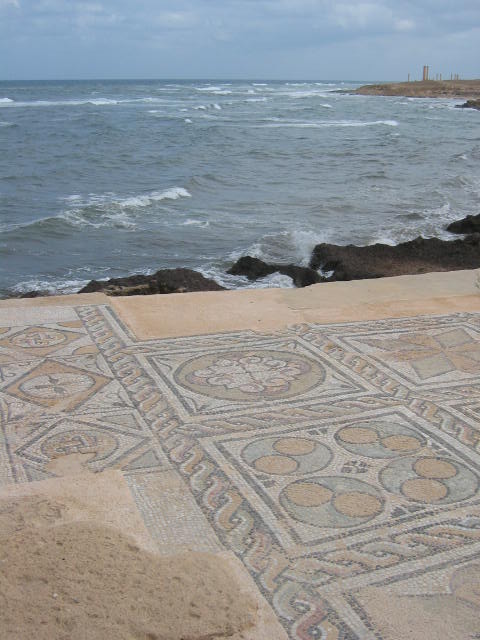
The earthquake and the tsunami caused several thousand deaths. Almost all cities in Crete were destroyed. In North Africa, Alexandria and Cyrene were very hardly hit. Leptis Magna was also ravaged by the tsunami. More distant cities like Oea (Tripoli) and Sabratha experienced lesser damage.
The earthquake had a deep impact on the imagination of the men of this time. The Roman historian Ammianus Marcellinus wrote a detailed description of the earthquake and the effects of the tsunami in Alexandria: “Slightly after daybreak, and heralded by a thick succession of fiercely shaken thunderbolts, the solidity of the whole earth was made to shake and shudder, and the sea was driven away, its waves were rolled back, and it disappeared, so that the abyss of the depths was uncovered and many-shaped varieties of sea-creatures were seen stuck in the slime; the great wastes of those valleys and mountains, which the very creation had dismissed beneath the vast whirlpools, at that moment, as it was given to be believed, looked up at the sun’s rays. Many ships, then, were stranded as if on dry land, and people wandered at will about the paltry remains of the waters to collect fish and the like in their hands; then the roaring sea as if insulted by its repulse rises back in turn, and through the teeming shoals dashed itself violently on islands and extensive tracts of the mainland, and flattened innumerable buildings in towns or wherever they were found. Thus in the raging conflict of the elements, the face of the earth was changed to reveal wondrous sights. For the mass of waters returning when least expected killed many thousands by drowning, and with the tides whipped up to a height as they rushed back, some ships, after the anger of the watery element had grown old, were seen to have sunk, and the bodies of people killed in shipwrecks lay there, faces up or down. Other huge ships, thrust out by the mad blasts, perched on the roofs of houses, as happened at Alexandria, and others were hurled nearly two miles from the shore, like the Laconian vessel near the town of Methone which I saw when I passed by, yawning apart from long decay.”
The damage caused by the earthquake accelerated the decline of the Greek cities of Cyrenaica. Shortly later, Cyrene was replaced by Ptolemais, a city that had been relatively spared by the earthquake, as the new capital of Cyrenaica.
