

Français – عربي – ⵜⴰⵎⴰⵣⵉⵖⵜ – English
In the Roman era, the region to the West of Libya was known as Tripolitania, for its three cities (tri polis), former Phoenician colonies later controlled by Carthage, and then by the Romans. Oea, the ancient Tripoli, is the oldest of these cities. It was founded by the Phoenicians as Oyat, and then shortly occupied by the Cyrenaican Greeks. It developed a lot during the Roman era, and Roman remains are still visible in Tripoli today.


In the 7th Century BCE, Phoenician traders, probably from Tyre, settled at the site of the future city of Tripoli. The Tripoli bay formed a natural port, which was ideal for their ships. On the small peninsula to the West of the bay, they founded a city, which they called Oyat (𐤅𐤉𐤏𐤕). Oyat is the oldest of the three Phoenician colonies in the region.

Later on, Oyat was conquered by the Cyrenaican Greeks, who named it Oea (Ἐώα), the Greek form of its former Phoenician name. Around 550 BCE, the Carthaginians intervened to take back the city from the Greeks. Oea, together with Leptis Magna and Sabratha, came under control of the Carthaginian Empire, but the city kept its Greek name.
After the fall of Carthage, the region came under Roman influence. In spring 70 AD, war broke out between Leptis Magna and the neighboring city of Oea. The conflict was originally motivated by tension between farmers of the two cities over harvest and cattle theft. As the inhabitants of Oea were heavily outnumbered, they made an alliance with the Garamantes of the Fezzan. Together, they pillaged the countryside around Leptis Magna and terrorized the city’s inhabitants, who were forced to draw back behind the city walls. The conflict was solved through the intervention of the Roman governor.

In the Roman era, Western Libya was first known as Syrtica, a reference to the Gulf of Sirte, and then as Tripolitania, because of its three cities (tri polis): Leptis Magna, Oea and Sabratha. Oea became a Roman colony during the reign of Emperor Trajan. Tripolitania, originally a part of the province of Proconsular Africa, became a Roman province during the reign of Septimius Severus, who was born in Leptis Magna.
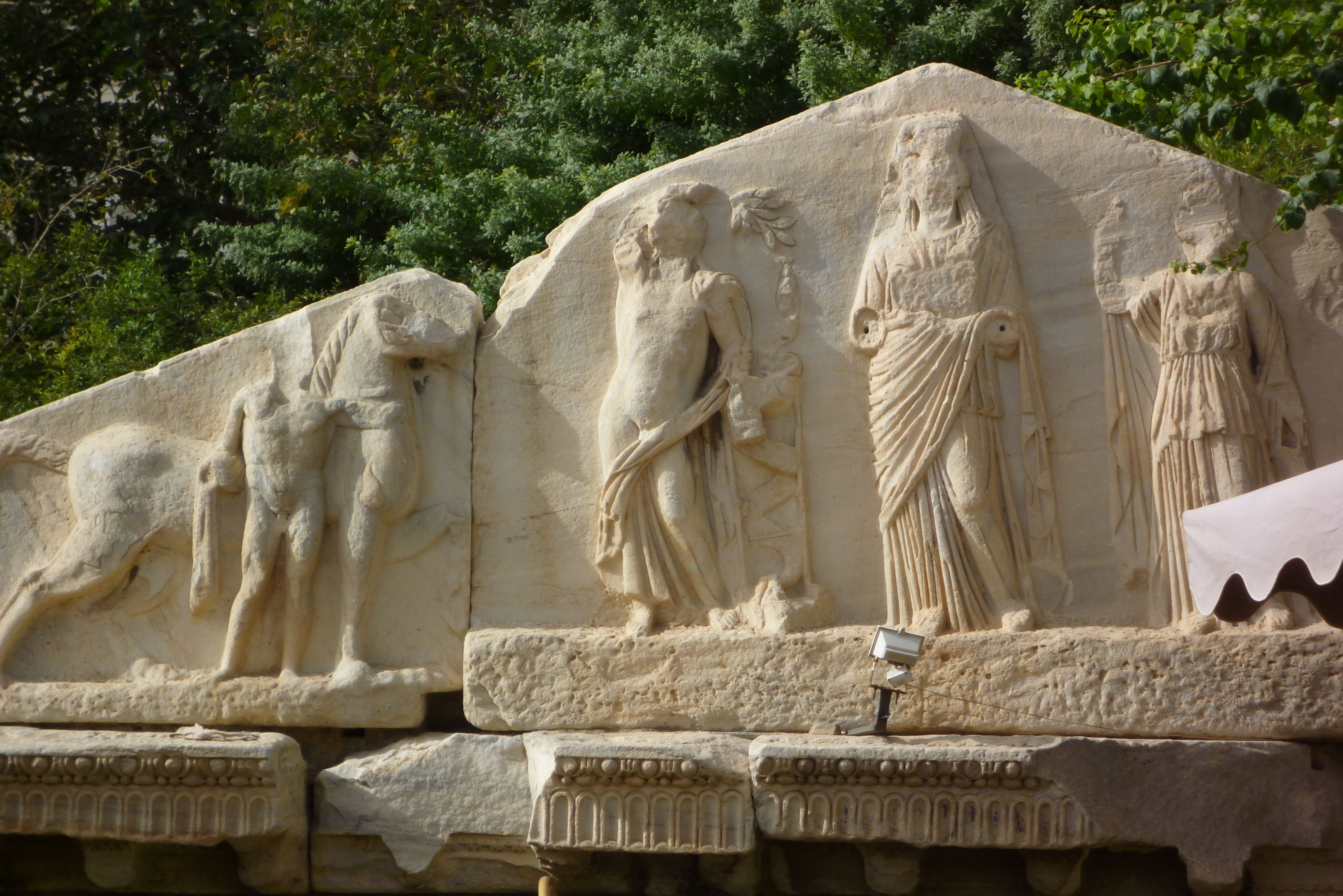
Unlike Leptis Magna and Sabratha, Oea/Tripoli was continually inhabited since the Roman era. Paradoxically, this means that its Roman remains are less well-preserved as in the neighboring cities, because its inhabitants either reused the stones of ruined buildings, or built on top of the ancient city. The main Roman building that has survived until today is the Arch of Marcus Aurelius (see image above), built in 165 by Emperor Marcus Aurelius, to commemorate his brother Lucius Verus’ victory against the Persian Emperor Vologases IV. The remains of a small Roman temple, Genus coloniae, are kept at the Tripoli Museum. Further archaeological treasures are certainly awaiting discovery underneath the modern city, but excavations have been limited for the moment.

The Roman African writer Apuleius, the author of The Golden Ass, the first Latin-language novel, lived in Oea. He was put on trial for sorcery in the neighboring city of Sabratha.
In the Roman era, Tripolitania became one of the most strongly Christian areas in the Roman Empire. In 255, the bishop Natal of Oea took part in a regional church council organized in Carthage, where he spoke in the name of his colleagues from Leptis Magna and Sabratha. The fact that he was chosen as a delegate to represent all Christians in Tripolitania shows that while Leptis Magna was much larger and more influential, Christianity was probably better established in Oea.
In the 5th Century, Oea was conquered by the Vandals together with the rest of Tripolitania. Bishop Cresconius of Oea was one of the North African bishops who were exiled by the Vandal King Huneric in 484.

The city underwent a small renewal in the Byzantine era. The ruins of the Byzantine Church of Oea can bee seen close to the ancient Medina of Tripoli.
After the Arab conquest of Tripolitania, the Arabs chose Oea as their new regional capital. The city’s old name was replaced by Tripoli (Tarabulus طرابلس in Arabic) around the 9th Century. Tripoli is sometimes called the “Mermaid of the Mediterranean” – in Arabic, Arusat al-Bahr (عروسة البحر), literally “bride of the sea” – because of its beautiful beaches.
