

Français – عربي – ⵜⴰⵎⴰⵣⵉⵖⵜ – English
At the time when the Carthaginian Empire was extending its domination on both sides of the Mediterranean Sea, it entered conflicts with another major maritime power: the Greeks, who were already present in Southern Italy and Gaul (Massalia). Sicily, the largest Mediterranean island, just opposite Carthage, and with several Greek colonies, would be at the heart of their rivalry. Between the 5th and the 4th Century BCE, Greeks and Carthaginians fought seven ward over Sicily.
Context

Starting in the 6th Century BCE, several Greek colonies were founded in Southern Italy. Greek influence in this region was so strong that the Romans called it Magna Graecia (Great Greece). In Sicily, the main Greek colony was Syracuse, founded around 734 by colonists from the city of Corinth. The Sicilian Greeks were divided in two groups: Ionians and Dorians.
There were also several old Phoenician colonies in Sicily. Those Phoenician cities, originally independent, came under Carthaginian control around 540.
Around 580, a group of Greek colonists from Rhodes and Cnidus tried to establish a Greek colony at the site of the future city of Lilybaeum (modern-day Marsala), surrounded by Phoenician territory and very close to the city of Motya. The Sicilian Phoenicians allied with the island’s indigenous people to expel them.
Around 510, Prince Dorieus of Sparta, after failing in his colonial project in Tripolitania, came to the region of Eryx. The colony he founded there, while isolated from other Greek cities in Sicily, was facing hostility from the neighbouring Carthaginian cities. After a few years, Dorieus and his companions were attacked and killed by the inhabitants of the neighbouring city of Segesta, a Carthaginian ally. The survivors fled to the South of Italy, where they took the Greek city of Heraclea Minoa.
Around the beginning of the 5th Century, most Greek cities in Sicily came under the power of tyrants (authoritarian leaders, against the Greek democratic ideal). Gelo, the tyrant of Syracuse, who controlled the largest territory, made an alliance with Thero of Akragas, creating an united Dorian Greek front, against the Ionian Greeks and the indigenous Sicels. Against this threat, the Ionians entered an alliance with Carthage.
The First Sicilian War (480)

Red: Syracusan territory; yellow: territory submitted to Syracuse ; blue: territory submitted to Akragas; black spots: Carthaginian cities
In 483, Thero of Akragas deposed Terrilus, the Ionian tyrant of Himera. Terrilus called on Carthage for help. The Carthaginians, concerned that the alliance between Gero and Thero would take over all Sicily, intervened in 480.
The Carthaginian army, led by King Hamilcar I, was defeated at the Battle of Himera. Hamilcar himself was killed, or committed suicide after his defeat, depending on the sources. Carthage however kept its Sicilian possessions.
This defeat caused deep change in the Carthaginian society: the aristocratic government was replaced by an elected assembly, while the King’s powers were significantly reduced.
Between the wars (480-410)
The victory of the Syracuse-Akragas axis opened the way for an era of prosperity for the Greek colonies in Sicily. The war booty was used for a public building program.
This period also saw the fall of the Greek tyrants and the establishment of democratic and oligarchic systems in Syracuse, Akragas, and other Greek cities.
The Second Sicilian War (410-404)
The Second Sicilian War started after several confrontations between the cities of Selinunte, an ally of Syracuse, and Segesta, a Carthaginian ally. After trying in vain to find a diplomatic solution to the conflict, the Carthaginians landed in Sicily and conquered Selinunte, then Himera, before drawing back.
Syracuse and Akragas, the two most powerful Sicilian cities, did not intervene. However, the rebel Syracusan general Hermocrates raised an army to attack the Carthaginian possessions in Sicily. While originally victorious, he was killed in Syracuse in 407.
After Hermocrates’ death, Carthage launched a punitive expedition. The Carthaginians took Akragas, then Gela and Camarina, and defeated the armies of the new Syracusan tyrant Dionysius I the Elder several times. The Carthaginian army would however be decimated by the plague, forcing its generals to enter a peace treaty with Syracuse. The treaty imposed a tribute on the last cities conquered by Carthage: the Carthaginian power in Sicily was now at its highest.
The Third Sicilian War (398-393)
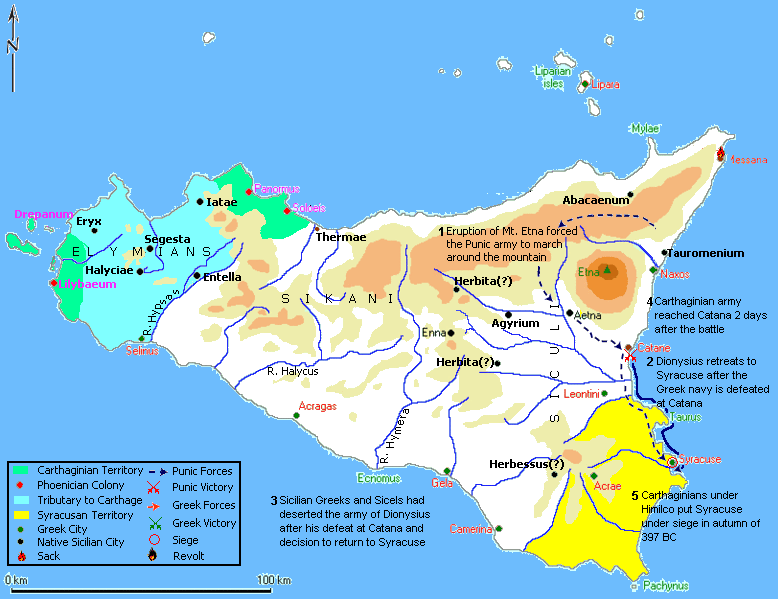
In 398, Dionysius the Elder, having consolidated his power, besieged and conquered the Carthaginian city of Motya, in violation of the peace treaty. The Carthaginians intervened, retook Motya, and then conquered Messana. In 397, after their decisive victory against the Greek fleet at the naval battle of Catania, they besieged Syracuse itself. The Carthaginian troops would again be decimated by the plague, forcing them to lift the siege. Carthage lost its latest conquests, but kept the rest of its territory.
During the next few years, Carthage was busy fighting a rebellion in Africa. In 393, the Carthaginians tried to retake Messana, but failed. With both sides facing internal difficulties, a new peace treaty was finally concluded, by which both Carthage and Syracuse committed to leave their rival in peace in their sphere of influence.
The Fourth Sicilian War (383-376)
Dionysius the Elder reengaged the hostilities in 383. Carthage entered an alliance with the Greeks of Southern Italy, to attack the Syracusans on two fronts. In 378, the Carthaginians were defeated in Sicily. They first sought to negotiate a new peace treaty, but Dionysius the Elder’s condition that they completely leave the island was unacceptable to them. Fighting broke out again, and the Carthaginians finally won a decisive victory in 376.
The Fifth Sicilian War (368-367)
In 368, Dionysius the Elder besieged Lilybaeum. The defeat of his fleet was a serious drawback for his war effort. After his death in 367, his son and successor Dionysius II the Younger made peace with Carthage.
The Sixth Sicilian War (345-333)

Close to the end of the reign of Dionysius the Younger, the Carthaginians took advantage of the divisions between rival political factions in Syracuse to enter the city at the invitation of one of these factions, but they were quickly expelled.
In 343, Timoleon, the new Syracusan leader, attacked the Carthaginian possessions in Sicily. The Carthaginian relief expedition was defeated in 339. Carthage was forced to sign a peace treaty, by which it only kept control of the Western half of the island.
The Seventh Sicilian War (311-306)
In 311, Agathocles, the new tyrant of Syracuse, attacked the Carthaginian territories in Sicily, in violation of the peace treaty. After being pushed back by the Carthaginian counter-attack, he was forced to withdraw to Syracuse. The Carthaginians now occupied all Sicily, except Syracuse, and besieged Syracuse.
In desperation, Agathocles led a military expedition to Africa, to attack Carthage herself. His maneuver proved to be a success: the Carthaginian troops in Sicily were forced to lift the siege and return to defend Carthage.
The first battle in Africa was a Carthaginian defeat. Agathocles then besieged Carthage, but the city was too strongly fortified for him to hope of conquering it; so he made an alliance with Aylimas, king of the Massyle Numids – an ancestor of Massinissa – and occupied the Northern region of modern-day Tunisia.
Agathocles and his men were finally defeated and driven out of Africa in 307. A new peace treaty was concluded the following year.
Aftermath
At the end of the Sicilian Wars, Carthage controlled most of the island, while Syracuse only held the South and the East, from Gela to Messana.
Later on, the Greek King Pyrrhus of Epirus, during his war against Rome (280-275), invaded Sicily in 279, to drive the Carthaginians out of the island. He managed to take a few cities, but returned to Italy in 276 after his siege of Libybaea failed. The Pyrrhic Sicily campaign can be considered as the last episode of the Greek-Carthaginian wars for the control of the island. Pyrrhus’ victories were so costly that the expression “Pyrrhic victory” was coined for a victory that is so costly to the victor that it is tantamount to defeat.

Finally, the First Punic War, between Rome and Carthage, was also fought in Sicily. Rome entered the war to support the Mamertines, a group of Italian mercenaries who were occupying the Messana region. After this war, the Carthaginians were expelled from Sicily.

https://www.amazon.co.uk/TANIT-Lost-goddess-Central-Mediterranean-ebook/dp/B0DBHTQST4