

Français – عربي – ⵜⴰⵎⴰⵣⵉⵖⵜ – English
At the beginning of the 3rd Century BCE, the Carthaginian Empire’s domination over the Mediterranean basin was threatened by the emergence of Rome. This new power had just taken over most of Italy, and was now interested in Sicily. The first of the three wars between Carthage and Rome was fought for the control of this island, which lay right between their spheres of influence.
Context

At the time, Sicily was shared between the Carthaginian Empire and the Kingdom of Syracuse, a Greek colony. Those two powers had already fought several wars over the island.
In 289, the Mamertines, a group of mercenaries, originally from Italy, whom the King of Syracuse had hired to help him fight the Carthaginians, rebelled and occupied the city of Messana (Messina), from where they started looting the surrounding regions. In 265, under the threat of the King of Syracuse, who wanted to take back Messana, they called on both the Carthaginians and the Romans to defend them. The Carthaginians were the first to answer, and sent a military garrison to Messana, but the Mamertines were unhappy with this, expelled the Carthaginian forces, and called on Rome for help, in the name of Italian solidarity.
War in Sicily (264-256)
While the Romans were first hesitant to help mercenaries, even Italian, who had taken a city by treachery from its rightful owners, the potential benefits they saw from a presence in Sicily finally convinced them to intervene. In 264, Roman troops crossed the Messina straight, without facing much resistance, and forced the Carthaginian and Syracusan forces to lift their siege of Messana. The Carthaginians drew back, trusting in the superiority of their fleet to remain the masters of the seas.
In 263, the Romans besieged Syracuse. The city was forced to an alliance with Rome, which required it to contribute to the Roman war effort in Sicily. During the next few months, several Carthaginian possessions in Sicily made allegiance to Rome. In 262, the Romains besieged Akragas (Agrigente), the main Carthaginian city in Sicily.
During this time, the Carthaginians recruited an army, joined Akragas by sea, and attacked the Romans in spring 261. The Romans were victorious and took over the city. The battle of Akragas was the first major Roman victory against Carthage.

During the following years, the fighting in Sicily came to a stalemate: Rome controlled most of the island, but the Carthaginians could easily defend their heavily fortified coastal cities. The stalemate in Sicily convinced the Romans that they needed to build their own fleet, so that they could fight at sea. The first major naval battle, at Mylae (Milazzo), in 260, was a surprise Roman victory. Later, the Roman fleet would take over Corsica, and then Sardinia.
Roman expedition in Africa (256-255)
The Romans, encouraged by their success at sea, decided to cross the Mediterranean Sea and invade Africa. The Roman and Carthaginian fleet fought the battle of Cape Ecnomus, possibly the largest naval battle in history, to the South of Sicily, in 256. Another Roman victory opened the way for an invasion of Africa.
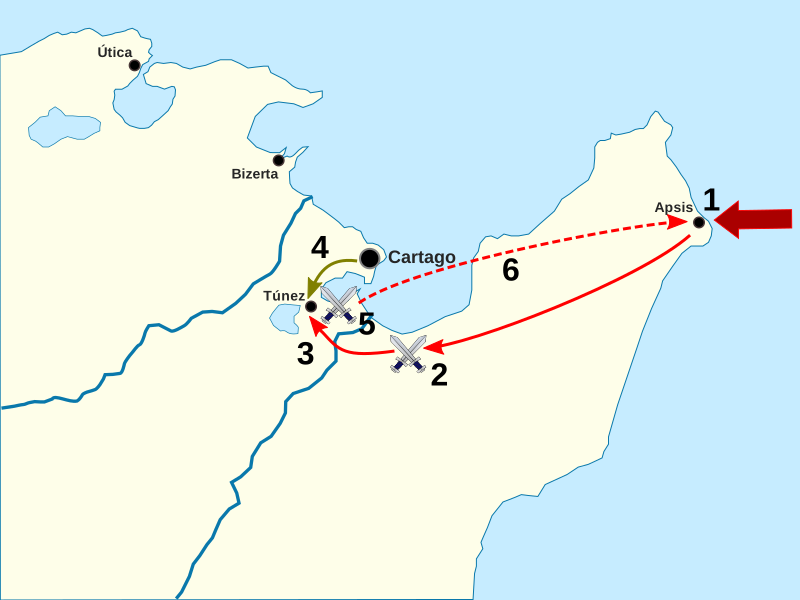
The Romans landed in Aspis (Kelibia) and took over the countryside around Carthage. The most prominent Carthaginian generals were called back to defend the city, but their army was also defeated. The Romans conquered Tunis, merely 16 km from Carthage. In desperation, the Carthaginians called on the Spartan mercenary Xanthippus, who managed to defeat the Romans and drive them out of Africa in 255.
Enf of the war in Sicily (255-241)

After their failed invasion of Africa, the Romans concentrated on their offensive in Sicily. In 254, they conquered Panormus (Palermo) by sea. When the Carthaginian general Hasdrubal tried to take back the city, his far more numerous army underwent a decisive defeat at the battle of Panormus, in 250. The Carthaginians now only controlled two Sicilian cities : Lilybaeum (Marsala) and Drepana (Trapani); but both were coastal, very well fortified cities, which could easily be supplied by sea.
After the final defeat and almost complete destruction of the Roman fleet at the battle of Phintias, in 249, the Carthaginians no longer needed to fear any attacks by sea, which led them to strongly reduce their war effort: they were content with strengthening their last remaining possessions, while avoiding fighting with the far superior Roman forces.
In 247, a young Carthaginian general, Hamilcar Barca (the father of the famous Hannibal) became the new Carthaginian commander in Sicily. Hamilcar decided to wage a war of attrition, through minor skirmishes against the Roman forces, but without large-scale fighting.
In 243, the Roman Senate, understanding that they would never be able to drive the Carthaginians out of Sicily as long as their maritime supply routes remained open, decided to build a new fleet. In 241, the Roman fleet defeated the Carthaginian fleet at the battle of the Aegates. The Carthaginian Senate, lacking the financial means to build a new fleet after over 20 years of war, ordered Hamilcar to negotiate a peace agreement. When Hamical proudly refused, another general, Gisco, was sent to do it instead. The treaty of Lutatius, signed at the end of 241, marks the end of the First Punic War: Carthage evacuated Sicily, and the Romans were the new masters of the island.
