Ce site présente l'histoire de l'Afrique du Nord avant les conquêtes arabes – This website presents the history of North Africa before the Arab conquests – يعرض هذا الموقع تاريخ شمال إفريقيا قبل الفتوحات العربية
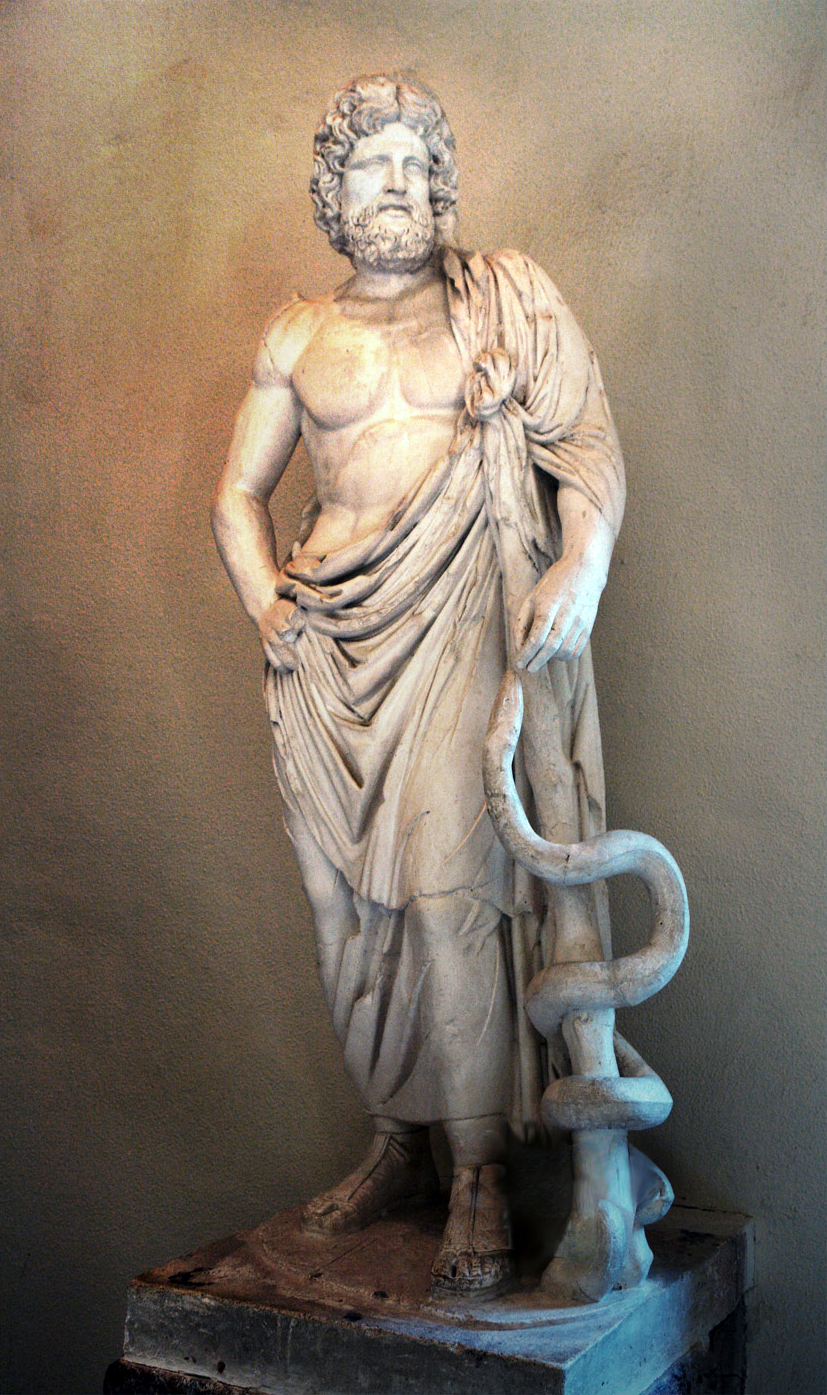
Balagrae (Al-Bayda), the last of the five cities of the Cyrenaican Pentapolis, was mostly famous for its Temple of Asclepius, the Greek god of medicine. Pilgrims from the whole region came to this temple, hoping to be healed of their illnesses.
The city of Balagrae was mostly famous for its Asclepium, a temple of Asclepius, the Greek god of medicine. This temple had been founded by colonists from Epidaurus, a city of the Peloponnese that had the largest Asclepian sanctuary in Greece. Pilgrims came to spend the night there, and then, on the next morning, they told the priests about their dreams. The priests then prescribed them a remedy based on their interpretation of the dreams. Snakes, an animal considered as sacred, played an important role in the cult of Asclepius: non-venomous snakes were crawling on the ground in the sanctuary, in the middle of the sick and wounded. Next to the altar and dormitory, the temple also contained a fountain to clean the patients’ wounds, baths, and a gymnasium. The prescribed remedies were mostly purification baths or workout in the gymnasium, together with a specific diet. The Asclepium of Balagrae was especially famous for the healing of children, as shown by the objects discovered during the excavations.
Portico of the Asclepium, Balagrae
A new complex was built in the Roman era, by Emperor Hadrian. It was a 40m-long, 35m-large square, surrounded by porticoes. The complex contained three temples: the largest, at the center, was the Temple of Asclepius, while one of the two others was dedicated to Serapis, the protector god of the city of Alexandria; we don’t know which god was worshipped in the third temple.
The Asclepium also contained an odeon, a small theater for musical concerts. It was known in Antiquity that music had a soothing effect on people with mental illnesses. The Asclepium probably employed musicians who played music for the sick. The odeon might also have served as a meeting place for the medical staff.
Balagrae declined a lot in the Roman era, until it was no longer part of the Pentapolis.
In the Islamic era, the city was famous for its tomb of Ruwaifi ibn Thabit al-Ansari, a companion of the Prophet Mohammed. More recently, in 1843, it was here that Mohammed Ali al-Senussi founded the Senusiyya order. The white-walled zawiya he built gave the city its name, Al-Bayda (البيضاء, “the White”). Today, Al-Bayda is the fourth-largest city in Libya, after Tripoli, Benghazi and Misrata.
Barca, one of the cities of the Pentapolis, the confederation of five Greek cities established in Libya, was located at the site of the current city of El-Marj. The city was founded in an area that was previously inhabited by indigenous Libyan tribes, and from the beginning, its population was both Greek and Libyan. The mingling between those two people groups was more pronounced in Barca that anywhere else in Cyrenaica. The indigenous elite was integrated into the city’s administration, as illustrated by the example of governor Alazir. Sadly, nothing is left today of the ancient city of Barca.
Al-Munaykhrat cemetery: one of the few ancient remains that can still be seen close to El-Marj (Source)
The area around Barca was originally inhabited by the Libyan Amazigh Barraci tribe. After the foundation of Cyrene, in 631 BCE, the Greek colonists allied themselves with the indigenous tribes.
Arcesilaus II on his throne
During the reign of King Arcesilaus II of Cyrene (560-550), his adviser Learchus (who, according to certain sources, was also his brother) rebelled against him. Learchus made an alliance with the Amazigh tribes, depriving the King of precious allies. Together, Greeks and Amazighs founded the city of Barca. They then declared war against Cyrene. They were victorious, and Learchus took the throne of Cyrene, but he was quickly killed.
Alazir (image created by ChatGPT)
A few decades later, King Arcesilaus III of Cyrene (530-515), fearing an uprising against him in Cyrene, fled to Barca. Arcesilaus III had family links with the Amazigh of the city: Alazir, the governor of Barca, who was from an Amazigh tribe, was the father of his wife. One day, on the market place in Barca, he was recognized by a group of Cyrenean exiles, who killed him together with Alazir.
At this time, Egypt was under Persian occupation since 525. After Arcesilaus III died, his mother Pheretima called on the Persian governor of Egypt to avenge him, claiming that he was killed because of his loyalty to the Persians. The Persian army besieged Barca and deported its population, and then entered Cyrene on Pheretima’s invitation: it was the beginning of the Persian domination of Cyrenaica.
Barca prospered a lot during the Persian occupation. Around the end of the 5th Century, it had apparently become the largest city in Cyrenaica, before Cyrene.
In 332, Alexander the Great conquered Egypt. The Greeks of Cyrenaica, happy to see a Greek king who aspired to unite all Greeks, submitted to him. Barca, together with the rest of Cyrenaica, became part of Alexander the Great’s Empire.
Coin with the effigy of Thibron
During the civil war that followed Alexander the Great’s death, Barca, together with the neighboring city of Euhesperides (Benghazi), supported the revolt of the Spartan mercenary Thibron, who was seeking to conquer an Empire in Libya. Thibron was defeated by Cyrene, with the support of the Ptolemy of Egypt. Cyrenaica then became part of the Ptolemaic Empire.
Ptolemy III Euergetes built a new city, Ptolemais, on the site of the former port of Barca. The city, deprived of its access to the sea, started declining and soon ceased to be part of the Pentapolis.
Barca still existed in the Roman and Byzantine era, but only as a small, unimportant town.
Barca was one of the first towns in Cyrenaica to be conquered by the Islamic Caliphate, in 643-644. The Muslims decided to make it their new provincial capital. Its name was Arabized as برقة (Barqa). With time, برقة became the Arabic name of the whole region previously known as Cyrenaica.
While Taucheira (Tocra) is the less well-known of the five Greek cities of the ancient Pentapolis, it is probably the oldest Greek colony in Libya after Cyrene itself, and its ruins conceal unsuspected archaeological treasures.
The name Taucheira is of Libyc origin. The prefix Tau (or To, or Ta) means “land”. Chei means “mouth”, while the suffix -ra has a sense of proximity. So, Taucheira means “land close to the mouth”, a metaphore for the coast.
Taucheira was located on the coastal road from Cyrene to Euhesperides, the two major cities of the Pentapolis. North-East of the city was the stone quarry where the the characteristic, reddish limestone of Taucheira was found. The quarry also served as a cemetery: the holes from where stone had been extracted were used as tombs.
The port of Taucheira (on the cover picture of this article) entertained trade links with Athens, Corinth and the Peloponnese. The following pictures show pieces of handicraft that were found during the port excavation and are now kept at the Taucheira Museum.
In 332, Alexander the Great conquered Egypt, where he built his new capital: Alexandria. The Greeks of Cyrenaica, happy to see a Greek king aspiring to unite all Greeks, submitted to him. After Alexander the Great’s death, Taucheira was conquered by the Spartan mercenary Thibron, who wanted to conquer an Empire in Libya. Cyrenaica then became part of the Ptolemaic Empire. The new port city of Ptolemais, founded by Ptolemy I Soter, became an important rival for Taucheira.
Gold coin with the effigy of Arsinoe II, the Queen who gave her name to the city
In 276, Magas of Cyrene proclaimed himself King of Cyrenaica. He reigned until his death around 250. After he died, his daughter Berenice married Ptolemy III Euergetes and the city of Euhesperides was renamed Berenice in her honor. The Ptolemy also gave a new name to Taucheira: Arsinoe, in honor of Arsinoe II, wife of Ptolemy II Philadelphus and step-mother of Ptolemy III Euergetes. Cyrenaica was again part of the Ptolemaic Empire, but enjoyed strong autonomy.
Ptolemy Apion, son of Ptolemy VIII, was proclaimed King of Cyrenaica in 105. After his death in 96, as he didn’t have a heir, his kingdom was bequeathed to Rome. However, the Romans only took possession of Cyrenaica in 74. During the interval years, Arsinoe was the victim of an attack by Libyan Amazigh tribes. An inscription that is now kept at the local museum commemorates how Aleximachus, son of Sostratus, financed the enlargement of the city walls. He also imported food during a time of famine. The city authorities published a decree to reward him.
During the Actium War, Arsinoe was briefly renamed Cleopatris by the Roman general Mark Antony, in honor of his wife Cleopatra of Egypt. The city would again be named Arsinoe after the Roman Empire was founded, and became a Roman colony. Little is known about its history in the Roman era, but several Roman buildings were built, especially a gymnasium and the Dolia, for textile dyeing. The cult of Cybele was especially popular in the city: a yearly festival in honor of this goddess was organized there.
In the Byzantine era, Emperor Justinian built new city walls, together with a fortress. The city walls were so solid that Apollonius, the last Byzantine governor of Cyrenaica, took refuge here at the time of the Arab invasion of the region. The city resisted for three years, from 642 to 645.
Apollonia (Marsa Susa), to the North of Cyrene, was founded as the port of Cyrene. Later on, it became an important city in its own right, succeeding Cyrene and Ptolemais as the capital of Cyrenaica.
Eastern port of Apollonia
Apollonia was probably the landing place of the first Greek colonists in Libya, in the 7th Century BCE. This site offers ships a safe anchorage, thanks to its two creeks.
Greek theater of Apollonia
In its early history, the port of Apollonia was not a city, but just a dependence of Cyrene, made of the port and several scaled habitations along the coast, without efficient military defenses as the enemies of Cyrene came from the continent rather than from the sea. Even the name Apollonia is mentioned only lately, in the 1st Century, by the Roman geographer Strabo. This seems to indicate that the port of Cyrene didn’t have its own name for a long time.
The oldest archaeological remains that were found in Apollonia date back to the 6th Century: a vase and two ceramics from Corinth and Rhodes.
Coin with the effigy of Thibron
In 332, Alexander the Great conquered Egypt, where he founded his new capital: Alexandria. The Cyrenaican Greeks, happy to see a Greek King who aspired to unite all Greeks, submitted to him. After the death of Alexander the Great, Thibron, a mercenary from Sparta, tried to conquer Cyrenaica. He started by taking control of Apollonia (the sources only mention the port of Cyrene, without a name), thanks to the lack of defensive structures. After his defeat, Thibron was crucified in Apollonia.
Cyrenaica then became part of the Ptolemaic Empire. To defend Apollonia, the Ptolemy built a protective wall around its port. A carved head of King Ptolemy III Euergetes has been found in Apollonia.
Pieces of ceramics and potteries that were discovered in Apollonia inform us about the economic exchanges between the port of Cyrene and the rest of the Mediterranean world in the 3rd and 2nd Centuries: around half of the fragments come from Greek cities on the Aegean Sea, especially amphorae from the island of Rhodes; a quarter were made in Cyrenaica; and a sixth come from Magna Graecia (Sicily and Southern Italy), mostly imported Italian wine. However, while Cyrenaica was under Egyptian sovereignty, there are very few remains from Naucratis, the ancient Greek colony in Egypt.
Acropolis of Apollonia
Apollonia became an autonomous city by the end of the Hellenistic era. According to the French archaeologist André Laronde, based on a passage by the Greek-Roman author Plutarch, the city became independent from Cyrene following a Roman intervention, around 85, during the civil war between Sulla and Marius.
Roman Baths of Apollonia
Cyrenaica became part of the Roman Empire in 74. Apollonia, like the other Greek cities of Cyrenaica, underwent a time of prosperity in the beginning of the Roman era, with the development of public buildings. The city dedicated a statue of Roman Emperor Hadrian, in Athens, and another statue of Emperor Marcus Aurelius, in Eleusis.
At some point in the 4th Century, Apollonia already briefly became the capital of Roman Cyrenaica. After the 365 earthquake, which devastated Cyrene and Apollonia, Ptolemais, relatively spared, became the provincial capital again.
In 411, Ptolemais was devastated by an attack of Amazigh tribes. Shortly after the attack, Apollonia succeeded Ptolemais as provincial capital. At the same time, the city received a new name: its ancient Greek name, which referred to the pagan god Apollo, an unacceptable reference in an Empire that was now Christian, was replaced by Sôzousa, the “city of the Savior”.
Theodora
The future Byzantine Empress Theodora stayed in Sôzousa in her youth, as the lover of Hecebolus, the Byzantine governor of Cyrenaica. This was her first time in North Africa, a region that would remain very dear to her. In 539, Theodora ordered the rebuilding of Olbia (Qasr Libya), an ancient city of Cyrenaica that had been destroyed by the Vandals. The new city was named Theodorias, in honor of its founder. A church in the city contains around fifty mosaics, considered as among the most beautiful in the world.
The city of Ptolemais (Tolmeita) was founded in the 3rd Century BCE, by the Ptolemy of Egypt. It became the seat of the Ptolemaic governor of Cyrenaica. The city continued to prosper in the Roman era.
Ptolemais
Ruins of Ptolemais
The city of Ptolemais was founded around 240 BCE. There already was a small Greek city at this site before: its name is unknown, and it served as the port of the city of Barca.
Governor’s Palace
When King Ptolemy III Euergetes took back control of Cyrenaica after the death of Magas of Cyrene, he decided to build a new city that would carry his name, as the seat of his governor. The walls of Ptolemais covered a surface of 280 hectares. Despite its size, the city never became as populated as Cyrene or Berenice (Benghazi).
Royal Mausoleum of Ptolemais
Most of the governors of Cyrenaica were junior members of the Ptolemaic royal family, often the younger brother or the son of the King. In 163, Ptolemy VIII Physcon, after he was expelled from Egypt by his brother Ptolemy VI Philometor, reigned over Cyrenaica as a vassal of his brother. Even though he reigned in Cyrene, the Royal Mausoleum, to the West of Ptolemais, seems to have been intended for him. He finally wasn’t buried there, as he was reestablished as King of Egypt in 145 and ended his life in Alexandria.
Villa of the Columns
Ptolemy Apion, son of Ptolemy VIII, was proclaimed King of Cyrenaica in 105. After his death, in 96, as he didn’t have a heir, his kingdom was bequeathed to Rome. The Romans reestablished Cyrene as capital of Roman Cyrenaica. Ptolemais nevertheless remained an important city.
Emperor Diocletian (284-305), when he reformed the administration of his Empire, chose Ptolemais as the capital of the province of Libya Superior (Cyrenaica). The city declined during the 4th Century, and was replaced by Apollonia as provincial capital. After the 365 earthquake, which devastated Cyrene and the other cities of Cyrenaica, while Ptolemais was relatively spared, the city became the provincial capital once again.
Cistern
During the Roman era, a hippodrome, an amphitheater, two theaters and an odeon (a building intended for musical shows) were built in Ptolemais. An aqueduct, which was probably built by Roman Emperor Hadrian, channeled water from a source located 8 kilometers away from the city, to the Cisterns Square, which contained 17 vaulted cisterns with a total capacity of 7000 kiloliter. During the Italian occupation of Libya, these cisterns served as a refuge for the rebels around Omar al-Mokhtar.
Ptolemais was attacked and ravaged by Libyan Amazigh tribes in 411. Apollonia then became capital of Cyrenaica again. Ptolemais was rebuilt during the reign of Byzantine Emperor Justinian, but the city never recovered its past glory. It was finally destroyed by the Arabs.
The ancient history of Benghazi is often neglected, overshadowed by its prestigious neighbor Cyrene. Despite this, the city, named Euhesperides by the Greeks, and then Berenice in the Roman era, has a rich ancient history and beautiful archaeological remains. This heritage is now in peril, after years of civil war. In this article, we will discover the ancient history of Benghazi.
Euhesperides: a Greek city
Ruins of Euhesperides
Greek vase found in Euhesperides
The city of Euhesperides was founded around 525 BCE, probably by Greek colonists from Cyrene and/or Barca. The ancient city was located to the East of the modern-day city of Benghazi, on a high piece of land facing the Sidi Abeid cemetery, in the Sebkha Es-Selmani neighborhood.
Euhesperides was built on the edge of a lagoon that opens on the sea. At the time, the lagoon was probably deep enough to be navigated by small ships.
The city of Euhesperides is mentioned for the first time in 515: the Greek historian Herodotus, in his narrative of the Persian conquest of Cyrenaica, mentions that the Persian army moved “as far West as Euhesperides”.
The first coins that were minted in Euhesperides date back to around 480. They show the oracle of Delphi on one side, and, on the other side, a silphium stem (silphium was a plant from the region, which was very popular in the ancient world for its medicinal virtues). Those coins are distinct from those of Cyrene, which suggests that Euhesperides probably enjoyed vast autonomy.
Coin with the effigy of Arcesilaus IV of Cyrene
Another important event that happened in Euhesperides was the death of the last King of Cyrene Arcesilaus IV. After winning the chariot race at the Pythian Games in Delphi, in 462, with a team of Libyan horses, Arcesilaus IV tried to use his victory to attract new Greek colonists to Euhesperides. He was hoping to build himself a place of refuge, where the population would be indebted to him, as his popularity in Cyrene was declining. This initiative proved itself to be completely inefficient: after the 440 revolution that overthrew Arcesilaus IV, he fled to Euhesperides, but he was assassinated as soon as he arrived into the city.
Gylippus of Sparta, the liberator of Euhesperides (Source)
Euhesperides, the westernmost of the major cities of Cyrenaica, was located in hostile territory, surrounded by Amazigh tribes who regularly attacked it. The Greek historian Thucydides mentions that the city was besieged by Libyan tribes, probably Nasamones, around 414. The city was delivered by the Spartan general Gylippus, who, while on his way to Sicily, had been pushed back to the Libyan coasts by adverse winds.
An inscription from the middle of the 4th Century shows that Euhesperides had a Constitution that was close to that of Cyrene, with an assembly of magistrates (ephors) and a council of elders (gerontes).
In 399, when the Messenians were expelled from their capital, Naupaktos, by the Spartans, they took refuge in Euhesperides.
In 332, Alexander the Great conquered Egypt. The Greeks of Cyrenaica, happy to see a Greek king who aspired to unite all Greeks, submitted to him. Euhesperides, together with the rest of Cyrenaica, became part of Alexander the Great’s Empire.
Coin with the effigy of Thibron
During the civil war that followed Alexander the Great’s death, Euhesperides, together with the neighboring city of Barca, supported the revolt of the Spartan mercenary Thibron, who was seeking to conquer an Empire in Libya. Thibron was defeated by Cyrene, with the support of the Ptolemy of Egypt. Cyrenaica then became part of the Ptolemaic Empire.
Berenice in the Ptolemaic era
Mosaica of Berenice II, the Queen who gave her name to the city – Greek Museum of Alexandria
Gold coin with the effigy of Berenice II
In 276, Magas of Cyrene proclaimed himself King of Cyrenaica. He reigned until his death, around 250. After his death, his daughter Berenice married Ptolemy III Euergetes. Cyrenaica was again part of Ptolemaic Egypt, but with strong autonomy. Euhesperides was renamed Berenice, in honor of the new queen. The city was also moved to a new location: the new city of Berenice was located at the city-center of modern-day Benghazi.
Ruins of Berenice. Background: Benghazi lighthouse
In 105, Cyrenaica became independent again, under King Ptolemy Apion, son of Ptolemy VIII. When he died without a heir in 96, his kingdom was bequeathed to Rome.
Berenice continued to prosper during the Roman era. In the 3rd Century, Berenice even became the biggest city in Cyrenaica, before Cyrene. The Romans built new infrastructures, public baths and several buildings with beautiful mosaics.
Roman statue, found in Benghazi in 1693, now exposed at the Palace of Versailles, France (Source)
After the Vandal conquest of Libya, Berenice was mostly destroyed by the Vandals. The city was rebuilt by Emperor Justinian after the Byzantine reconquest. Cyrenaica was then attached to Byzantine Egypt.
During the last few decades before the coming of the Arabs, the cities were mostly left to themselves to face the recurring Amazigh revolts. At the time of the 642 Arab conquest, Berenice was only an insignificant village surrounded by magnificent ruins. The Arabs called it Berniq (برنيق).
From Berniq to Benghazi
First mention of the name of Benghazi (as Marsa Bani Ghazi), by Ibn Abd al-Zahir
What is the origin of the name Benghazi ? Wikipedia says, “In 16th century maps, the name of Marsa ibn Ghazi (مرسى ابن غازي, port of Ibn Ghazi) appears”. However, the first to mention this name is actually Ibn Abd al-Zahir, a 13th-Century Egyptian historian, who writes Marsa Bani Ghazi (مرسى بني غازي, port of the sons of Ghazi, plural). In Arabic, غازي (Ghazi) means “warrior” or “conqueror”. It is a title given mostly to Muslim warriors who fight non-Muslims.
A research conducted by the Libyan researcher Ghalb Elfituri shows that a family from Fes, Morocco, settled in Berniq starting in 1125, to protect the Libyan coast against potential attacks by Byzantine ships. The Bani Ghazi were probably the men of this family, and the city was likely named after them. Learn more (link in Arabic)
Conclusion
Lupa Capitolina: colonial-era bronze statue, stolen in the 1970s, then found again in Benghazi in 2023
Today, the ancient heritage of Benghazi, just like its more recent historical heritage, is threatened: many historical remains were destroyed and pillaged during the years of civil war. The loss of this heritage would be an invaluable loss for Libya. Luckily, the Department for the Monitoring of Antiquities in Benghazi works to preserve it.