

Français – عربي – ⵜⴰⵎⴰⵣⵉⵖⵜ – English
The Greeks, the most prestigious civilisation in the Mediterranean basin, knew North Africa and had contacts with its inhabitants, especially after the foundation of the Greek colonies in Cyrenaica, in the 7th Century BCE. They were especially fascinated by the region to the far West of the continent, at the edge of the world they knew. So, they placed some of their myths in North Africa. Sometimes, according to their custom, they also borrowed Amazigh myths, giving Greek names to local gods.
Atlas: the giant turned into a mountain
The Atlas, the highest mountain chain in the Mediterranean basin, inspired many myths.

According to the Greek myth of the Titanomachy, Atlas was originally a titan, a previous generation of gods that had been overthrown by the Olympian gods. As a punishment for his revolt, Zeus, the new king of the gods, condemned him to stand still at the far end of the world, on the highest top of the mountains now named after him, and carry the sky on his shoulders for all eternity.
Another myth tells that Atlas was the first King of Mauretania. When the hero Perseus came to his court, seeking hospitality, Atlas, instead of the honorable welcome required by custom, drove him away. Then, Perseus made him see the head of the Medusa, a monster he had killed, that changed into stone all those who saw it. The King, who was very tall, was petrified, and thus the Atlas mountains appeared.
Those two myths are completely different. The second story is a local myth that was adopted by the Greeks. With time, the King of Mauretania became associated to the titan Atlas, who lived in the same region.
The origins of Libya
In Greek mythology, Libya was a princess of Egypt, the daughter of King Epaphus (identified to the Egyptian god Apis). She was ravished by Poseidon, the god of the sea, and gave him two sons : Belus and Agenor.
Cyrene was a Greek princess and a passionate huntress. The god Apollo fell in love with her after seeing her kill a lion with her bare hands, and took her to Libya, where they founded the city of Cyrène.
The sea god Triton is also described as living in Libya.
According to some mythological sources, the goddess Athena was born in Libya.
The Garden of the Hesperides
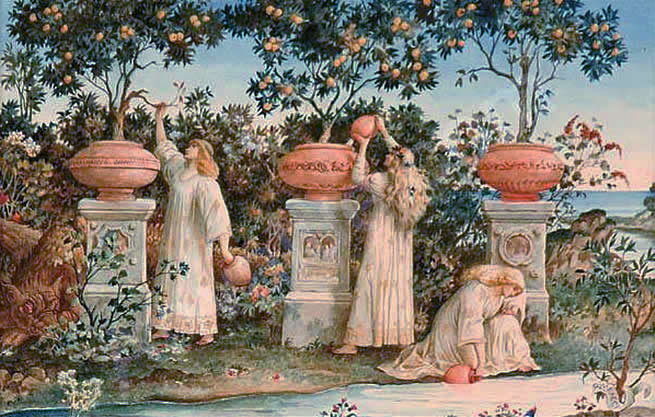
The Garden of the Hesperides was a fabulous garden, the domain of the three Hesperides, evening nymphs, who were the daughers of the titan Atlas. In this garden, guarded by a dragon, there was a tree that bore golden apples. This is probably a mythological allusion to oranges, as this fruit was not yet known in Greece.
Hercules, the greatest hero of Greek mythology, was a half-god, the son of the god Zeus and a human woman. To be admitted among the gods, he had to fulfill twelve extremely difficult tasks. One of his twelve tasks was to steal the golden apples of the Garden of the Hesperides.
According to an alternative version of this myth, Hercules did not accomplish this task alone, but with the help of Atlas. When Hercules came to find him and asked him where the garden was, Atlas offered to bring him the golden apples himself, on condition that Hercules would carry the sky for him during that time. In reality, he was all too happy to get rid of his heavy burden, and had no intention of carrying it again when he returned. So the sly Hercules asked him to take back the sky on his shoulders briefly, until he found a comfortable posture, and then he ran away with the apples.
The original Garden of the Hesperides was beyond the boundaries of the world of men, in a space accessible only to the gods. Later, after the beginning of the Greek colonisation in Cyrenaica, the myth changed: the garden was now in Euhesperides (Benghazi). In later versions of the myth, it was found at the edge of the known world: in Lixus (Larache), Mauretania, or in Spain.
The giant Antaeus
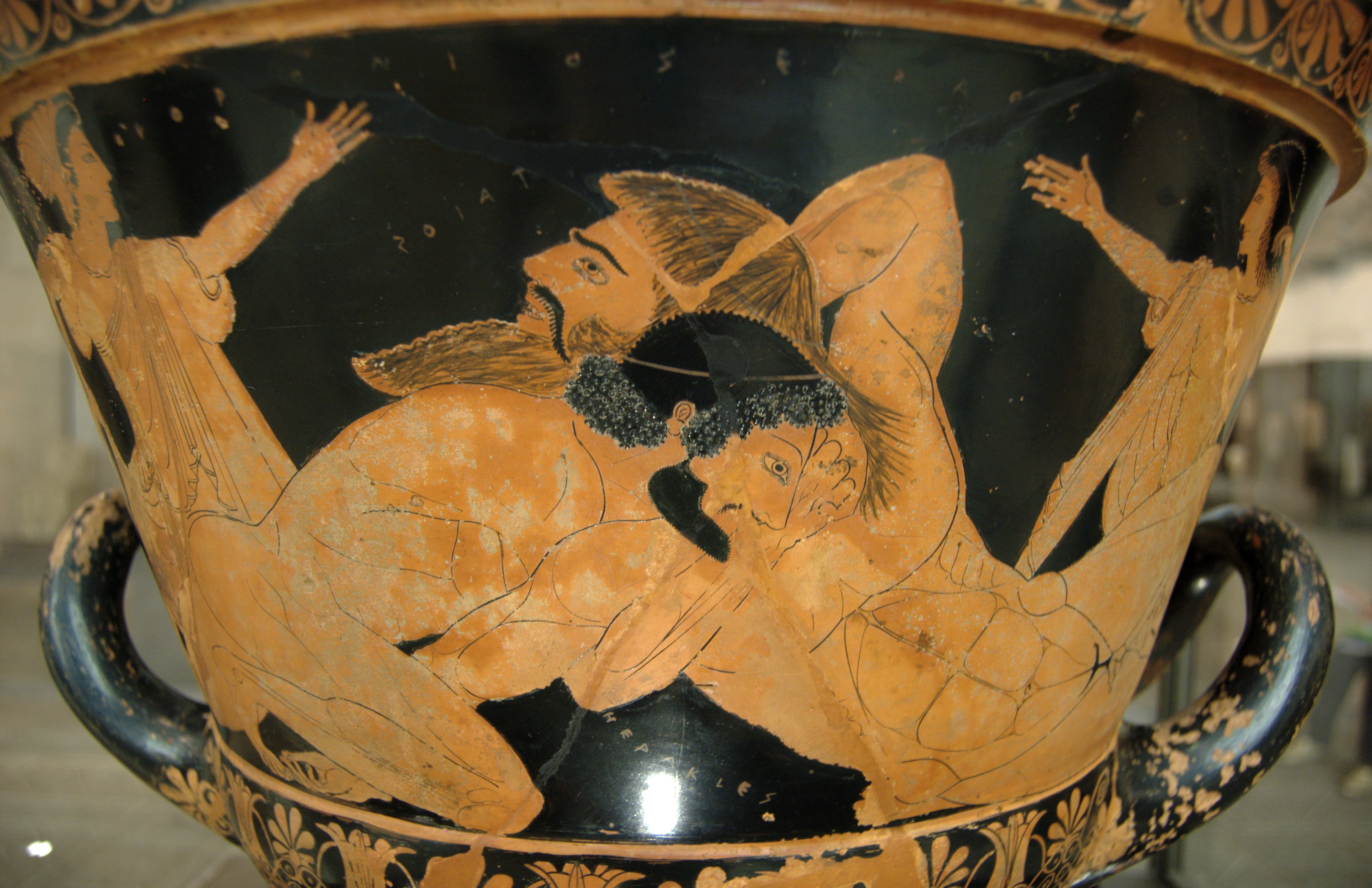
Antaeus (in Greek, Antaios, adversary) was a giant, the son of Poseidon (the sea) and Gaia (the earth). He was the first King of Libya, and the guardian of North Africa against foreign invaders. All the travelers who crossed through his Kingdom had to wrestle against him. As he was the son of the earth, Antaeus recovered his full strength every time he touched the earth, which enabled him to beat any opponent.
When Hercules came to Antaeus on his way to the Garden of the Hesperides, he challenged him for a wrestling match. To beat him, Hercules lifted him up in the air, so that he could not recover his strength by touching the earth, and then he strangled him to death.
In the oldest myths, Antaeus lived in the Libyan desert, an allusion to the contacts between Cyrenaican Greeks and Libyan Amazigh. More recent versions place him far further to the West, in Mauretania.
The Straight of Gibraltar

In ancient cosmology, the earth was seen as a flat disc, surrounded by the primeval ocean, an infinite water mass that absorbed the waters of all the world’s oceans. Mauretania and Spain were considered the last inhabited regions, before the unknown, full of scary monsters. The Straight of Gibraltar represented the end of the civilized world, with the “Pillars of Hercules”, two mountains on either side of the straight, indicating travelers that they had arrived at the edge of the known world.
There are many myths about the origins of the straight. According to one version, Hercules, while crossing the Atlas mountains during his quest for the Garden of the Hesperides, smote a mountain that was in his way. Because of his superhuman strength, the mountain was split in two, creating both sides of the straight from what was previously one single continent. The two parts of this mountain became the Pillars of Hercules. Other sources tell that instead of creating the straight, he actually narrowed it down, to prevent the sea monsters living in the Atlantic Ocean from entering the Mediterranean Sea.
The cities on the straight played an important role in the Greek worldview, as guardians of the civilized world. Some sources mention Tingis (Tangier) as the place were Hercules fought Antaeus. After killing him, Hercules slept with his wife, Tinjis, daughter of King Atlas of Mauretania. Their son Syphax founded the city of Tingis and named it in honor of his mother. The city is actually older than this legend: it was a way for the Greeks to invent a Greek origin to a city that was important to them.
The Greeks also made Hercules the founder of Icosium (Algier): when he returned from the Garden of the Hesperides, he left behind twenty of his companions, who founded the city.
The Libyan Amazons
The Amazons were a mythical people, made of female warriors, whom the Greeks fought on several occasions. One of the main Amazon groups lived in Libya. Their Queen was called Myrina.
Odysseus in Africa
Homer’s Odyssey is one of the most famous epic poems of Antiquity, that tells of the travels of Odysseus, one of the heroes of the Trojan war, to return home to his native island, Ithaca.
The places Odysseus visited cannot be identified with any certainty. His adventures are actually so full of fantasy that no direct link with real places and people can be made. However, some episodes could have happened in North Africa.

In Book 9, Odysseus and his companions land on an island. The inhabitants feed them lotus leaves, a plant that, as soon as they have tasted it, makes them forget all about their country, their family and all their past lives, so that they wish to stay there forever. Odysseus is forced to seize his companions and make them leave by force. Most specialists believe the island of the Lotus-eaters is the island of Djerba, in Tunisia.
After losing all his companions, Odysseus is stranded all alone on an island called Ogygia, where he will spend 7 years with the nymph Calypso, who promises him immortality if he agrees to stay with her and marry her. Calypso is described as the daughter of the titan Atlas, and her island is located at the far end of the world. The most common identification for this island is Gozo, in the Malta archipelago, but other specialists locate is closer to the Pillars of Hercules. One possibility is Perejil Island, of the Moroccan coast.

1 thought on “North Africa in Greek mythology”