

Français – عربي – ⵜⴰⵎⴰⵣⵉⵖⵜ – English
The Phoenicians were one of the first civilisations to develop vine cultivation and winemaking. While wild vine was already growing in North Africa long before the first Phoenician ships arrived, it was the Phoenicians, in Carthage and their other colonies, who taught the indigenous populations how to cultivate vine. Mago’s agricultural treaties, exposing the ancient Carthaginian viticulture techniques, strongly influenced the Romans and contributed to the growth of viticulture all through Europe.
From the Phoenicians…

Various species of wild vine have always grown all around the world. In North Africa, they are mostly found in mountain regions like the Atlas and Kabylie. Ancient men were quick to discover that when they pressed the grapes that grew on these vines, they obtained a juice that started fermenting immediately; but much more skills were required to transform the fermented grapes into a palatable drink.

The first archaeological traces of winemaking from wild vine were found in the Caucasus region. Vine cultivation started around 6000 years ago. The oldest known vineyard was discovered in Armenia and contains a clay tank and a vine press.
From the Caucasus, vine cultivation spread to Mesopotamia, and then the Middle East, and all the way to Greece. The Phoenicians used wine in their religious ceremonies, as an offering to the gods. The Phoenicians probably introduced wine to Egypt, where a prosperous winemaking industry appeared around 3.000 BCE.
The Phoenician traders were the first to see wine’s commercial value, which brought them to develop new, more sophisticated winemaking techniques in order to grow their production. The Phoenician cities of Tyre, Sidon and Byblos exported and sold wine by sea through all the Mediterranean world. The development of Phoenician colonies, including in North Africa, grew the demand for wine. Phoenician wine was so popular in the Greco-Roman world that the adjective “bybline” (from Byblos) was used for good-quality wine.
The two oldest Phoenician shipwrecks, Tanit and Elissa, were discovered in 1997, at the bottom of the Mediterranean. The ships contained 780 remarkably well-preserved amphorae of wine dating back to the 8th Century BCE. The two ships traded wine between Phoenicia and Carthage.

The Phoenicians diffused new varieties of vine through the Mediterranean basin, especially Vitis vinifera pontica, which became the ancestor of most of the most widely cultivated varieties of white grapes around the world today. They also taught the local populations – like the North African Amazigh – to cultivate the wild vine they already knew.
At the same time, the Greeks were also making wine. Greek viticulture learned a lot from the Phoenicians. In North Africa, the Greek colonists introduced vine into Cyrenaica in the 7th Century BCE. This fertile, luxurious region was ideal for large-scale viticulture. Wine presses were found in cities like Cyrene and Euhesperides (Benghazi). The Greeks also introduced vine to Massalia, Southern Gaul.
… to Carthage…

Carthage, the main Phoenician colony in North Africa, was an important winemaking center. Passum, a highly popular straw wine (produced from dried grapes), was from Carthage.
In the 4th Century BCE, the Carthaginian countryside was full of vine and olive trees. Wine from the Bagradas (Medjerda) river valley was especially popular.

The Carthaginians also introduced vine into Spain, in the old coastal Phoenician colonies. They sold wine to the local tribes, in exchange for precious metals like silver and tin, which were abundant in the region.
Mago, a 2nd-Century Carthaginian author, wrote an agricultural treaty in 28 books, on Carthaginian agricultural knowledge. Major sections of his book explain how to plant and prune vine. He recommends to plant vine on slopes oriented towards the North, to protect them from the sun. He also exposes the best Carthaginian winemaking practices, especially how to produce the best straw wine. His book was so influential that after the destruction of Carthage, the Roman Senate ordered it to be translated into Latin.
… to the Romans…

Viticulture and winemaking in North Africa continued in the Roman era, especially in urban centers like Carthage and Volubilis. African wine was highly appreciated in the whole Roman world. Together with wheat and olive oil, it played an important role in the region’s economy.

Under the influence of Mago, the Romans developed advanced viticulture techniques inspired from the Carthaginians. Mago’s book is now lost, but it was quoted by Latin authors. Columella, a 1st-Century author who quotes Mago abundantly, was from Gadir (Cadiz), a former Punic city in Spain, which explains his interest for the Carthaginian author. It can be said that, via Mago, the whole modern European and Western winemaking industry is in debt to Carthage.
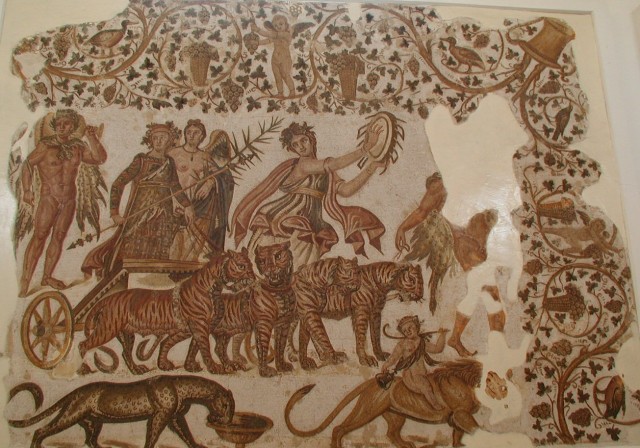
The Greek-Roman god of wine was Dionysus – his Latin name was Bacchus – who, according to mythology, taught men how to cultivate vine. The cult of Bacchus was highly popular in Roman Africa, and involved ecstatic rites of drunkenness, often together with sexual orgies.

In the Roman era, large Jewish communities settled in North Africa. Later on, Christianity also became very popular in the region. Both religions see wine as a gift of God – their sacred texts even say that wine “rejoices the heart of man” – while also condemning drunkenness and encouraging a reasonable consumption. Christians even use wine in their religious service, as an element of the Eucharist. The Christianisation of the region caused a deep change in wine drinking habits, by discouraging excessive drinking. Later on, Christian monks developed new fermentation methods, for wine and beer, to create new flavors.
… until today
Winemaking in North Africa strongly decreased after the arrival of Islam, because of the religious prohibition of alcohol consumption; but it never completely disappeared. Especially, North African Jews continued producing wine for their own consumption.

The North African winemaking industry underwent a renewed time of growth in the French (and Italian, in Libya) colonial era, when many new vineyards were planted. Especially in Algeria, French colonists produced wine, for their local consumption or to export it to metropolitan France. There is even a theory that the French community in Algeria were called “Pieds-Noirs” (“Black-Feet”) because their feet were black from crushing grapes! When in the middle of the 19th Century, an epidemic ravaged the French vineyards, Algerian wine filled the void.

Just before independence, Algeria was the fourth-largest winemaking country in the world after France, Italy and Spain, and had over a dozen of estates classified as “Vin délimité de qualité supérieure” (Superior quality delimited wine). After the colonists and the French army, two important local wine-drinking groups, left, Algerian wine production started declining, forcing the local vineyards to find new markets like USSR. New efforts are now ongoing to revive the Algerian wine market.

Morocco’s wine production developed a lot since the 1990s, and the country is now seen as having the highest winemaking potential in the region. Thanks to the efforts of local producers, Morocco now has over 50.000 hectares of vineyards, mostly in the Fes-Meknes and Oriental regions, and produces high-quality wine for the local and international markets. Boulaouane, a wine from Doukkala region, is the best-sold foreign wine in France.

In Tunisia, winemaking is mostly located around the Cape Bon, and the country mostly produces rosé wine. A local producer in Kelibia renders homage to the Carthaginian agronomist Mago, whose writings spread the Carthaginian winemaking know-how through the whole Roman world, by producing the country’s most popular wine, called Magon.
