

Français – عربي – ⵜⴰⵎⴰⵣⵉⵖⵜ – English
Originally from the desert of Arabia, dates have been cultivated in the Middle East for thousands of years. Their arrival in North Africa is much more recent: the first date palms arrived in Egypt about 6000 years ago, and then Libya about 3000 years ago. When it started spreading in the region, the Arabian date palm crossed with local wild date palm species, giving birth to the North African date palm. While the Phoenicians are not the originators of date cultivation in North Africa, they certainly played a role in its spread.
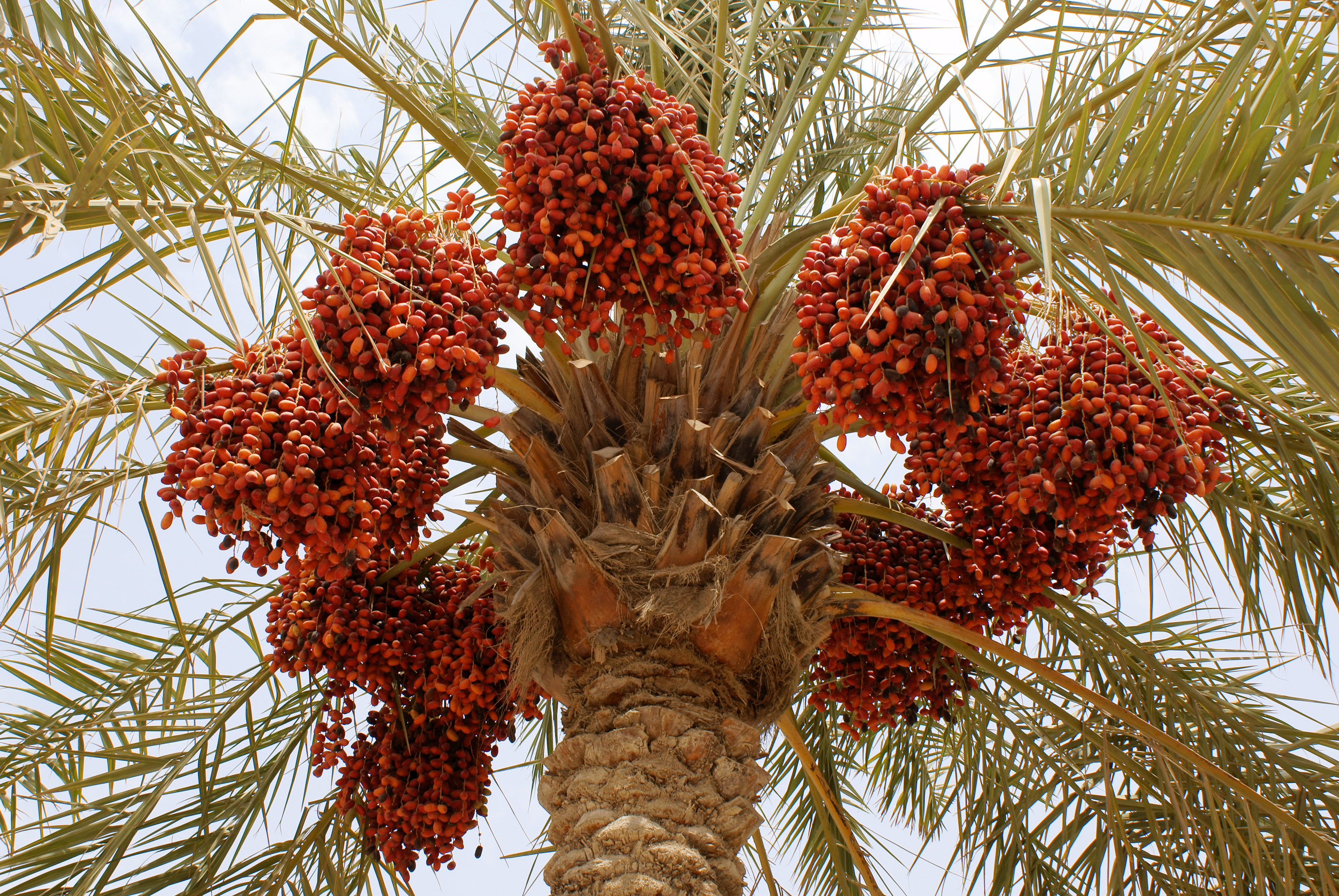
Date palms are a type of palm trees, originally from Arabia and the Indus Valley. Their deep roots, which enable them to reach underground waters that are inaccessible to other plants, and their resistance to heat, make them ideally adapted to life in desert regions. Their naturally sweet fruit is emblematic of oasis agriculture.

The oldest archaeological traces of date cultivation go back to 7000 BCE in modern-day Pakistan, and 5500 BCE in Arabia. Date cultivation spread to Egypt around 4000 BCE. In the rest of North Africa, it started much later: around 1000 BCE in Libya, from where it spread to the whole region. The Greek historian Herodotus mentioned that the Nasamon Amazigh cultivated dates in the Awjila oasis.
On its arrival in North Africa, the Arabian date palm (Phoenix dactylifera) met another wild variety of date palm: Phoenix theophrasti, originally from Crete, which was already living in the region. A crossing between the two species happened around 3000 years ago, giving birth to the modern-day North African date palm.

What role did the Phoenicians play in the spread of date cultivation? Their role is not well-known, but it cannot be a coincidence that the time when date palms started spreading in North Africa corresponds to the establishment of the first Phoenician colonies. The Latin name of the date, Phoenix, refers to the Phoenicians.
The Phoenicians certainly didn’t import the first dates on their ships: this desert fruit spread by land, from Egypt to Libya. The crossing between the Arabian date palm and the local wild date palm was probably a natural hybrid, but the Phoenicians certainly selected the best plants in order to obtain new varieties. What is certain is that the Phoenicians largely contributed to the spread of dates produced in North Africa, especially the new hybrid form, throughout the Mediterranean world.

Later on, date cultivation developed a lot in Carthage, where dates played a crucial role in the economy of the Carthaginian Empire: they served as basic food, natural sweetener, exchange money, and trade resource. The Carthaginians developed sophisticated agricultural and irrigation techniques to optimize their date production, exploiting the fertile land in their territory. Carthaginian dates were sold throughout the Mediterranean world. Date palms were a strong symbol of the power and fertility of Carthage, and were often represented on coins.

Date cultivation in Carthage and its zone of influence continued in the Roman era. In the Roman world, date palm branches were used for military processions, as a symbol of victory.
Dates also play an important symbolic role in the Jewish, Christian and Muslim religions: they are mentioned over 50 times in the Bible and 20 times in the Quran. The Jews eat dates for their religious celebrations. In Christianity, date palm branches are used on Palm Sunday, to celebrate Christ’s triumphant entry into Jerusalem, one week before his crucifixion.

Nowadays, date cultivation still has an important place in the North African socioeconomic landscape, especially in the desert oases. Despite its traditional importance, date cultivation is threatened by drought and disease. The North African nations, from Egypt to Morocco, still produce over 1.9 million tons of dates per year.
