

Français – عربي – ⵜⴰⵎⴰⵣⵉⵖⵜ – English
After the Roman Empire became Christian, many Roman temples and civil buildings were transformed into churches. For the Christians, this was a way to reclaim the ancient Roman genius, by putting its most beautiful constructions in the service of their religion. A good example is the Severan Basilica, an emblematic building of the Libyan city of Leptis Magna.
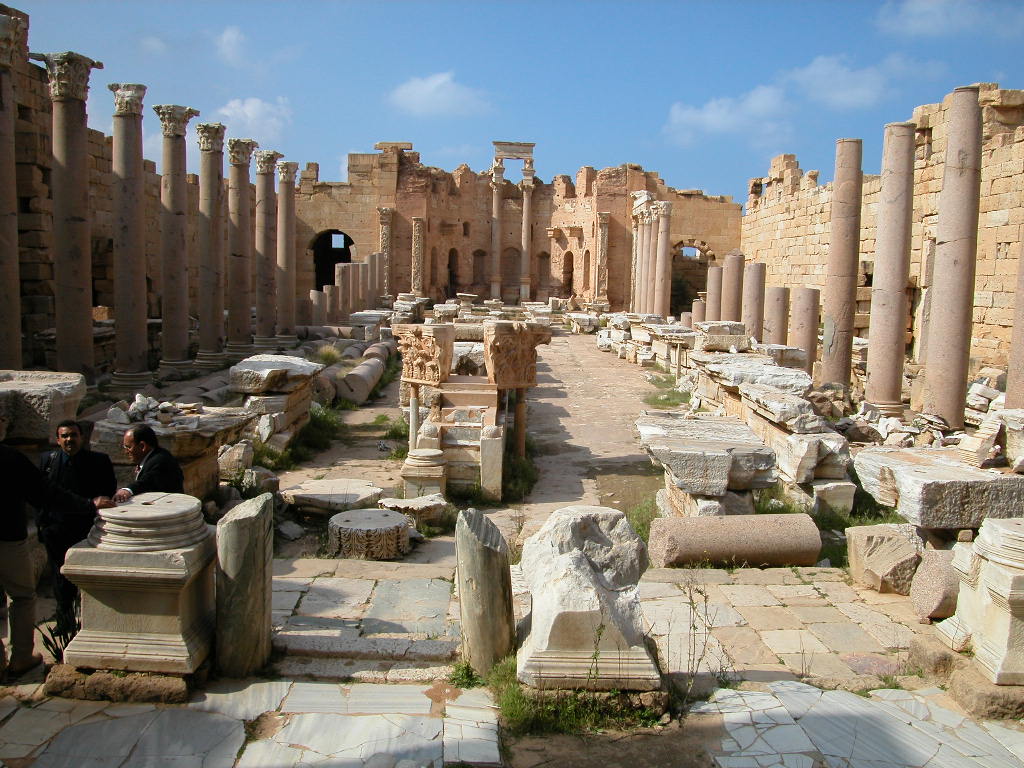
The Severan Basilica was built by the Roman Emperor Septimius Severus, who was born in Leptis Magna. Its history is linked to the Arch of Septimius Severus: when Septimius Severus visited Leptis Magna in 203, the local authorities built the Arch in his honor. To thank them, the Emperor then built the Basilica, inspired by the Ulpia Basilica, in Rome. Septimius Severus’ son and successor Caracalla later finished the construction of the Basilica.

The Basilica was about 95 meter long and 35 meter large. Is was divided into three naves, which were separated by ranges of columns. The columns were made of Egyptian purple granite and Euboean green marble. At the two sides, there were apses (semi-circular walls) with platforms on which the magistrates could stand. The Basilica served as a public court, among other uses.
Two of the Basilica’s columns contain especially remarkable decorations. One represents Hercules, the other Dionysus.

In 533, the Severan Basilica, which had fallen in ruins during the Vandal occupation, was restored. It then became a Christian church, consecrated to Mary the mother of Jesus.
The church pulpit was built with the stones of an old altar in the Basilica, to symbolize the pagan idols’ powerlessness and the triumph of the Christian God. A baptistery, in the shape of a cross, was also built. However, apart from those elements that were necessary to Christian worship, the old Roman Basilica was left largely intact. Roman Christians did not see their faith as a break with the past, but they wished to preserve all that made the glory of ancient Rome, by removing only what went directly against their faith.
