Christianity in North Africa, Roman North Africa

Synesius of Cyrene: a Neoplatonic philosopher from Cyrene

Français – عربي – ⵜⴰⵎⴰⵣⵉⵖⵜ – English

Synesius of Cyrene, a Neoplatonic philosopher from Cyrenaica, was the last major figure from a previously highly influential region. Originally from Balagrae (Al-Bayda), he represented Cyrenaica as ambassador to the Imperial court. After a prestigious political career, he even became bishop of Ptolemais by the end of his life. His works sought to reconcile classical Greek-Latin thought and Christian theology.

Origins

Synesius of Cyrene

Synesius was born around 370, close to Balagrae (Al-Bayda). He was the eldest son of an ancient noble family with Greek origins, who claimed descendence from the kings of Sparta. He grew up on the family domain in the Jebel Akhdar, surrounded by nature and the pleasures of rural life. At the same time, he received an elite education, in Cyrene, then Alexandria.

At this time, the formerly prosperous region of Cyrenaica was declining. Cyrene, weakened by the 365 earthquake and by the recurring attacks of the surrounding Amazigh tribes, had been replaced by Ptolemais as provincial capital. In this context, the young Synesius discovered his life vocation: preserving Greek-Roman civilization in Cyrenaica.

Hypatia of Alexandria

As a young man, Synesius was sent by his family to continue his studies in Alexandria with his brother Euoptios. In the Egyptian capital, Synesius became a disciple of the famous philosopher Hypatia, who introduced him to Neoplatonic philosophy. All his life, he would keep a deep admiration for Hypatia. One of the letters he wrote to her contains the first mention of the hydrometer, a liquid measuring tool she fabricated.

Around 395, he traveled to Athens. While he had high expectations about this visit to the city of philosophers, he returned to Cyrene very disappointed. This trip made him aware of the decline of the Hellenistic intellectual tradition.

Mission to Constantinople

Around 398, Synesius was sent as an emissary of Cyrenaica to the imperial court, to plead the cause of his fellow citizens and petition the Emperor for a tax exemption, so that the region may rebuild itself. In his address to Emperor Arcadius, he advises him on how to reign with wisdom, with special insistence on the importance of fighting corruption. After long diplomatic negotiations, his mission was finally successful. From this experience, he kept a deep dislike for the political intrigues of the imperial court, which upset the young philosopher’s idealism.

Astrolabe

In Constantinople, he contacted Paeonius, a military officer from the Emperor’s circle, who was interested in Hypatia’s scientific experimentation. As an introductory present, he gave him a scientific tool which he had fabricated in Alexandria: an astrolabe, to measure the position of the stars. Together with this gift, he wrote an essay encouraging civil and military authorities to show interest in science and philosophy.

Is was probably also during this stay in Constantinople that he had his first significant contacts with Christianity, which was highly influential at the imperial court. The majority of the Roman world, including in Cyrenaica, were already following the new religion, but Synesius’ family were part of the conservative elite that remained faithful to the old religious traditions. However, his discovery of Christianity did not lead to a break with this heritage: on the contrary, it led him to seek to preserve classical Greek-Roman thought by integrating it into Christian thought.

Career in Alexandria and Cyrenaica

Alexandria

Synesius returned to Cyrene in 402. The following year, he got married, in Alexandria. His wife, whose name is unknown, was from an influential Alexandrian family, and she was a Christian. They had three children, who all died before him. The letters Synesius wrote show that he deeply loved his wife and was very attached to his family. He wrote a poem in honor of his wife.

During the following years, Synesius spent his time between Alexandria, where his family lived, and his native Cyrenaica. In Cyrenaica, his main preoccupation was defending the cities against attacks by Amazigh tribes. In 409, he wrote a letter to Troilus, a philosopher from the court of Praetorian Prefect Anthemius, asking him to intervene with Anthemius and ask him to protect Cyrenaica against these attacks. In Alexandria, he became friends with bishop Theophilus, who might have officiated at his wedding.

In his spiritual journey, Synesius slowly came closer to Christianity, without ever cutting off his Hellenistic roots. His wife’s Christian faith, as well as his friendship with bishop Theophilus of Alexandria, certainly played a decisive role in his gradual conversion. At the same time, he remained very close to Hypatia, who, while she was a pagan, was tolerant of Christians and had many Christian students. A few years after he got married, Synesius finally asked to be baptized.

Bishop of Ptolemais

Church ruins in Ptolemais

In 410, Synesius’ friend bishop Theophilus of Alexandria chose Synesius to become the new bishop of Ptolemais. As bishop of the capital of Cyrenaica, he would have authority over all the bishops in the province. This nomination was surprising: while Synesius was a trained classical philosopher, his knowledge of the Christian sacred texts was limited. It is possible that he wasn’t even baptized yet! Despite this, Theophilus believed that the Church needed leaders with his education, to manage the growing Christian influence in society. Synesius’ case was not unique: many other young nobles who had only recently converted received responsibilities in the Church around the same time.

Synesius was hesitant to accept this nomination. First, most Christian leaders at the time were celibate, and he didn’t want to have to renounce his family. Also, some of his ideas, especially his belief in the preexistence of the soul, a fundamental Neoplatonic tenet, went against official Christian doctrine. He finally agreed, on condition that he would not have to separate from his wife, and that he would not be forced to confess certain Christian doctrines he did not believe in, like the creation of the soul, bodily resurrection, and the future destruction of the world. In exchange for these concessions, he committed not to preach his ideas publicly. The fact that this arrangement was accepted is an indicator of the doctrinal flexibility of Christian church authorities at this time.

Church ruins in Ptolemais

As the bishop of Ptolemais, Synesius opposed Andronicus, the prefect of Cyrenaica, a tyrant who had tortured innocent citizens. After calling him several times to repent, he finally excommunicated him (excluded him from the Church). This decision could have cost him his life, but he stood firm against the injustices his fellow citizens were suffering. In a letter he wrote, Synesius testifies that during this confrontation, he was tempted to renounce his charge as a bishop, especially when one of his friends, the treasurer of public funds, was imprisoned by Andronicus. However, all this ended up strengthening his resolve to continue.

He also had to solve a conflict between the bishops of Darnis (Derna) and Erythrum (Al-Athrun), over a church that was located at the border between their two dioceses. His skills in civil administration came in handy in this business. His mediation effort shows how important peace and harmony inside the church was to him.

In 411, Ptolemais was attacked and destroyed by Amazigh tribes. In exile, Synesius wrote the Catastasis, a lamentation on the fall of Cyrenaica.

In 413, Synesius’ third and last son died. This was another very hurtful experience for him. Synesius himself died in 414, at around 44 years of age. On his deathbed, he wrote a last letter to Hypatia; she would be killed the following year.

Works

Synesius’ most famous works are his nine Hymns: poems of Neoplatonic inspiration, describing the mystical quest of the human soul as it seeks unity with God. The first Hymns were written while he wasn’t yet a Christian, and the following ones show how his thinking evolved, to integrate Christian ideas into his Neoplatonic spirituality. All his works are a unique and fascinating synthesis between Christianity and Neoplatonicism.

Synesius’ life is known mostly from his 159 Letters, which he wrote to his wife, to his brother, to Hypatia, to Theophilus of Alexandria, to other bishops, etc. These letters also give a good look on his noble character.

One of his letters is the last mention of silphium: he writes that this plant no longer exists in his lifetime, and that its disappearance is one of the causes of the decline of his native Cyrenaica.

Some of his letters mention poems he wrote, which are lost.

We already mentioned his speech On Imperial Rule, addressed to Emperor Arcadius, and his essay on the fabrication of the astrolabe. During his stay in Constantinople, he also wrote an allegorical poem on the war between the Roman Empire and the Goths, with thoughts on the reasons why God allows evil.

During his whole life, Synesius was fascinated by dreams, which he saw as a way for the soul to discover hidden truths and to communicate with God. Around 405, he wrote a treatise on dream interpretation.

Another one of his work is humorous: in On Baldness, he argues that being bald is better than having hair, because a bald head looks more like a sphere, the most perfect of all shapes.

From his years as a bishop, we still have two homilies (church sermons), that give us an idea of how he interpreted the Christian sacred texts.

After the destruction of Ptolemais, he wrote the Catastasis, a lamentation on the fall of Cyrenaica.

Finally, he wrote a lost book on how to breed hunting dogs. Hunting was his great passion, which he reluctantly gave up when his responsibilities no longer allowed him to practice it.

Roman North Africa

The three Roman cities of Libya: Sabratha, theater, temples and sea

Français – عربي – ⵜⴰⵎⴰⵣⵉⵖⵜ – English

In the Roman era, the region to the West of Libya was known as Tripolitania, for its three cities (tri polis), former Phoenician colonies later controlled by Carthage, and then by the Romans. Sabratha, the Westernmost of the three cities, grew considerably in the Roman era and still contains some of the most spectacular Roman ruins in Libya. The Roman African writer Apuleius lived in Sabratha.

Forum of Sabratha
Libyan-Punic Mausoleum of Bes (Source)

Sabratha was founded in the 6th Century BCE, by Phoenician colonists from Tyre or Sidon. It was the last of the three Phoenician colonies in the area to be established. Its name is of Libyan origin and means “grain market”.

Around 550, Sabratha, together with the rest of the region, came under control of the Carthaginian Empire. The Mausoleum of Bes is the only Punic building that still remains in Sabratha.

After the Second Punic War, the region was conquered by King Massinissa of Numidia. While Leptis Magna and Oea (Tripoli) became free cities under Roman sovereignty after the revolt of Jugurtha, Sabratha remained Numidian for one more century. The port of Sabratha was used as a trade outlet for the Saharan hinterland of the Kingdom of Numidia.

Coin from Sabratha (Source)

Sabratha came under Roman control after the 1st-Century Roman civil war. It was originally part of the province of Africa Nova, and then of Proconsular Africa. Punic influence remained strong in Sabratha: the city still minted coins with Punic inscriptions during the reign of Emperor Augustus.

Sabratha theater

In the Roman era, Western Libya was first known as Syrtica, a reference to the Gulf of Sirte, and then as Tripolitania, because of its three cities (tri polis): Leptis Magna, Oea and Sabratha. Sabratha became a Roman colony around 157, during the reign of Emperor Antonine. Tripolitania, originally a part of the province of Proconsular Africa, became a Roman province during the reign of Septimius Severus, who was born in Leptis Magna.

Roman baths (Source)

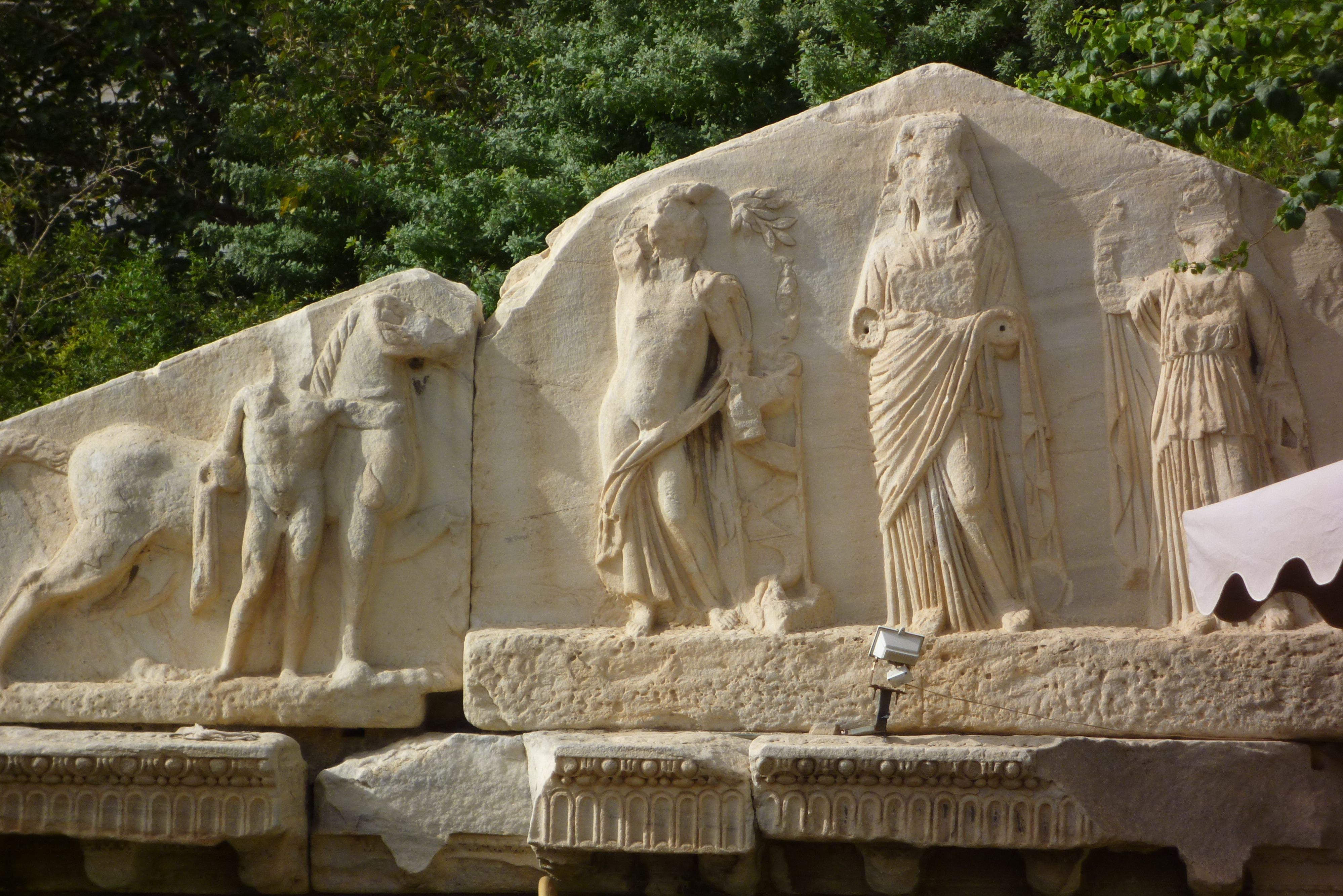
Sabratha underwent a spectacular development in the Roman era, especially under the Severan dynasty. Its size almost doubled. The city contains beautiful, remarkably well-preserved remains of Roman buildings. The main one is the theater, which was built during the reign of Septimius Severus or of his predecessor Commodus. There is also a forum, several temples – including the Temple of Hercules, built by Commodus – and Roman baths next to the sea. Finally, several beautiful mosaics have been preserved.

Basilica of Apuleius

The Roman African writer Apuleius, the author of The Golden Ass, the first Latin-language novel, was put on trial for sorcery in Sabratha. The Basilica of Sabratha, where the trial took place, was named Basilica of Apuleius. It became a church in the 5th Century.

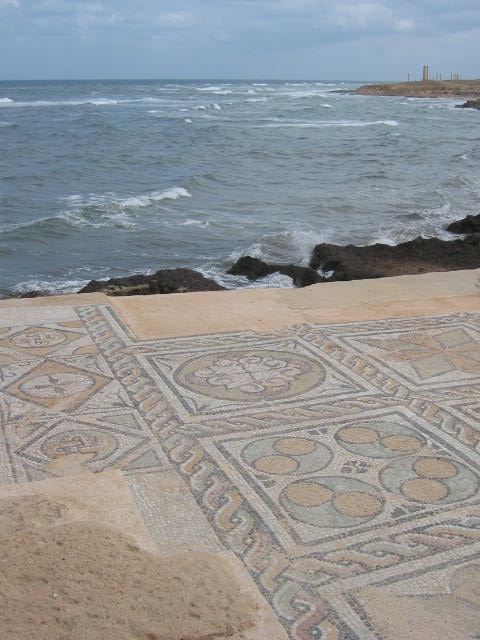
Christian mosaic in Sabratha : the peacock was a Christian symbol of immortality (Source)

In the Roman era, Tripolitania became one of the most strongly Christian areas in the Roman Empire. In 255, the bishop of Oea took part in a regional church council organized in Carthage, where he spoke in the name of his colleagues from Leptis Magna and Sabratha. This means that there was a Christian community in Sabratha at this time, with a bishop, even though we don’t know his name. Several ruined churches can still be seen in Sabratha today.

Sabratha was strongly damaged by a tsunami in 365. The city was mostly abandoned in the Vandal era. It underwent a small renewal in the Byzantine era. After the Arab conquests, it lost most of its importance.

Roman North Africa

The year when Oea waged war against Leptis Magna

Français – عربي – ⵜⴰⵎⴰⵣⵉⵖⵜ – English

The ancient cities of Leptis Magna and Oea (Tripoli) were rivals since their foundation. In spring 70 CE, the inhabitants of Oea profited from an internal crisis in the Roman Empire to declare war on their old enemy. With the help of the Garamantes, they attacked Leptis Magna and ravaged the surrounding countryside.

Context

Nero

By the end of the reign of Emperor Nero, who was becoming more and more tyrannical, major factions of the Roman army rebelled against him. Nero wad defeated and committed suicide in 68. After his death, the Empire fell into instability, with four Emperors succeeding each other in one year.

In Africa, the proconsul Lucius Calpurnius Piso supported Vitellius as Emperor. When Vitellius was overthrown by Vespasian, Valerius Festus, the commander of the Roman legions and an ally of Vespasian, killed the proconsul and succeeded him. Detailed article

The war between Oea and Leptis Magna

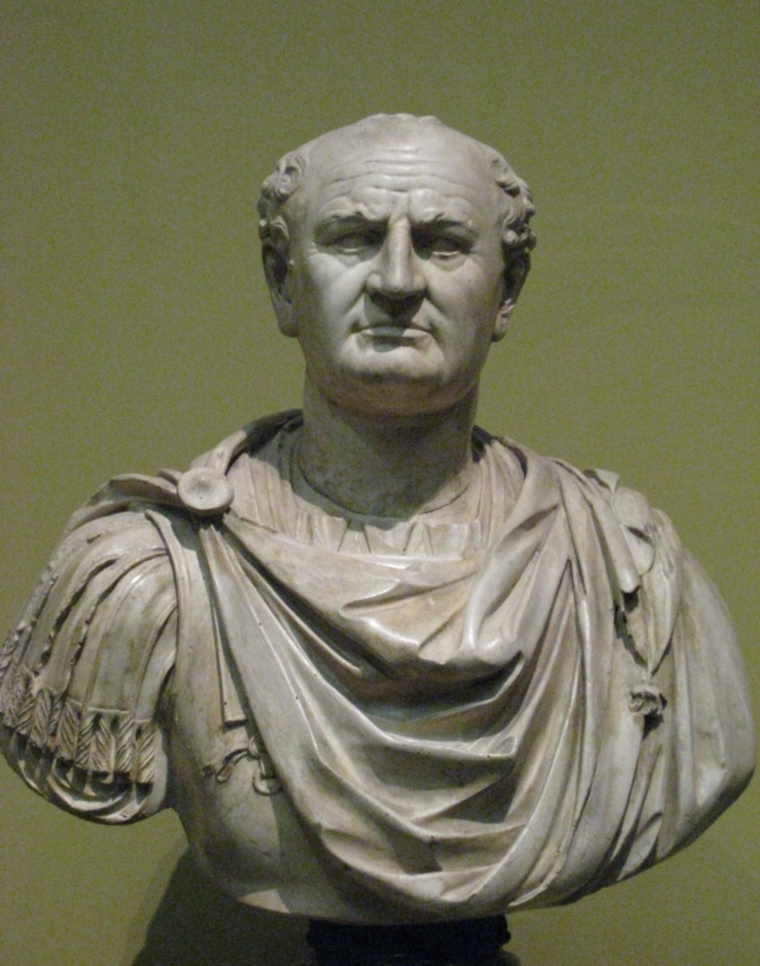
Vespasian

When the inhabitants of Oea saw that the Roman administration was weakened by the crisis, they seized the opportunity to declare war on their old enemies of Leptis Magna, believing that the new proconsul would not intervene. The official cause of the conflict tensions between farmers of the two cities over harvest and cattle theft. The war was actually a continuation of their ancestral rivalry.

As the inhabitants of Oea were heavily outnumbered, they made an alliance with the Garamantes of the Fezzan. Together, they pillaged the countryside around Leptis Magna and terrorized the city’s inhabitants, who were forced to draw back behind the city walls.

Mosaic showing the execution of a Garamante, amphitheater of Leptis Magna (Source)

The Roman historian Tacitus recounts these events: “Its origin had been petty – the stealing of crops and herds by the peasants of the two states. But by this time it involved full-scale hostilities and set battles. The reason was that the men of Oea, being outnumbered, had called out the Garamantes, a wild tribe much given to plundering its neighbors. Thus the people of Lepcis had been reduced to sore straits. Their lands had been extensively ravaged, and they were now cowering behind the walls of their capital. But the intervention of the Roman auxiliary horse and foot resulted in the utter defeat of the Garamantes and the recovery of all the loot, apart from that which the nomads had sold to the people of the interior as they wandered from one inaccessible encampment to another.”

Despite the inhabitants of Oea’s expectations that he wouldn’t intervene, the Roman proconsul did send troops to put an end to the conflict. This war might have been the first time that the Roman army used camels.

Roman North Africa

The three Roman cities of Libya: Oea, the ancient Tripoli

Français – عربي – ⵜⴰⵎⴰⵣⵉⵖⵜ – English

In the Roman era, the region to the West of Libya was known as Tripolitania, for its three cities (tri polis), former Phoenician colonies later controlled by Carthage, and then by the Romans. Oea, the ancient Tripoli, is the oldest of these cities. It was founded by the Phoenicians as Oyat, and then shortly occupied by the Cyrenaican Greeks. It developed a lot during the Roman era, and Roman remains are still visible in Tripoli today.

Arch of Marcus Aurelius: the main Roman building in Tripoli
Reconstitution of the Phoenician port of Oyat – Image created by ChatGPT

In the 7th Century BCE, Phoenician traders, probably from Tyre, settled at the site of the future city of Tripoli. The Tripoli bay formed a natural port, which was ideal for their ships. On the small peninsula to the West of the bay, they founded a city, which they called Oyat (𐤅𐤉‬𐤏‬𐤕‬). Oyat is the oldest of the three Phoenician colonies in the region.

Punic sphinx of Oea (Source)

Later on, Oyat was conquered by the Cyrenaican Greeks, who named it Oea (Ἐώα), the Greek form of its former Phoenician name. Around 550 BCE, the Carthaginians intervened to take back the city from the Greeks. Oea, together with Leptis Magna and Sabratha, came under control of the Carthaginian Empire, but the city kept its Greek name.

After the fall of Carthage, the region came under Roman influence. In spring 70 AD, war broke out between Leptis Magna and the neighboring city of Oea. The conflict was originally motivated by tension between farmers of the two cities over harvest and cattle theft. As the inhabitants of Oea were heavily outnumbered, they made an alliance with the Garamantes of the Fezzan. Together, they pillaged the countryside around Leptis Magna and terrorized the city’s inhabitants, who were forced to draw back behind the city walls. The conflict was solved through the intervention of the Roman governor.

Reconstitution of the Roman city of Oea – Image created by ChatGPT

In the Roman era, Western Libya was first known as Syrtica, a reference to the Gulf of Sirte, and then as Tripolitania, because of its three cities (tri polis): Leptis Magna, Oea and Sabratha. Oea became a Roman colony during the reign of Emperor Trajan. Tripolitania, originally a part of the province of Proconsular Africa, became a Roman province during the reign of Septimius Severus, who was born in Leptis Magna.

Facade of the Genus coloniae temple

Unlike Leptis Magna and Sabratha, Oea/Tripoli was continually inhabited since the Roman era. Paradoxically, this means that its Roman remains are less well-preserved as in the neighboring cities, because its inhabitants either reused the stones of ruined buildings, or built on top of the ancient city. The main Roman building that has survived until today is the Arch of Marcus Aurelius (see image above), built in 165 by Emperor Marcus Aurelius, to commemorate his brother Lucius Verus’ victory against the Persian Emperor Vologases IV. The remains of a small Roman temple, Genus coloniae, are kept at the Tripoli Museum. Further archaeological treasures are certainly awaiting discovery underneath the modern city, but excavations have been limited for the moment.

Apuleius

The Roman African writer Apuleius, the author of The Golden Ass, the first Latin-language novel, lived in Oea. He was put on trial for sorcery in the neighboring city of Sabratha.

In the Roman era, Tripolitania became one of the most strongly Christian areas in the Roman Empire. In 255, the bishop Natal of Oea took part in a regional church council organized in Carthage, where he spoke in the name of his colleagues from Leptis Magna and Sabratha. The fact that he was chosen as a delegate to represent all Christians in Tripolitania shows that while Leptis Magna was much larger and more influential, Christianity was probably better established in Oea.

In the 5th Century, Oea was conquered by the Vandals together with the rest of Tripolitania. Bishop Cresconius of Oea was one of the North African bishops who were exiled by the Vandal King Huneric in 484.

Arabic map of Tripoli

The city underwent a small renewal in the Byzantine era. The ruins of the Byzantine Church of Oea can bee seen close to the ancient Medina of Tripoli.

After the Arab conquest of Tripolitania, the Arabs chose Oea as their new regional capital. The city’s old name was replaced by Tripoli (Tarabulus طرابلس in Arabic) around the 9th Century. Tripoli is sometimes called the “Mermaid of the Mediterranean” – in Arabic, Arusat al-Bahr (عروسة البحر), literally “bride of the sea” – because of its beautiful beaches.

Christianity in North Africa, Greeks in North Africa, Roman North Africa

Hypatia: the last philosopher of Alexandria

Français – عربي – ⵜⴰⵎⴰⵣⵉⵖⵜ – English

Hypatia of Alexandria was a Neoplatonist philosopher, mathematician, and astronomer, who was leading the Neoplatonist school of Alexandria in the 4th-5th Centuries. She was renowned for her knowledge and respected by all for the wisdom of her teaching and council. She is the first female mathematician whose life is so well documented.

Hypatia was born between 355 and 370, depending on the sources. She was the daughter of the mathematician Theon of Alexandria. Her father was the director of the Museion, a highly renowned Neoplatonist school. While she had many suitors, she wasn’t interested in men and never married (legend has it that she gave an especially pushy suitor a tissue soaked with her menstrual blood).

Hypatia taught mathematics and astronomy to students who originated from the whole Mediterranean basin. While she was a Pagan herself, she was very tolerant of Christians and had many Christian students, including future bishops. Her most famous student was Synesius of Cyrene, who deeply admired her.

As for her works, she wrote a commentary of Diophantus of Alexandria’s Arithmetics, and of Apollonios of Perga’s treatise on conic sections. She probably also participated in her father’s edition of Claudius Ptolemy’s Almagest. She knew how to make astrolabes (instruments used to calculate the date and time based on the planets’ position) and hydrometers (instruments used to determine a liquid’s density). In astronomy, she mostly devoted herself to the calculation of the date of the equinox.

Fictional portrait of Hypatia, by Alfred Seifert

Hypatia was a well-known and respected figure in Alexandria. The Christian historian Socrates Scolasticus speaks very highly of her: “There was a woman at Alexandria named Hypatia, daughter of the philosopher Theon, who made such attainments in literature and science, as to far surpass all the philosophers of her own time. Having succeeded to the school of Plato and Plotinus, she explained the principles of philosophy to her auditors, many of whom came from a distance to receive her instructions. On account of the self-possession and ease of manner, which she had acquired in consequence of the cultivation of her mind, she not unfrequently appeared in public in presence of the magistrates. Neither did she feel abashed in coming to an assembly of men. For all men on account of her extraordinary dignity and virtue admired her the more.” Despite this, she became a victim of the growing intolerance of Alexandrian Christianity, eager to overcome the old order.

In 412, bishop Theophilus of Alexandria died and his nephew Cyril succeeded him. While Theophilus seems to have been on good terms with Hypatia, Cyril mistrusted her. In 414, after several violent incidents between Jews and Christians in Alexandria, bishop Cyril had all the city’s synagogues closed and expelled the Jewish population. These measures shocked Orestes, the city governor, who was a close friend of Hypatia. Orestes, who had himself recently converted to Christianity, shared Hypatia’s desire for peaceful coexistence between Christians, Jews and Pagans. He was also concerned that the bishop was overstepping his prerogatives and impinging on the powers of the civil authorities, with the support of the Alexandrian popular classes, who were strongly Christian and more and more fanaticized.

The conflict between the bishop and the governor degenerated into a violent clash. In this confrontation, Cyril could count on the support of the monks (parabalani) of the Nitrian desert, South-West of Alexandria. During a riot, a monk named Ammonius threw a stone on Orestes, wounding him at the head. Orestes, furious, had him tortured so violently that he died. Cyril wanted to proclaim him a martyr, but most Christians were opposed to this move, which increased the tensions even more.

Death of Hypatia

In this context, rumors started to spread that Hypatia, who was advising the governor, was working against any reconciliation between him and the bishop. The monks, furious, seized her and killed her. Socrates Scolasticus recounts her murder: “Some of them therefore, hurried away by a fierce and bigoted zeal, whose ringleader was a reader named Peter, waylaid her returning home, and dragging her from her carriage, they took her to the church called Cæsareum, where they completely stripped her, and then murdered her with tiles. After tearing her body in pieces, they took her mangled limbs to a place called Cinaron, and there burnt them.”

Was Bishop Cyril himself behind Hypatia’s death? Did the monks act on his orders, or at their own initiative? This point is still debated by specialists. Whether or not Cyril did order Hypatia’s murder, the intolerant measures he took definitely contributed to the toxic atmosphere that led the monks to take action.

While Socrates Scolasticus doesn’t claim that Cyril ordered Hypatia’s murder, he mentions that her death was very detrimental to the bishop’s popularity: most Alexandrian Christians appreciated Hypatia and were shocked when she was killed.

Roman North Africa

The three Roman cities of Libya: Leptis Magna, the African Rome

Français – عربي – ⵜⴰⵎⴰⵣⵉⵖⵜ – English

In the Roman era, the region to the West of Libya was known as Tripolitania, for its three cities (tri polis), former Phoenician colonies later controlled by Carthage, and then by the Romans. Leptis Magna, the most important of the three, became the birth city of the Roman Emperor Septimius Severus. The city underwent such a strong development during his reign that it became known as the “African Rome”.

From the Phoenicians…

Founded by the end of the 7th Century BCE, Leptis was originally the largest of the three colonies founded by the Phoenicians on the Libyan coasts: Leptis, Oyat (Tripoli) and Sabratha. The Roman historian Sallust wrote that Leptis was founded by the Sidonians, while Pliny the Elder described the city as a Tyrian colony. The name Leptis is of Libyc, not Phoenician origin, which shows that the site was already occupied by Libyan Amazigh tribes.

In 515, Prince Dorieus of Sparta tried to establish a Greek colony in the region. The inhabitants of Leptis expelled him. This episode apparently motivated Carthage to take over the region.

Coin from Leptis, showing the Phoenician god Eshmoun (Source)

In the Punic era, Leptis was called Leptis Magna (Greater Leptis), to distinguish it from Leptis Parva (Lemta, Tunisia). The city became the main Eastern port of the Carthaginian Empire, used by Carthage for trade with Egypt and the Middle East. Tingis (Tangier), on the Gibraltar Strait, was the main Western Carthaginian port, for trade with Spain and beyond. Already at the time, Leptis Magna traded products from South of the Sahara, which they bought from the Garamantes of the Fezzan.

Bilingual Punic-Latin inscription on the Leptis Magna theater

After the fall of Carthage, Leptis Magna came under Roman influence, although the city retained strong autonomy and a Punic administration. The famous Tripolitanian Punic inscriptions are from this time.

… to the Romans

Shortly after the Second Punic War, Leptis Magna was conquered by King Massinissa of Numidia. During the revolt of Jugurtha, the city sided with the Romans. As a reward, Rome made it a free city, with tax exemption.

Coins from Leptis Magna – Dionysus to the left, Hercules to the right – Source

Leptis Magna prospered a lot in the beginning of the Roman era. Its coins, with Punic inscriptions and images of Hercules and Dionysus, reflect the city’s double culture. Its prosperity depended mostly on the fertility of its land. Around 46 BCE, its olive oil production was so massive that the city could deliver over a million Liter per year to Julius Caesar.

Amphitheater of Leptis Magna, built by Emperor Nero

After the founding of the Roman Empire, Leptis Magna, while part of the province of Proconsular Africa, held the status of civitas libera et immunis (free and immune city): the governor had minimal control over it. The city lost this status during the reign of Emperor Tiberius, who fully integrated it into the Imperial administration, but it remained one of the most influential cities in Roman Africa. Under Emperor Trajan, Leptis Magna became a Roman colony.

In spring 70 AD, war broke out between Leptis Magna and the neighboring city of Oea. The conflict was originally motivated by tension between farmers of the two cities over harvest and cattle theft. As the inhabitants of Oea were heavily outnumbered, they made an alliance with the Garamantes of the Fezzan. Together, they pillaged the countryside around Leptis Magna and terrorized the city’s inhabitants, who were forced to draw back behind the city walls. The conflict was solved through the intervention of the Roman governor.

Arch of Septimius Severus

The city reached its zenith under the reign of one of its own sons: Septimius Severus, who was born in Leptis Magna. Septimius Severus made Tripolitania a full Roman province, distinct from Proconsular Africa, with Leptis Magna as its capital. He loved his city, and made it one of the most beautiful cities in the Empire. He built a forum, a basilica and a hippodrome. He also enlarged the amphitheater, which had been built by Nero, to a capacity of 15.000 spectators. Since the time of Septimius Severus, Leptis Magna became known as the “African Rome”.

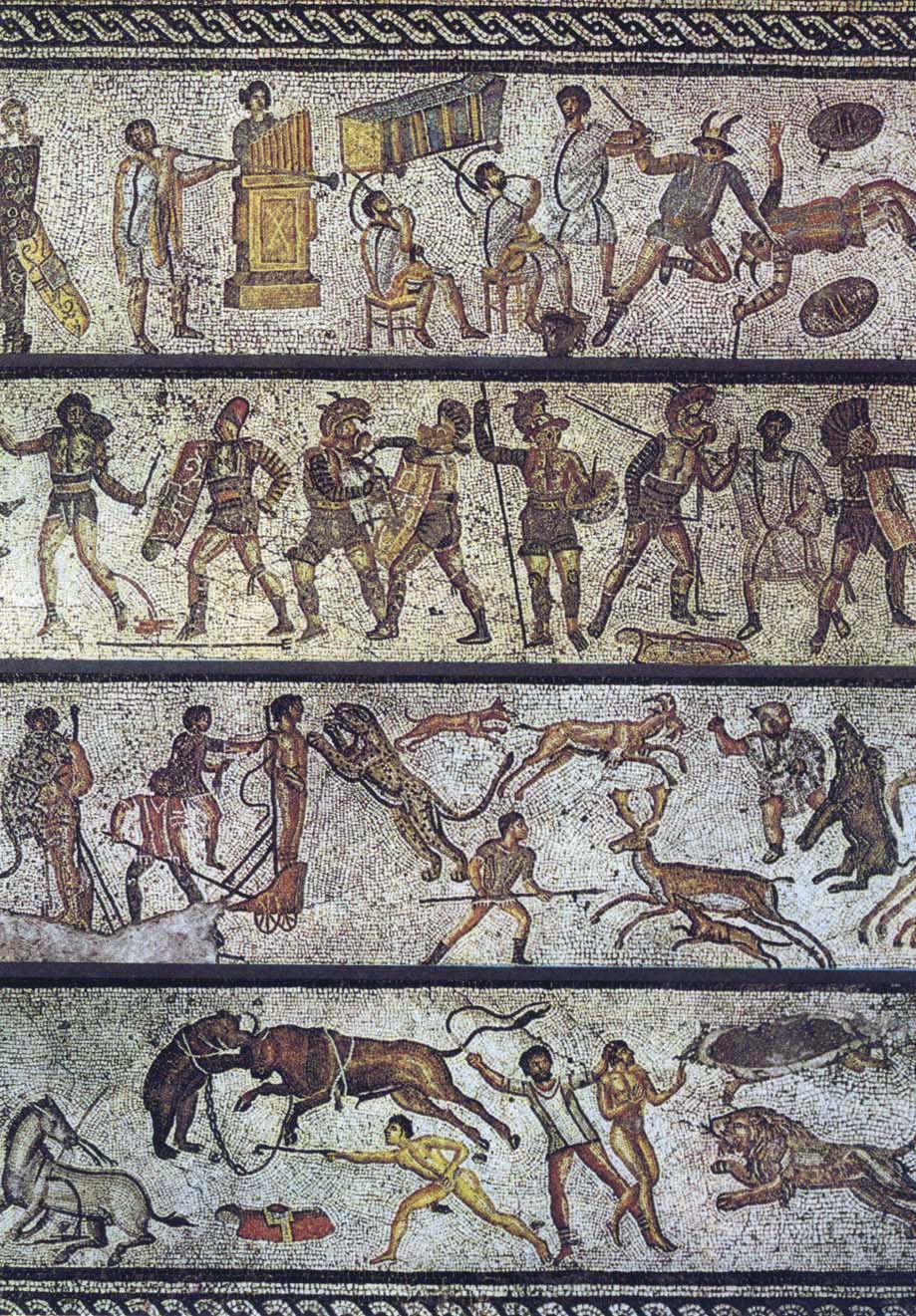
Mosaic of the Gladiators, Villa Bar Duc Ammera, Zliten, close to Leptis Magna

Leptis Magna prospered thanks to Trans-Saharan trade: it sold precious exotic goods, like ivory, wild animals for the games, carbuncles, ebony wood and ostrich feathers.

The Villa Bar Duc Ammera, close to Leptis Magna, was one of the most beautiful Roman villas on the North African coast. It is famous for its mosaics, which can be admired at the Archaeological Museum of Tripoli.

In the Roman era, Tripolitania became one of the most strongly Christian areas in the Roman Empire. The first known bishop of Leptis Magna was Victor, a contemporary of Septimius Severus, who later became bishop of Rome. In the Byzantine era, the Basilica of Leptis Magna, built by Septimius Severus, was transformed into a church. Other ruins of Christian churches can still be seen.

Leptis Magna declined a lot during the 3rd-Century crisis. It was ravaged by a tsunami after the 365 earthquake. In the following years, the city’s inhabitants complained to Emperor Valentinian about a corrupt Roman official who forced them to pay bribes for their protection.

After the Vandal conquest, the Vandals destroyed the city walls to prevent an uprising. Leptis Magna was rebuilt by the Byzantines, but never recovered its former glory. After the Arab conquest of the region, the Arabs chose Tripoli as their new capital. Leptis Magna was abandoned.

Today, the ruins of the “African Rome”, close to the modern-day city of Khoms, are one of the most spectacular archaeological sites in Western Libya, and a UNESCO World Heritage site. Less well-known as the Cyrenaican sites, and neglected during the civil war, Leptis Magna nevertheless has everything to become a major tourist destination. This article of the Middle East Eye (in French) contains beautiful pictures of Leptis Magna.

Roman North Africa, From Antiquity to Middle Age: cultural bridgebuilders

Martianus Capella: The North African Author Who Influenced the Medieval World

Français – عربي – ⵜⴰⵎⴰⵣⵉⵖⵜ – English

Translation: Ibrahim Ait Dami

Martianus Capella was a Neoplatonic author of the early Fifth Century, hailing from Madauros (M’Daourouch) in Roman Africa. His work established the concept of the “seven liberal arts,” which profoundly influenced the educational system throughout the Middle Ages.

Born in Madauros, Numidia, Martianus Capella shared his birthplace with another influential Romano-African writer: Apuleius, the author of the first Latin novel. Martianus Capella authored his texts in the early fifth century, following the sack of Rome by the Visigoth king Alaric I in 410, an event he explicitly mentions, but prior to the Vandal conquest of North Africa in 429.

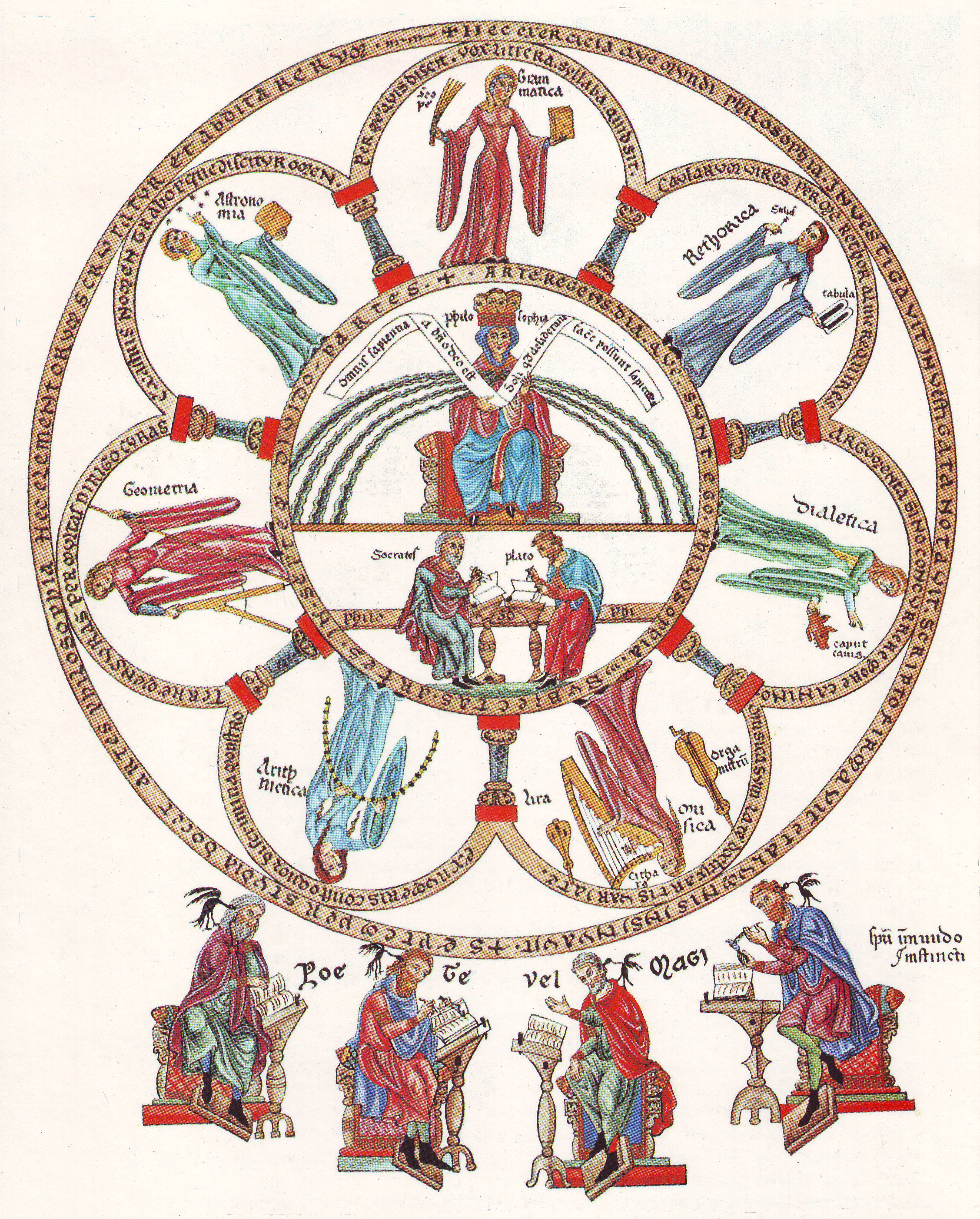
His main work, On the Marriage of Philology and Mercury, is an allegorical tale. The book recounts the union between Mercury, the god of commerce, and Philology, the personification of the love of letters and scholarship, whom the gods elevate to the status of a goddess. As a wedding gift, the couple receives seven young maidens who are destined to serve Philology. Upon being introduced, each maiden delivers an exposition on the core principles of the science she represents.

Martianus Capella wrote during a period when the Roman Empire had been largely Christianized. The fact that he drew inspiration from mythology does not necessarily dictate that he was a pagan, as Christian authors similarly extracted allegories of human wisdom from the mythological universe. However, the complete absence of Christian references gives the distinct impression that the author was indeed pagan, rather than Christian, a characteristic that did not hinder his work from achieving immense popularity within the medieval Christian world.

Martianus Capella’s writings remained highly popular over the ensuing centuries and left a deep imprint on the Middle Ages, particularly within the realms of education and pedagogy. Under this classical educational framework, the seven “liberal arts” were eventually divided into the trivium (rhetoric, grammar, and logic) and the quadrivium (astronomy, arithmetic, geometry, and music).

Roman North Africa

The 365 earthquake: a devastating natural disaster

Français – عربي – ⵜⴰⵎⴰⵣⵉⵖⵜ – English

In July 365, a violent undersea earthquake occurred in the Mediterranean Sea, close to Crete. The whole Eastern Mediterranean basin was devastated by the tremor and by the tsunami that followed. Cyrene and the other historical cities of Cyrenaica were almost entirely destroyed.

–
The port of Apollonia (Marsa Susa) was submerged by the tsunami

The earthquake occurred on 21 July 365, close to sunrise. Its epicenter was situated close to the island of Crete. Its magnitude is estimated at 8.5 on the Richter scale: it was stronger than any other earthquake recorded in this region in the modern era. It was felt all the way to Spain.

The earthquake caused a tsunami that ravaged the North African coast, especially Cyrenaica and the Nile Delta, all the way to Alexandria. The water hurled ships up to 3km inland.

In Sabratha, the sea advanced all the way to the baths

The earthquake and the tsunami caused several thousand deaths. Almost all cities in Crete were destroyed. In North Africa, Alexandria and Cyrene were very hardly hit. Leptis Magna was also ravaged by the tsunami. More distant cities like Oea (Tripoli) and Sabratha experienced lesser damage.

The earthquake had a deep impact on the imagination of the men of this time. The Roman historian Ammianus Marcellinus wrote a detailed description of the earthquake and the effects of the tsunami in Alexandria: “Slightly after daybreak, and heralded by a thick succession of fiercely shaken thunderbolts, the solidity of the whole earth was made to shake and shudder, and the sea was driven away, its waves were rolled back, and it disappeared, so that the abyss of the depths was uncovered and many-shaped varieties of sea-creatures were seen stuck in the slime; the great wastes of those valleys and mountains, which the very creation had dismissed beneath the vast whirlpools, at that moment, as it was given to be believed, looked up at the sun’s rays. Many ships, then, were stranded as if on dry land, and people wandered at will about the paltry remains of the waters to collect fish and the like in their hands; then the roaring sea as if insulted by its repulse rises back in turn, and through the teeming shoals dashed itself violently on islands and extensive tracts of the mainland, and flattened innumerable buildings in towns or wherever they were found. Thus in the raging conflict of the elements, the face of the earth was changed to reveal wondrous sights. For the mass of waters returning when least expected killed many thousands by drowning, and with the tides whipped up to a height as they rushed back, some ships, after the anger of the watery element had grown old, were seen to have sunk, and the bodies of people killed in shipwrecks lay there, faces up or down. Other huge ships, thrust out by the mad blasts, perched on the roofs of houses, as happened at Alexandria, and others were hurled nearly two miles from the shore, like the Laconian vessel near the town of Methone which I saw when I passed by, yawning apart from long decay.”

The damage caused by the earthquake accelerated the decline of the Greek cities of Cyrenaica. Shortly later, Cyrene was replaced by Ptolemais, a city that had been relatively spared by the earthquake, as the new capital of Cyrenaica.

Roman North Africa

Emperor Diocletian’s father: the freedman of a North African Senator?

Français – عربي – ⵜⴰⵎⴰⵣⵉⵖⵜ – English

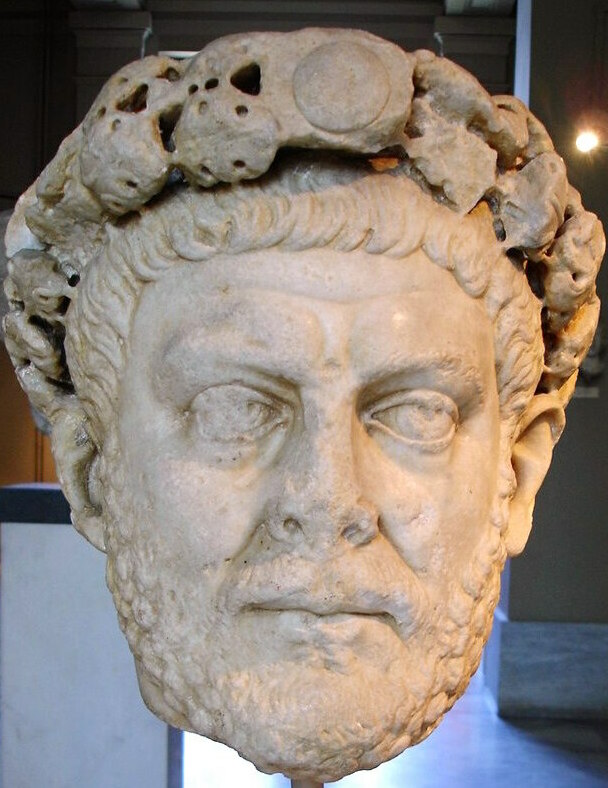
Some sources claim that the father of the Roman Emperor Diocletian was a former slave of a Senator named Anullinus, who was freed by his master. The same of this Senator shows that he was from Roman Africa.

Diocletian

The future Emperor Diocletian was born around 242, in Dalmatia (modern-day Croatia). All historical sources agree that he was from a modest background. According to the Roman historian Eutropius, while he is usually considered as the son of a scribe, some also claim that his father was a freed slave of a Senator called Anullinus. The two descriptions are not necessarily incompatible: some slaves served as scribes for their masters.

Some historians believe that Diocletian was called “son of a freedman” only by his enemies, to discredit him. However, the fact that a serious historian like Eutropius reports this, and even mentions the name of his former master, gives credit to the information.

Emancipation ceremony of Diocletian’s father – Image created by ChatGPT

The name Anullinus shows that this Senator was from an African family: several inscriptions dedicated to figures of this name have been found in various cities of Roman Africa. The most well-known member of this family was Publius Cornelius Anullinus, an ally of Septimius Severus, who commanded his troops against his rival Pescennius Niger. Publius Cornelius Anullinus was born in Granada, Southern Spain, close to North Africa. His African origins explain his links with the first North African Emperor.

Anothr member of the Anullinus family, Gaius Annius Anullinus, served as proconsul of Africa, and then as Prefect of Rome, during the reign of Diocletian. He played an important role in Diocletian’s persecution campaign against the Christians: several African Christian martyrs were executed by him. He might have been the son of the Senator who freed Diocletian’s father.

Roman North Africa

The sons of Nubel the Moor: Firmus’ and Gildo’s uprisings

Français – عربي – ⵜⴰⵎⴰⵣⵉⵖⵜ – English

Since the crises that shook the Roman Empire in the 3rd Century, Roman domination on the North African interior was fragile. Firmus, an Amazigh tribal chief, took advantage of the Romans’ weakness to rebel against them and proclaim himself King of Africa. After his death, his brother Gildo, who originally supported the Romans against Firmus, also revolted.

The children of Nubel

Nubel

Flavius Nubel was a 4th-Century, Romanised and Christian Amazigh tribal chief. He was from the Jubaleni (Zouaoua) tribe, and reigned over the territory of modern-day Kabylie. His fortress, Petra (or Mlaklou), was close to Bejaia. Roman historians describe him as one of the most powerful Amazigh chiefs of his time. He was a Roman ally, and had Roman knights based in his fortress.

Nubel had several wives and seven known children. The fact that he was both a polygamist and a Christian is surprising, as polygamy was condemned by the Church. He probably converted to Christianity as an adult: baptized believers weren’t allowed to take more than one wife, but those who already had several wives at the time of their conversion could keep them. Nubel’s sons fought both alongside the Romans and against them; this family illustrates the complexity of relations between Rome and the Amazigh tribes at this time.

When Nubel died around 370, his eldest son Zammac succeeded him, but he was killed by another son, Firmus, who accused him of stealing his share of heritage.

Firmus’ uprising (370-375)

Petra (Maklou), Firmus’ fortress

After his brother’s murder, Firmus revolted against the Romans and proclaimed himself Emperor of Africa. At the head of a dozen Amazigh tribes and two Roman legions, he took control of all Mauretania Caesariensis.

In the years before Firmus’ uprising, Romulus, the Roman comes (governor) of Africa, had committed extortion against the African cities, by forcing them to pay a protection tax against the attacks by Amazigh tribes. Roman Emperor Valentinian was now forced to take action both against Firmus and against his own comes. He sent his general Theodosius the Elder (the father of the future Emperor Theodosius) to depose Romulus. Firmus first adopted a conciliatory attitude, and seemed ready to find an agreement with the Romans, but then, he tried to assassinate Theodosius, was discovered, fled, and restarted his uprising.

Fictitious representation of Cyria, Firmus’ sister

Firmus’ uprising was a family affair: Firmus had the support of his brothers Mazuca and Dius, and his sister Cyria, while two other brothers, Gildo and Mascezel, fought against him alongside the Romans.

Firmus also enjoyed the support of the Donatists, a North African Christian movement that was considered heretical by the official church, as he protected the Donatists against persecution.

The Romans were afraid of having to fight another long and bloody guerrilla war, like their wars against Jugurtha and Tacfarinas. However, Theodosius led an efficient campaign: after battling and defeating a tribal confederation led by Firmus’ sister Cyria, close to Castellum Tingitanum (Chlef), he moved into the desert with a light infantry column, forcing Firmus to flee from tribe to tribe.

Saint-Salsa Basilica, Tipaza

In 374, Firmus besieged the city of Tipasa, but couldn’t take it. According to legend, he entered a chapel dedicated to Saint-Salsa, a young Christian girl who had been killed for her faith in Tipasa, to ask for her blessing. However, his prayers were turned down. In his anger, he allegedly hit the martyr’s tomb with his lance.

After his defeat at Tipasa, Firmus fled to the Hodna Mountains. After a short time, as he was informed that one of his allies, Igmazen, the chief of the Isaflenses tribe, had betrayed him, he killed himself to avoid being captured. He died close to Auzia (Sour el Ghozlane). His body was given over to Theodosius by Igmazen.

Theodosius, the victorious Roman general, settled in Carthage. After Emperor Valentinian’s death, he was executed in 376, for unknown reasons. His son Theodosius became Emperor in 379.

Gildo’s uprising

The two youngest brothers of Firmus, Gildo and Mascezel, took Theodosius’ side against Firmus. In 385, the new Emperor Theodosius chose Gildo as the new comes of Roman Africa, to thank him for supporting his father. Gildo built close relations with the Roman aristocracy: his daughter married the nephew of Empress Flacilla. He governed Africa with a large degree of independence.

Corbita, merchant ship used to provide supplies to Rome

However, his relationship with Emperor Theodosius started to deteriorate after he refused to support him against the usurper Eugenius. After Theodosius died, in 395, the Empire was divided between his two sons: Honorius, in the West, and Arcadius, in the East. Two years later, Gildo revolted against Honorius and proclaimed his support for Arcadius, thus attaching Africa to the Eastern Roman Empire. He was supported by the Donatist bishop Optatus of Thamugadi (Tmgad), who was the philosophical influence behind his political movement. Gildo also put in place a blockade to prevent the provision of African grain to Rome.
In spring 398, the Romans sent an army against him, led by his brother Mascezel. Gildo mobilized the Roman forces in Numidia and called on the Amazigh tribes, but he was easily defeated after his Roman troops abandoned him. He was captured at Theveste (Tebessa) and executed at Thabraca (Tabarka).

Mascezel, the last son of Nubel, was honored by the Romans for restoring their domination over Africa. He settled in Rome, where he was assassinated by the imperial regent Stilicho, who was jealous of his popularity.