

Français – عربي – ⵜⴰⵎⴰⵣⵉⵖⵜ – English
In Roman Africa, as in the whole Roman world, gladiatorial fights, chariot races and theatrical shows were an extremely popular form of mass entertainment. Many of the most beloved gladiators, auriges, athletes and actors had African origins. In this article, we will discover the most famous Roman African gladiators, athletes, playwrights and actors.

Gladiators
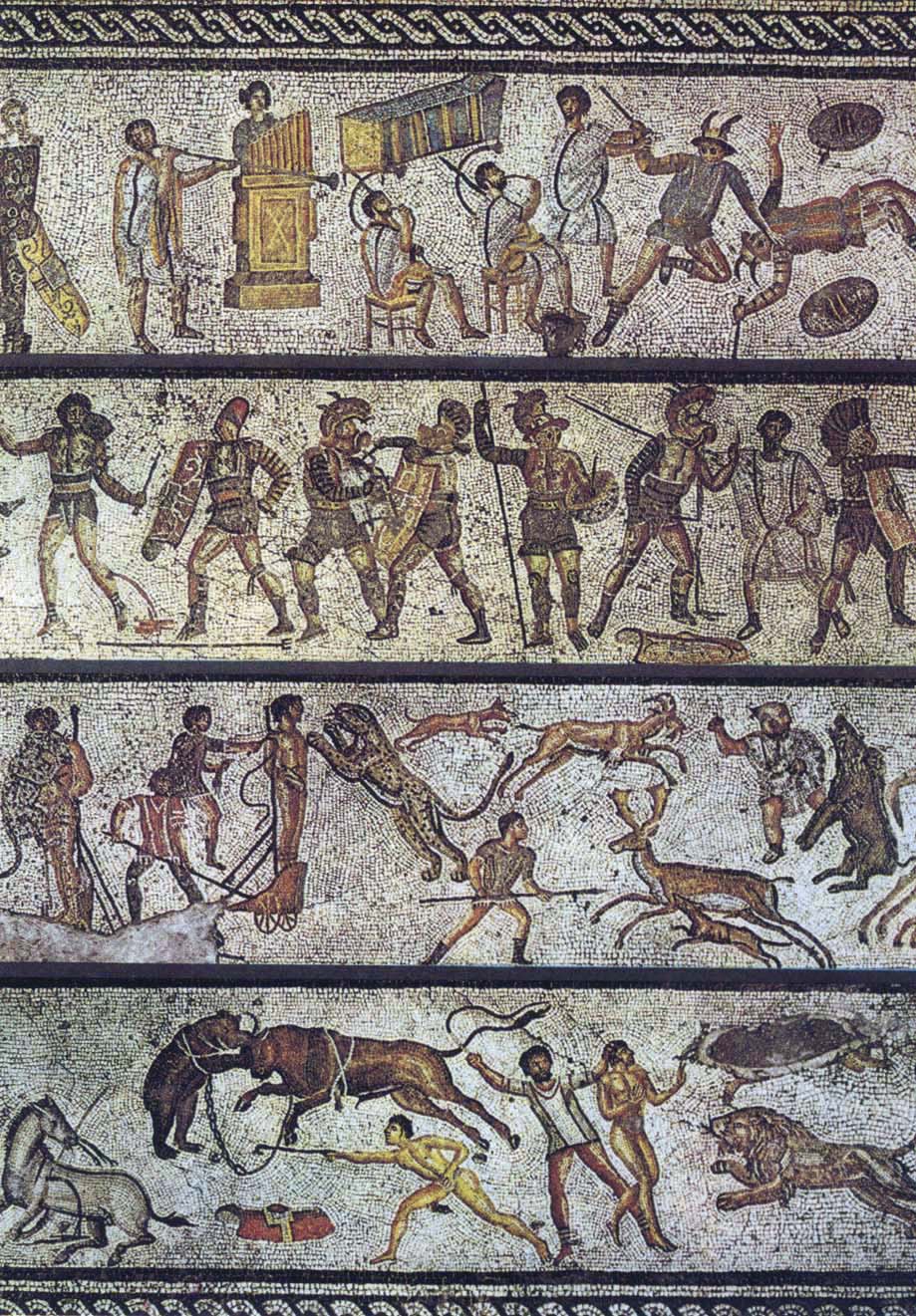
Gladiators were armed fighters, trained to fight until death against other gladiators. Gladiatorial fights were merciless: kill or be killed… for the great pleasure of the public! Most gladiators were captives or slaves who were forced to fight; others chose to become gladiators, to escape poverty or in quest of celebrity.
In Rome, several funerary inscriptions of gladiators show an African origin (with names like Afer, Numidicus, Maurus or Getulicus). The Roman poet Martial mentions a gladiator named Lucius Afer, who became famous in Rome. In Capua, where the famous Spartacus was trained as a gladiator, a Thracian gladiator (Thracian being a reference to his armor, not to his origins), who was killed at 25 years of age after winning several victories, is described as Afer.
In Africa, there were gladiatorial schools (ludi) in Carthage, Leptis Magna, Hadrumetum (Sousse) and Lambaesis (Tazoult). African gladiators who were trained there then became part of gladiatorial troops who fought in African cities; the best were sent to Rome. Inscriptions found in Thuburbo Maius, close to Zaghouan, Tunisia, mention two local gladiators: Quintianus and Pudentilla. Pudentilla is a feminine name: female gladiators were rare and even more valued.

Gladiators also fought wild beasts, at reconstituted hunting parties called venationes. Other times, animals fought each other, or devoured prisoners who had been sentenced to death (including Christian martyrs). Most of the animals used for those spectacular scenes came from Africa.
Auriges

Chariot races were another important element of popular shows. There were usually four teams: the Blue, the Green, the Red and the White, aligned on political factions. Numidian horses were famous in the whole ancient world for their speed, and were especially appreciated for those races. Chariot runners were called auriges, while the arena was called circus.
The first famous African aurige was Mastanabal, son of King Massinissa of Numidia. In 168 or 164, he won the chariot race at the Panathenaic Games, a sports competition organised in Athens.
Another famous aurige who, given his name, might have had African origins, was Scorpus, who raced for the Greens in Rome. After winning over 2000 races, he died at 27 years of age. The cause of his death is unknown, but it seems likely that he lost his life in one of the many accidents in the arena. The poet Martial wrote a poem in his honor.

Porphyry, an aurige in the Byzantine era, considered as one of the best auriges of his time, was from Libya. While racing champions are traditionally honored with one single statue, no less than seven statues of Porphyry were erected along the Hippodrome of Constantinople after he retired at about 60 years of age. His time is considered as the golden age of Byzantine chariot racing.
Athletes

Running races, boxing and wrestling fights, archery competitions, and discus and javelin throwing were also highly popular in the roman world. Athletical exercise at the gymnasiums was an important part of the training of young men, according to the Latin proverb “Mens sana in corpore sano”, “A healthy soul in a healthy body”. Major sporting events, inspired from the Greek competitions, occurred regularly.
Marcius Porcius, an athlete from Leptis Magna, is mentioned in an honorific inscription, for winning athletic competitions in Rome, Greece and Asia Minor.
Another African athlete was Victorinus , from Cuicul (Djemila, close to Setif, modern-day Algeria), who is honored by an inscription in Numidia.
Theater
Theater was a flourishing art in Roman Africa. Over 40 theaters were built in African cities.

Terence, one of the most prominent playwrights in the Roman world, was of African origin. Born in Carthage between the Second and the Third Punic War, in his youth he was sold as a slave in Rome. His Latin comedies, inspired by Greek sources, were played all around the Empire.
There were also African actors. In Thamugadi (Timgad, modern-day Algeria), an altar consecrated to Apollo was a gift to the city by a group of itinerant actors. In Sabratha, honorific statues in the theater show how actors, who were often freedmen, could reach a certain level of social prestige.
There were also theater competitions: in Carthage, an inscription refers to a “crowned tragic actor” who won the local tragedy’s competition.
Are there any names of actors that are known to us? In Thuburbo Maius, a funerary inscription mentions Quintus Valerius Restitutus, a histrio (comical actor) who was originally from the city.
