Français – عربي – ⵜⴰⵎⴰⵣⵉⵖⵜ – English
Drusilla, daughter of Ptolemy, the last King of Mauretania, reportedly had a remarkable destiny after her father’s death. According to social media publications, she married a Roman governor, and, later, a Syrian King, becoming the Queen of a Kingdom neighboring Rome. However, the ancient sources that mention her are so rare that some historians even doubt her existence. This article sums up what we really know about this enigmatic Princess.
Cover picture: Wedding of Felix and Drusilla of Mauretania – Image created by ChatGPT
Drusilla: a Mauretanian Princess?


The Roman historian Tacitus writes that Antonius Felix, an emancipated slave of the Imperial family who became the Roman governor of Judea, “married Drusilla, granddaughter of Antony and Cleopatra” (Histories, book V, 9). This passage by Tacitus is the only mention of this Drusilla. As we will see later in the article, Tacitus’ version is problematic, to the point that some modern historians believe he was mistaken.
The Roman general Mark Antony and Queen Cleopatra of Egypt had three children. Their daughter Cleopatra Selene married King Juba Juba II of Mauretania. Their other children probably died young and had no known descendance.

Tacitus seems to believe that Drusilla was the daughter of Juba II and Cleopatra Selene. It is however chronologically more likely that she was their granddaughter, probably the daughter of their son Ptolemy, who, after his father’s death, became the last King of Mauretania. The Latin word used by Tacitus, neptem, is usually translated by granddaughter, but can also mean a descendant in a more general sense.
At this time, several women of the Roman elite were named Drusilla, in honor of Julia Drusilla, the sister of Emperor Caligula. Julia Drusilla was Ptolemy of Mauretania’s cousin, so it would make sense for him to name his daughter after her.
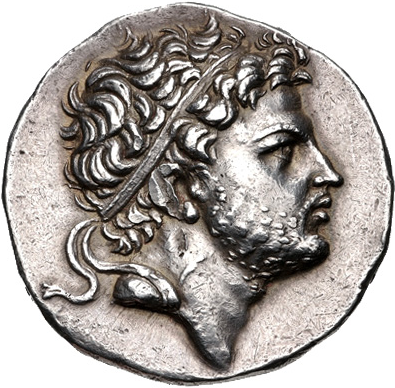
Ptolemy of Mauretania was killed in the year 40 CE. After his death, Mauretania became part of the Roman Empire. If Ptolemy indeed had a daughter, she probably would have been raised in Rome, as many children of allied royal families were.
Felix: the slave who became a governor
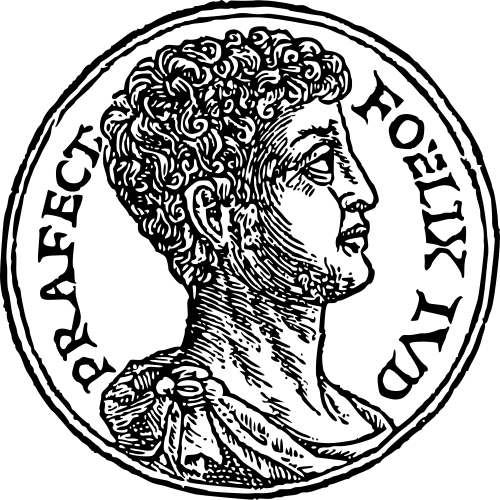
Felix was a freedman of Emperor Claudius (or of his mother Antonia Minor, depending on the sources). Thanks to the influence of his brother Pallas, who served as secretary to the treasure during the reign of Claudius, Felix was named governor of Judea. During his mandate, he earned a reputation for cruelty and corruption: he is known especially for having the Jewish high priest Jonathan assassinated. The Roman aristocrats like Tacitus despised Felix, a former slave who reached the height of power.
How could a simple freedman have married a Princess of Mauretania? As the fallen Princess certainly lived at the Imperial court, it is possible that the Emperor himself arranged their marriage. However, this would be surprising, given their difference in social status.
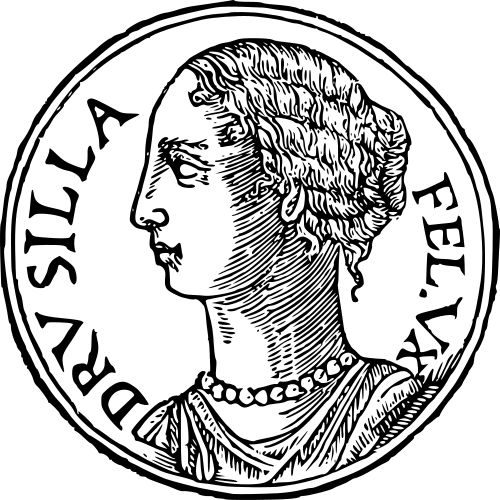
On the other hand, historians agree that Felix married another Drusilla: the daugther of King Herod Agrippa of Judea. While she was already married to King Aziz of Emesa (modern-day Homs, Syria), who had converted to Judaism to marry her, Felix seduced her and convinced her to leave her husband for him. Their marriage was scandalous for both Jews and Romans.
Felix and Drusilla are actually mentioned in the Bible: after the Aposte Paul was arrested in Jerusalem for his preaching, while he was in prison awaiting his trial, the governor Felix, together with his wife, invited him to come to speak to them about his faith. Felix was mostly hoping that Paul would offer him money to free him, which he refused to do. The text mentions that Felix’ wife was Jewish, which shows that it was Drusilla of Judea, not Drusilla of Mauretania.
Felix and Drusilla had a son, Marcus Antonius Agrippa, who died in 79, in the eruption of the Vesuvius, a volcano in Southern Italy. The historian Flavius Josephus writes that he died “σὺν τῇ γυναικὶ” (sun tè gunaiki), literally “with the woman”. The most likely translation is that he died with his wife, but another possibility is that the author refers to the woman whom he previously mentions: his mother Drusilla.
A confusion by Tacitus?

How can the passage by Tacitus be harmonized with the story of Felix’ marriage to Drusilla daughter of the King of Judea? It would have been possible for Felix to marry Drusilla of Mauretania in Rome before he became governor of Judea. However, no historical source mentions that Felix was already married when he met Drusilla of Judea, or that he divorced to marry her. The Jewish historian Flavius Josephus, who was outraged that Drusilla abandoned her husband to marry Felix, would certainly not have omitted it if Felix had dome the same!
Another Roman historian, Suetonius, wrote that Felix “married three queens”. We don’t know exactly what he means by “queens”: it might be just an honorific title, or even a satirical use of the word – such an use was common with Suetonius.

It should also be mentioned that Drusilla of Mauretania never was a “queen”, in the strict sense: this title was given only to the sovereigns of territories recognized by Rome, while Mauretania already was a Roman province. Some even speculated that the title of “queen” means Drusilla of Mauretania must have married another king later on – Sohaemus of Emesa is often mentioned as her second husband. Again, there is absolutely nothing in the ancient sources to substantiate this.

Also, a careful examination of the sources shows that, still according to Flavius Josephus, Drusilla of Judea was promised in marriage to Ptolemy of Mauretania while she was still a child (a common practice at a time when royal marriages were mostly celebrated to seal political alliances). Their marriage never took place, because Ptolemy died while Drusilla was still too young. Flavius Josephus wrote at a time closer to the events than Tacitus, and he had close links with the royal family of Judea. His writing can thus be considered as reliable.
Given the absence of any other mention of a Mauretanian Princess named Drusilla, the most likely theory is that Tacitus mistook Drusilla of Judea for the descendant of Cleopatra and Mark Antony. His confusion can be explained by Flavius Josephus’ mention of the marriage plans between Ptolemy of Mauretania and Drusilla of Judea. It is also possible that Tacitus simply wanted to exaggerate the social contrast between Felix and his wife, by claiming an even more illustrious ancestry for her than in reality.

Zenobia, an Arabic Queen of Palmyra, in Syria, who led a revolt against Rome in the 3rd Century, claimed that she was a descendant of Cleopatra of Egypt. Some sources claim that Drusilla of Mauretania and her second husband Sohaemus of Emesa became the ancestors, not only of Zenobia, but also of Julia Domna, the Syrian wife of Emperor Septimius Severus. However, most modern historians believe that this Mauretanian Princess never existed, and that all the sources that mention her are based on Tacitus’ confusion.