Français – عربي – ⵜⴰⵎⴰⵣⵉⵖⵜ – English
Syracuse was a Greek colony in Sicily. During the 5th and the 4th Centuries BCE, Syracuse fought several wars against Carthage and its Sicilian colonies, for the control of the island. One century before the Punic wars, the tyrant Agathocles of Syracuse already tried to conquer Carthage, and took control of several Punic cities of the region.

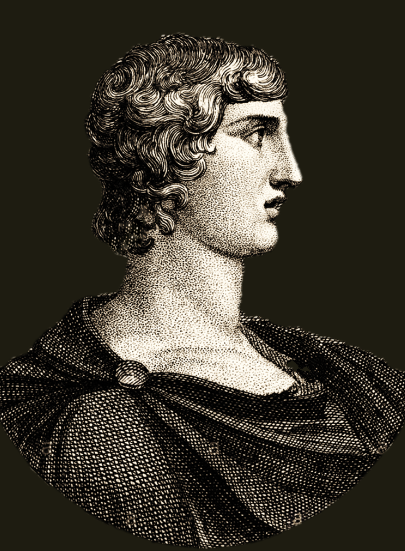
Since the beginning of the 5th Century, Syracuse was led by tyrants, authoritarian leaders, against the Greek democratic ideal. Agathocles started his career as a military officer in support of the democratic faction. He was from a modest background and liked presenting himself as a man of the people. However, after taking power through a coup in 317, he showed himself even more tyrannical then his predecessors. Especially, he led an overtly aggressive military policy: his ambition was to follow the model of Alexander the Great, becoming the new protector of the Greek world against the “Barbarians” – in his case, the Carthaginians.
As soon as he was in power, Agathocles declared war on Carthage. In 311, he was defeated, and the Carthaginian army besieged Syracuse. This led him to take a desperate measure: with his remaining troops, he forced the Carthaginian blocus of the city, and invaded Africa to attack Carthage herself. He was hoping to force the Carthaginian troops that were besieging Syracuse to lift the siege and return to defend their homeland.

Agathocles’ army landed on Cape Bon in August 310. Agathocles won a first victory, that enabled him to establish his camp close to Tunis. He besieged Carthage, but the city was too strong for him to hope to conquer it.
Agathocles then decided to turn East and take control of the Punic cities on the coast, like Neapolis (Nabeul), Hadrumetum (Sousse) and Thapsus (Bekalta). For this campaign, he made an alliance with Aylimas, the King of the Massyli Numidians and an ancestor of Massinissa. Tofether, they occupied all the North of modern-day Tunisia. Later, however, Agathocles, wanting to extend his power inwards, killed his ally Aylimas, who had become an obstacle to his ambition. He then took control of the Numidian army and its war chariots.

After breaking his alliance with Aylimas, Agathocles, seeking new allies, contacted Ophellas, a former officer of Alexander the Great, who was now serving as governor of Cyrenaica under Ptolemy of Alexandria. In order to convince Ophellas to help him fight the Carthaginians, he promised to cede him all the territories conquered in Africa, keeping only Sicily for himself. Ophellas raised a large army, and then marched West to join Agathocles at Carthage, becoming the first to lead an army through the Central Libyan desert. A few days after Ophellas arrived, Agathocles had him killed. The Cyrenean army, without a commander, joined Agathocles.
The Carthaginians, imitating Agathocles’ strategy, sent another army against Syracuse. Agathocles returned to Sicily, leaving his lieutenant Eumachos behind him in Africa. Eumachos continued the conquests towards the West, all the way to Hippo (Annaba).

In 307, Agathocles returned to Africa to lead the final conquest of Carthage. Faced with his men’s insatisfaction because of unpaid salaries, he promised them enormous spoils in case they were victorious. After several defeats, his army abandoned him. He was forced to flee to Sicily, giving up on his conquests in Africa. The following year, he signed a peace treaty with the Carthaginians, that allowed them to take back all their territory.
After his African campaign, Agathocles proclaimed himself King of Sicily. He spent the rest of his life strengthening his power over the Greek cities on the island, and then in Magna Graecia, a region in Southern Italy with many Greek colonies. It is said that at the time of his death, in 289, he was preparing a new attack against Carthage.