Ce site présente l'histoire de l'Afrique du Nord avant les conquêtes arabes – This website presents the history of North Africa before the Arab conquests – يعرض هذا الموقع تاريخ شمال إفريقيا قبل الفتوحات العربية
After the death of Emperor Nero, the Roman Empire fell into instability. Four Emperors succeeded each other in one year. The Roman proconsuls and military officers based in North Africa played an important role in this crisis.
Context
Nero
By the end of his reign, Emperor Nero became more and more tyrannical. Several influential Roman military factions rebelled against him. Nero, beset by enemies on all sides, killed himself on 9 June 68.
After the death of Nero, civil war broke out. Galba, the governor of Spain and the leader of one rebel faction, became Emperor, followed by two other military officers, Otho and Vitellius. Each of them reigned for a few months before they were killed or committed suicide.
Vespasian
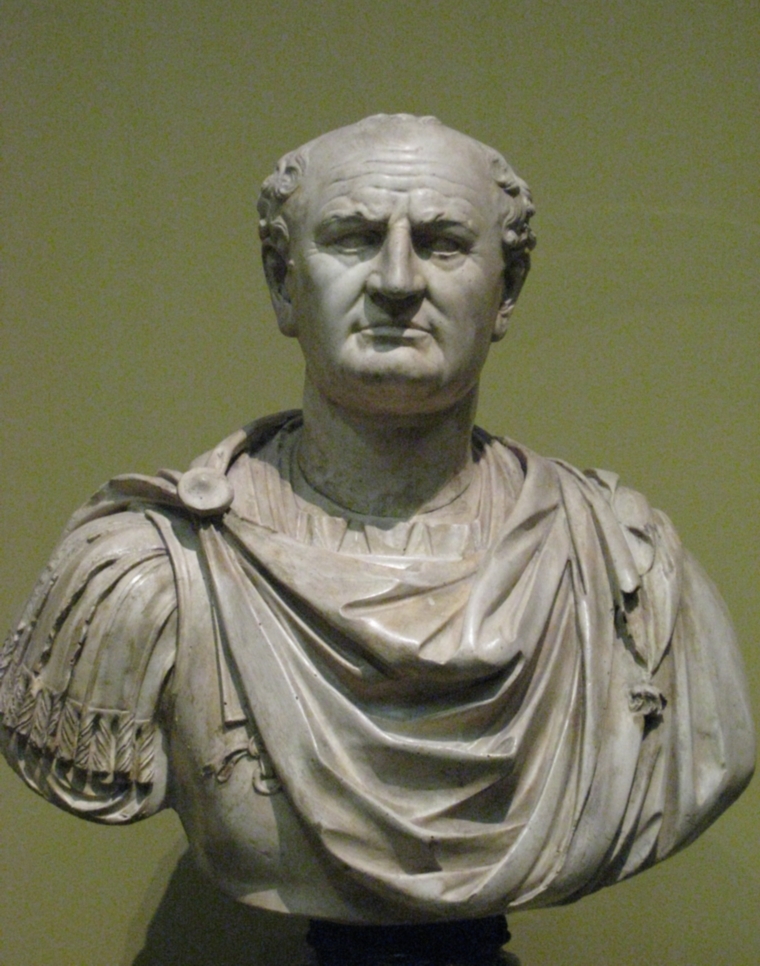
Vespasian, the commander of the Roman troops in the war against the Jews in Judea, took the throne in December 69. The following year, his son Titus, whom he had entrusted commandment in Judea before returning to Rome, conquered Jerusalem and destroyed the city with its Temple. The fall of Jerusalem caused a major exodus of Jews from Palestine towards other regions, including Roman Africa. Vespasian reigned for ten years, restoring stability in the Empire and founding a new dynasty.
In Roman Africa
Gold coin with the effigy of Clodius Macer
Lucius Clodius Macer, the commander of the Roman legions stationed in Africa, took part in the revolt against Nero, probably under the influence of the African courtier Calvia Crispinilla. In order to weaken the Emperor, he cut the delivery of African wheat to Rome. While Macer was originally an ally of Galba, Galba had him assassinated after he became Emperor, as he suspected that he had Imperial ambitions for himself.
Lucius Calpurnius Piso, the proconsul of Africa, was an ally of Vitellius, who had been proconsul of Africa himself a few years earlier and was still very popular in the region. After Vitellius was defeated, Piso refused to recognize Vespasian as the new Emperor. Valerius Festus, the new commander of the Roman legions in Africa, who was leading secret negotiations with Vespasian, killed the proconsul and was chosen by Vespasian to succeed him.
After the death of Julius Caesar, three of his closest allies, Octavian (the future Emperor Augustus), Mark Antony and Lepidus, formed a triumvirate to govern the Roman territory together. Lepidus, the least known of the three, governed North Africa.
Context
While Julius Caesar had several children from different women, he had no legitimate heir according to Roman law. Shortly before he died, he invited Cleopatra of Egypt to Rome, with their son Caesarion. He probably intended to make Caesarion his heir, but he didn’t have time: he was assassinated on 15 March 44.
Gold coin with the effigy of Lepidus
After his death, his close ally Mark Antony and his adoptive son Octavian allied themselves to fight his murderers. After their victory, they were threatening to fight each other for power. To avoid a new civil war, they formed a triumvirate (trium viri, power of three men), together with another Roman politician: Lepidus, a former ally of Caesar. The three men decided to divide the Roman territory between themselves. Lepidus governed Africa and Numidia as proconsul.
Lepidus in Africa
Coin with the effigy of Lepidus
Lepidus, who knew he wasn’t powerful enough to face the other triumvirs, stayed away from the conflicts between Octavian and Mark Antony. In 41, Octavian charged Lepidus with defending Rome against an attack by Lucius Antonius, Mark Antony’s brother. Lucius Antonius, at the head of a more numerous military force, took the city easily. Lepidus was forced to flee to Octavian’s camp.
After these events, Mark Antony entrusted Lepidus six legions to accompany him to Africa. Lepidus retired with his legions, and no longer played a role in Roman politics: he was content with governing Africa.
Lepidus also encouraged the Romanization of the Numidian city of Thibilis (Sellaoua Announa, wilaya of Guelma, modern-day Algeria).
Gold coin with the effigy of Sextus Pompey, minted in Sicily during his revolt
In 36, Sextus Pompey, the son of Caesar’s former rival Pompey, revolted against the triumvirs in Sicily. Lepidus sent troops to fight him. After Sextus Pompey’s defeat, Octavian and Lepidus disputed each other the control of the island. Octavian used this as a pretext to sideline Lepidus and end his power. Lepidus returned to Rome, where he ended his life in anonymity.
As Roman influence in North Africa grew, the reigns of the last Numidian and Mauretanian kings became so intertwined with Rome that Roman wars and political intrigues increasingly affected the region. This article, part of our series on the final decades of the Roman Republic, we will discover the Actium War, the last Roman civil war before the founding of the Empire, which largely took place in Egypt.
Context
While Julius Caesar had several children from various women, he didn’t have a legitimate heir according to Roman law. Shortly before he died, he invited Cleopatra of Egypt to Rome, with their son Caesarion. He probably wanted to make Caesarion his heir, but he was killed before he could do so, on 15 March 44.
Mark Antony
After his death, his faithful ally Mark Antony and his adoptive son Octavian allied themselves to fight his murderers. After their victory, they were threatening to fight each other for power.
To avoid another civil war, they formed a triumvirate with another Roman politician, Lepidus, and decided to divide the Roman territory between themselves. To seal this agreement, Mark Antony married Octavia, Octavian’s sister, whom the Roman historians see at the ideal Roman woman.
Octavian Augustus
Soon after this, however, Mark Antony left for Egypt, where, like Caesar before him, he had an affair with Queen Cleopatra. They had several children, including Cleopatra Selene, the future wife of King Juba II of Mauretania. In Egypt, Mark Antony fell under the charm, not only of Cleopatra, but also of the flamboyant ways of the East – an unforgivable crime for the sober and proud Romans.
His rival Octavian seized the opportunity to castigate Mark Antony as an immoral man, who abandoned his faithful wife and their children for a life of promiscuity with a foreign queen. In 32 BCE, the Roman Senate, at Octavian’ initiative, declared war against Mark Antony.
The Actium War
The armies of Octavian and Mark Antony first fought in Greece.
In September 31, their two fleets fought at sea, at the Battle of Actium. This battle was a decisive victory for Octavian: Mark Antony’s fleet, the largest in all Roman history, was completely destroyed. Mark Antony and Cleopatra fled to Alexandria.
During the following spring, Octavian pursued Mark Antony all the way to Egypt. In July 30, he arrived in Alexandria and besieged the city. Mark Antony and Cleopatra both committed suicide, Mark Antony by falling on his own sword, Cleopatra by having her breast bitten by an asp.
After the war
Caesarion, Cleopatra and Caesar’s son, who reigned over Egypt with his mother, was killed. The children of Cleopatra and Mark Antony were brought to Rome, to be raised by Octavia according to Roman custom.
Cleopatra’s defeat was the end of the Ptolemaic Kingdom: Octavian proclaimed himself Pharaoh and made Egypt his personal property. In 27, when the Empire was founded, Egypte became a Roman province.
Later on
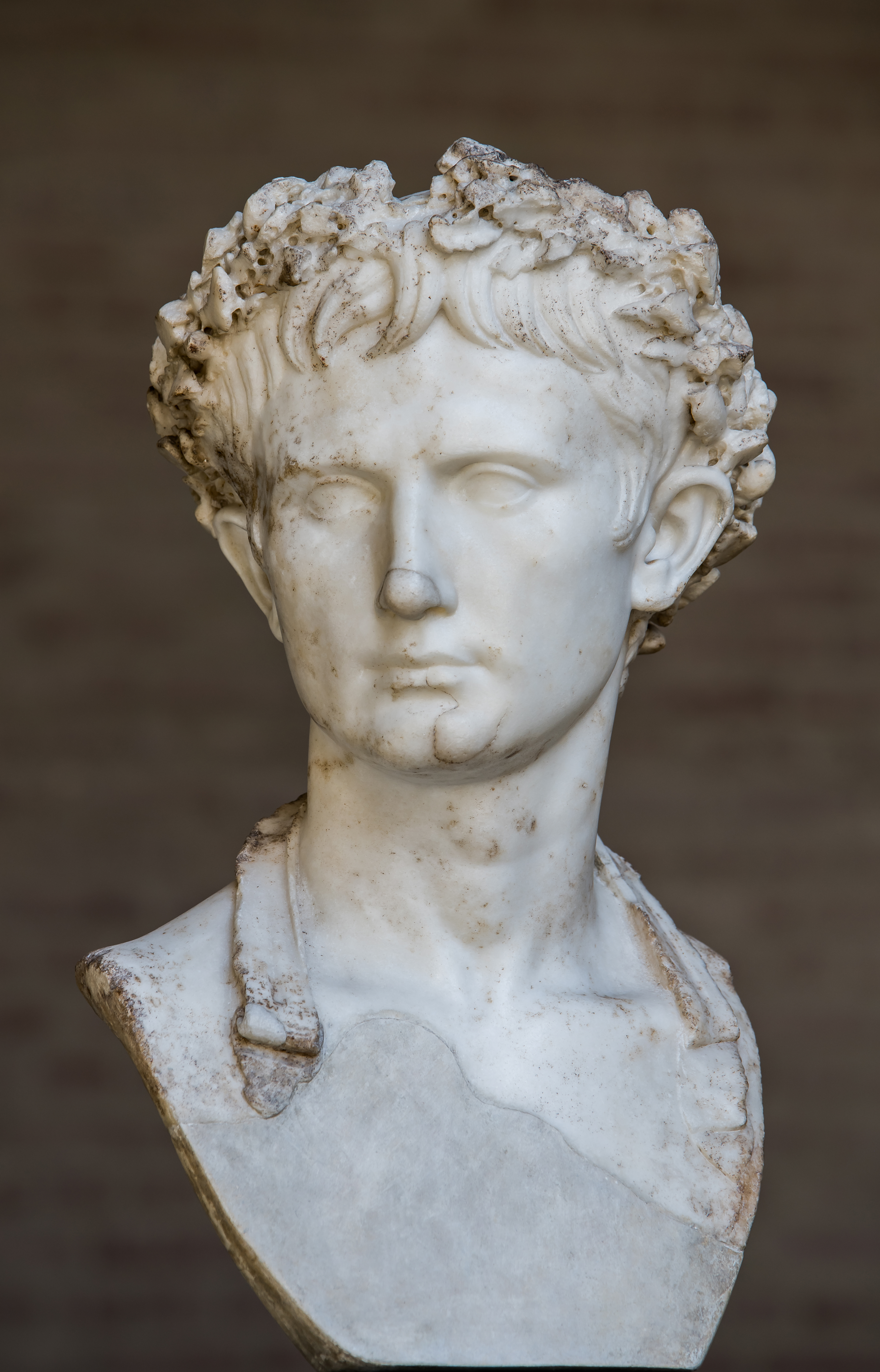
After Mark Antony’s defeat, Octavian was the undisputed master of Rome. At the same time, his victory put an end to the series of fratricidal civil wars that ravaged the Roman world, giving the people under Roman domination what they most desired: peace.
During the following months, he implemented a series of laws that, while preserving the forms of the Republic, gave him unprecedented powers. In 27, he proclaimed the Roman Empire and became its first Emperor, under the name of Augustus.
Cleopatra Selene, the daughter of Mark Antony and Cleopatra, married Juba II and became Queen of Mauretania. In Caesarea (Cherchell), their capital, she would seek to revive her mother’s Hellenistic legacy. Their son Ptolemy was the last King of Mauretania, before its annexation by the Roman Empire.
As Roman influence in North Africa grew, the reigns of the last Numidian and Mauretanian kings became so intertwined with Rome that Roman wars and political intrigues increasingly affected the region. This article, part of our series on the final decades of the Roman Republic, examines the impact of the Roman civil war of 49-45 BC, between Julius Caesar and Pompey, on Roman Africa and the kingdoms of Numidia and Mauretania.
Context
Pompey
Julius Caesar
By the mid-1st century BC, the Roman Republic was in crisis, reeling from Sulla’s dictatorship and the Catilinarian conspiracy. In 59 BC, the three most powerful men in Rome—Julius Caesar, Pompey, and Crassus—formed the First Triumvirate. This alliance, while serving their personal ambitions, proved detrimental to the Republic.
From 58 to 50 BC, Caesar was absent from Rome, engaged in his Gallic Wars. His military successes, culminating in his victory over Vercingetorix in 52 BC, significantly increased his power and wealth. Meanwhile, Pompey consolidated his power in Rome. After Crassus’s death in 53 BC, a clash between Caesar and Pompey became inevitable.
In 52 BC, Pompey was elected sole consul, a departure from the traditional two-consul system. In 50 BC, he demanded that Caesar relinquish command of his legions, claiming the Gallic conquest was complete.
Beginning of the civil war
Caesar crosses the Rubicon
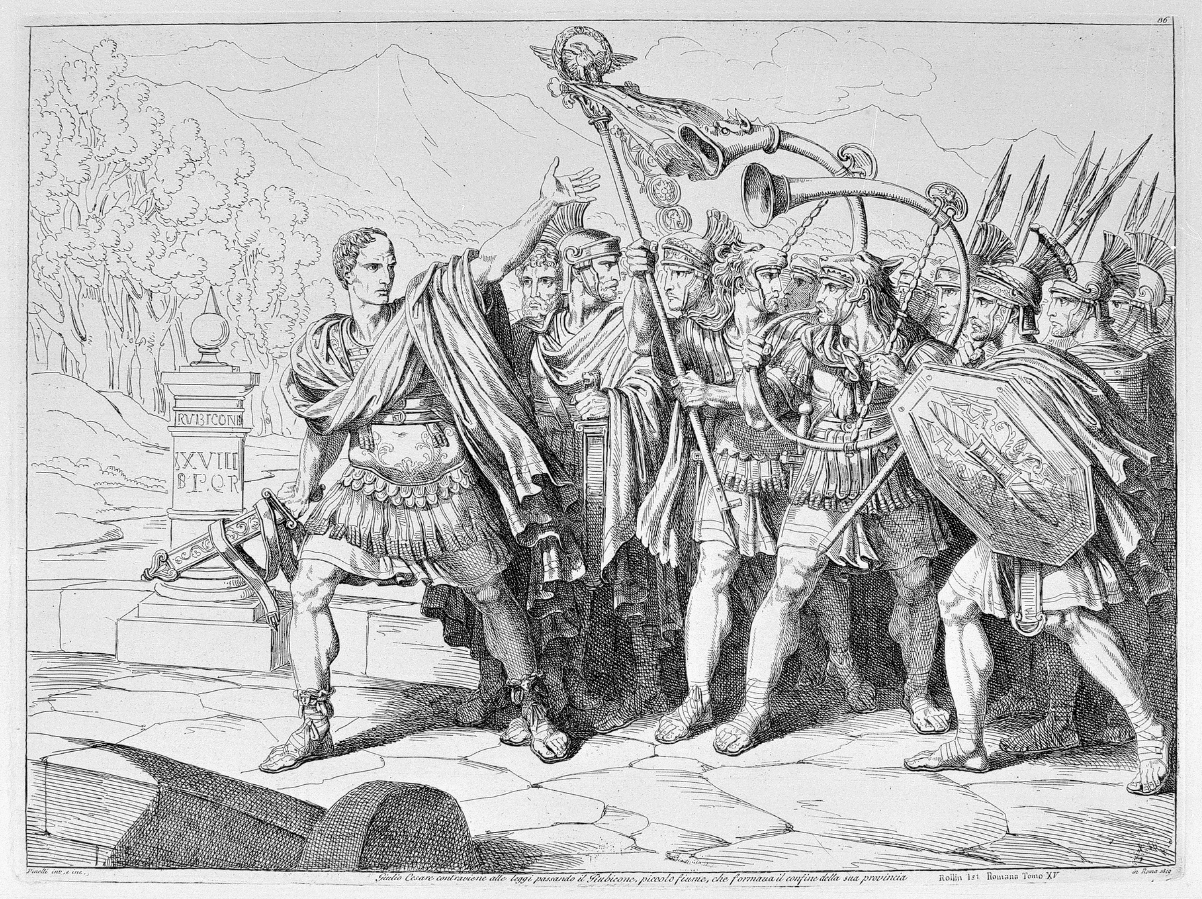
In January 49 BC, Caesar crossed the Rubicon, a small river marking the boundary of Roman Italy, leading his troops. Roman law required any general returning to Roman territory to disband their army first. Caesar’s action constituted a declaration of war, effectively making him a rebel against the Republic. As he crossed, he is said to have declared, “Alea jacta est” (“The die is cast”).
Roman Italy was wholly unprepared for invasion. Caesar captured several cities unopposed before marching on Rome. Pompey and his allies, along with many senators, fled the city, fearing retribution.
While Caesar consolidated control over Italy, Pompey escaped to Greece, where he raised an army from the eastern Roman provinces.
The ensuing Civil War saw Caesar’s and Pompey’s forces clash across Italy, Spain, Africa, Greece, and Asia. This article focuses on the fighting in Africa.
First battles in Africa
Juba I
Following Pompey’s flight to Greece, Caesar marched toward Spain. Simultaneously, he dispatched his ally, Caius Scribonius Curio, to Sicily and then Africa. Pompey’s forces in Africa were commanded by Publius Attius Varus and supported by the cavalry of Numidian King Juba I.
The initial engagement near Utica resulted in a victory for Caesar’s supporters, driving Varus back into the city. However, a few months later, Caesar’s troops suffered a decisive defeat at the Battle of Bagradas (near the Medjerda River) in October 49 BC. Curio was killed in action, and Pompey’s faction gained control of Africa.
Juba I entered Utica and massacred the remaining members of Caesar’s camp, sparing only a few Roman senators, whom he imprisoned and took back to Numidia, where they were executed. Following this victory, Juba I was granted the title “friend of Rome.” However, his relationship with his Roman allies remained strained by mistrust. He insisted on being treated as an equal ally, not a vassal, and was determined to maintain Numidian independence.
Succession war in Egypt
Cleopatra
In 48 BC, Caesar and Pompey clashed in Macedonia. After several defeats, Pompey fled to Egypt in despair. Upon arriving at Pelusium (Tell el-Farama), he was assassinated. Caesar, in pursuit, arrived in Egypt three days later.
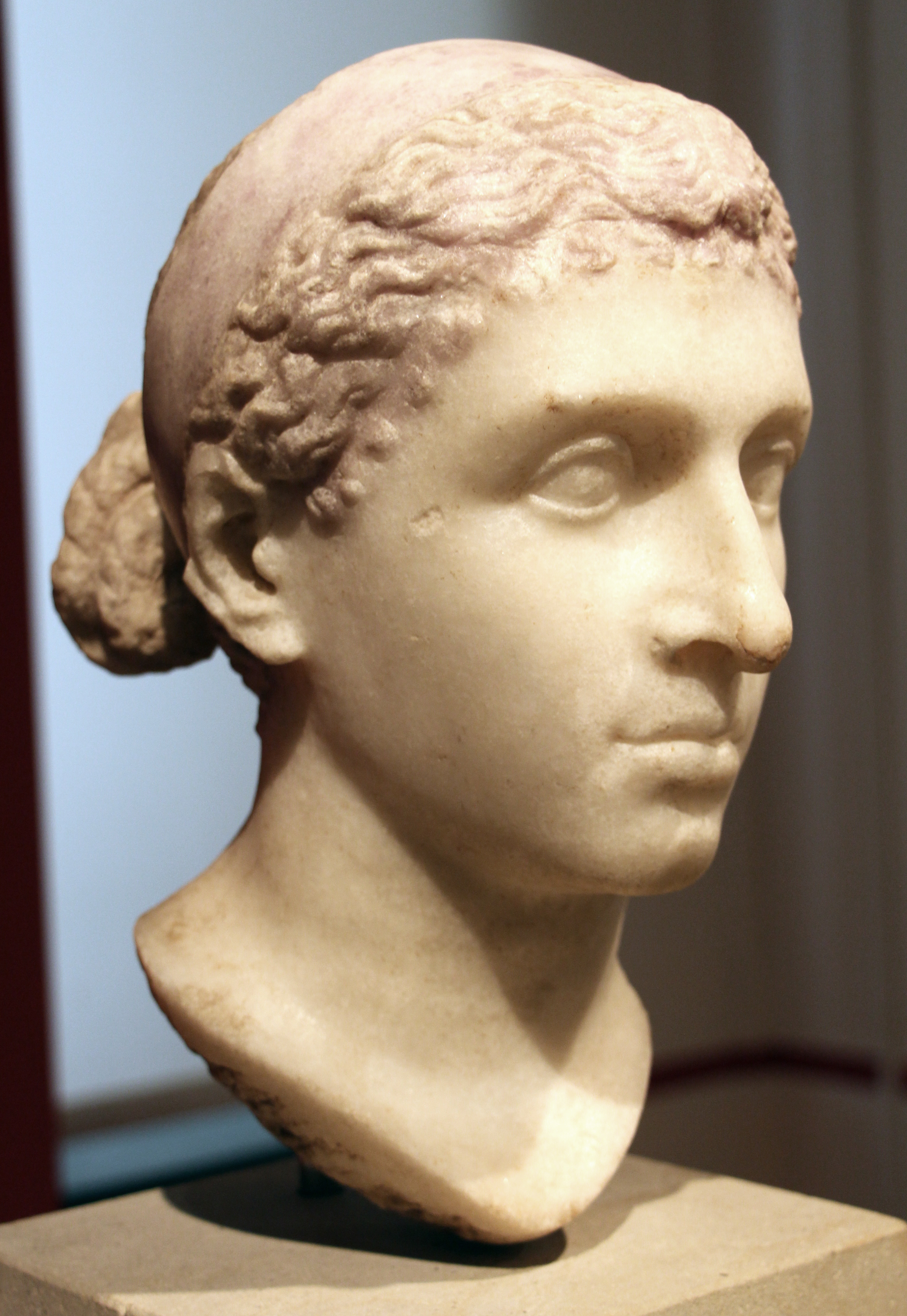
At that time, the last two heirs of the Ptolemaic dynasty, Ptolemy XIII and his sister Cleopatra, were vying for the Egyptian throne. Upon his arrival, Caesar demanded repayment of Egypt’s debt and offered to mediate between the two claimants. Besieged in Alexandria by Ptolemy XIII’s forces, Caesar met Cleopatra, who seduced him and became his lover. Caesar subsequently sided with Cleopatra against her brother.
During the siege, Caesar had the Egyptian ships in Alexandria’s harbor burned. The fire spread, resulting in the burning of the Library of Alexandria.
In early 47 BC, a supporting army arrived in Egypt from Syria. Caesar and Cleopatra’s forces joined them and crossed the Nile. Together, they engaged Ptolemy XIII’s troops in the Battle of the Nile, which Caesar won. Ptolemy XIII drowned while attempting to escape.
Following his victory, Caesar remained in Egypt for several months. His cruise on the Nile with Cleopatra served as an opportunity for rest and to secure the new queen’s loyalty to Rome. When he left, Cleopatra was pregnant. Their son, Ptolemy XV Caesar, became known as Caesarion.
Caesar’s final campaign in Africa
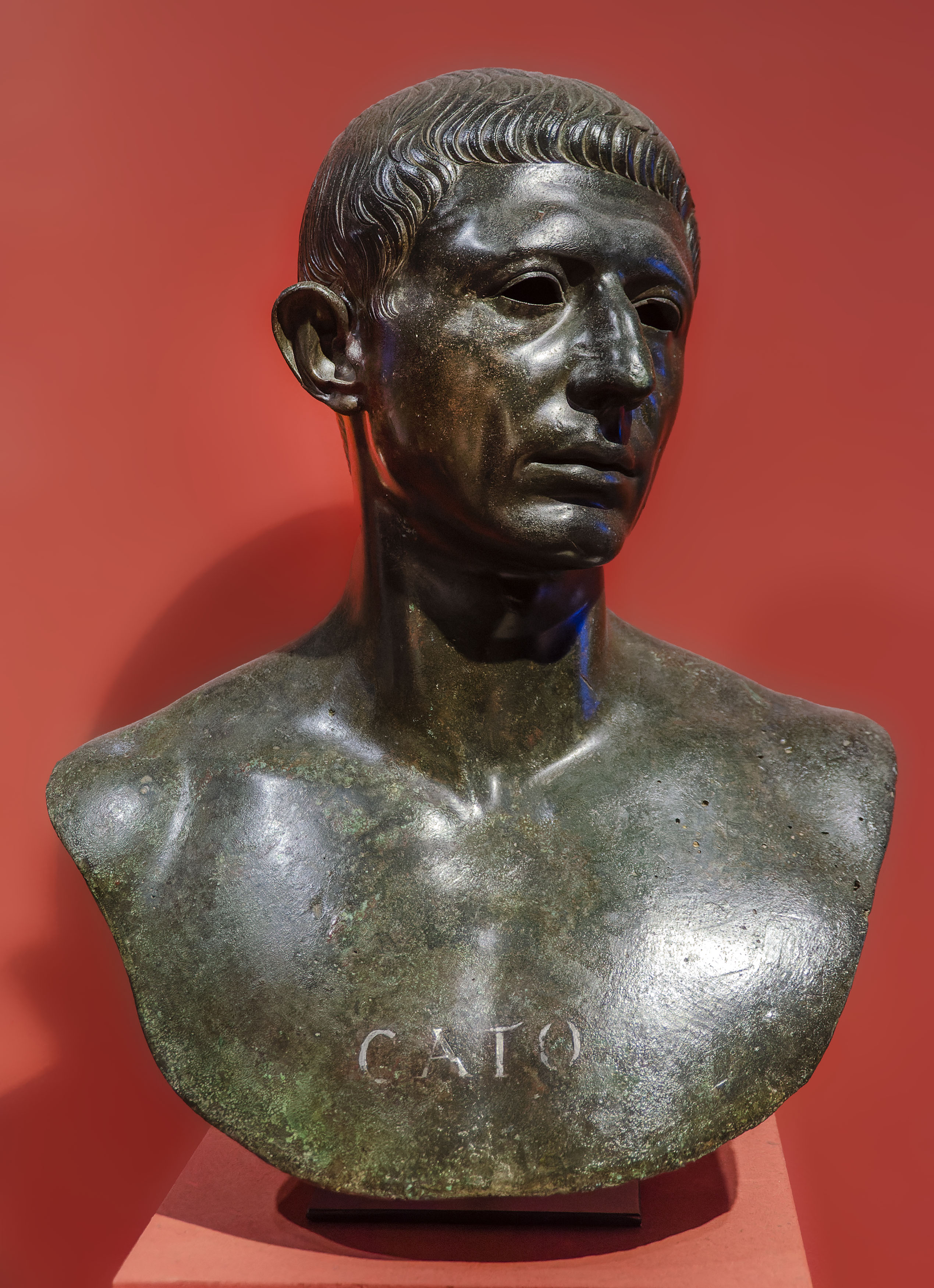
Cato the Younger
After Pompey’s death, some of his followers resolved to continue the fight. Cato led his troops across the Cyrenaican desert to Africa, where he joined forces with Scipio Metellus, commander of Pompey’s African forces. The Roman governor of Hispania Ulterior (southern Spain) also joined their cause.
Leaving Egypt, Caesar first addressed a crisis in Asia, where King Pharnaces II had capitalized on the civil war to reclaim territories Rome had seized from his father, Mithridates VI. His victory over Pharnaces was so swift that he famously declared, “Veni, vidi, vici” (“I came, I saw, I conquered”).
Back in Rome, he faced a mutiny. In December 47 BC, he assembled his legions in Sicily to confront Pompey’s remaining supporters in Africa. One anecdote recounts that upon landing in Africa, Caesar stumbled. Rising, he dispelled his officers’ superstitious anxieties by grabbing two handfuls of sand and exclaiming, “I hold you, Africa!”
At the outset of his campaign, Caesar’s forces were significantly outnumbered. Scipio Metellus commanded ten legions (compared to Caesar’s six), in addition to Juba I’s Numidian cavalry and 120 war elephants. After Hadrumetum (Sousse) refused him entry, Caesar established his headquarters at Ruspina (Monastir). The initial engagement at Ruspina resulted in a victory for Pompey’s supporters.
Meanwhile, King Bocchus II of Mauretania, supported by the Roman mercenary Publius Sittius, invaded Numidia. While Caesar played no role in this attack, he benefited from it, as Juba I was compelled to withdraw and defend his own territory.
In February 46 BC, Caesar besieged Thapsus (Ras ed-Dimas), hoping to draw Scipio Metellus into battle. The decisive battle occurred in April 46 BC, resulting in a complete victory for Caesar. Over 10,000 enemy soldiers were killed. Metellus Scipio escaped by sea but committed suicide when his ship was intercepted.
After the battle
Cato, the other prominent leader of Pompey’s faction, did not participate in the battle, as he was garrisoning Utica. Upon learning of the defeat, he committed suicide to avoid capture by Caesar. Such was his popularity in Utica that, without fear of Caesar’s retribution, the townspeople honored him with a proper burial and bestowed upon him the posthumous title of Cato Uticensis (Cato of Utica).
Juba I also did not participate in the battle. Following his defeat, he wandered from town to town, eventually reaching his capital, Zama. Everywhere, his subjects refused him entry, following his earlier orders not to welcome him if he lost the war against Caesar. Alone and abandoned, he ultimately took his own life.
Massinissa II, Juba I’s brother and co-ruler of Numidia, also sided with Pompey. His fate after the war remains unknown.
North Africa after the Civil War – in dark green, the territory of Publius Sittius (Source)
Numidia was divided: its eastern portion became the Roman province of Africa Nova, while the western part was incorporated into Mauretania. Publius Sittius claimed the region of Cirta (Constantine) as spoils of war.
Upon his return to Rome, Caesar was proclaimed dictator for life. Shortly thereafter, on March 15, 44 BC, he was assassinated by a group of senators led by Brutus, who feared his growing power.
In Numidia, Arabio, the son of Massinissa II, successfully ousted Bocchus II and Publius Sittius, reclaiming his father’s throne.
Juba II, son of Juba I, grew up in captivity in Rome. He later became the last king of Numidia and Mauretania before their annexation by Rome.
The Civil War in Roman poetry A century later, the Roman poet Lucan composed an epic poem, the Pharsalia, which depicted the Roman civil war in a semi-mythological context. Through his admiration for Pompey’s supporters, whom he represented as defenders of the old Republic, Lucan expressed his nostalgia for that era and his animosity toward the burgeoning Empire. Lucan was later arrested and executed for his involvement in a plot against Emperor Nero. Books 4, 9 and 10 are set in Africa. The Pharsalia can be read online on this page.
As Rome’s power expanded in North Africa, the last Numidian and Mauritanian kings became inextricably linked to the Roman Empire. The Roman wars and political intrigues increasingly shaped the fate of the region. In this article, from our series on the last decades of the Roman Republic, we will discover the Catilinarian conspiracy, wrought by Catiline, a former governor of Roman Africa.
Catiline’s beginning
Catiline
Lucius Sergius Catilina was born around 108 BCE, in an old Patrician family. During Sulla’s civil war, he joined Sulla’s side, and enriched himself a lot during his dictatorship, from the proscriptions.
In 67-66, he was the governor of the Roman province of Africa. After returning to Rome, African embassies arrived to protest against his administration. He wanted to stand for the consular elections in 65, but his candidacy was denied. He was judged for corruption during his time as a governor, but was acquitted thanks to his friends in high places. He then stood for the consular elections in 64 and 63, but wasn’t elected.
The Catilinarian conspiracy
After his last electoral defeat, he started plotting to take power by force, overthrowing the two consuls in 63: Cicero – the greatest orator in Roman history – and Gaius Antonius Hybrida. His conspiracy assembled a coalition of malcontents: corrupt senators, aristocrats who were unhappy about losing elections, veterans of Sulla’s dictatorship, etc.
The conspiracy was discovered by Cicero, who denounced Catiline and his accomplices to the Senate. Catiline fled Rome, but he was captured, sentenced to death, and executed.
It is possible that Cicero exaggerated the threat that the Catilinarian conspiracy represented for Rome, to promote his own political career.
Later on
For Roman historians, the Catilinarian conspiracy was a sign of the decline of the Roman Republic, which they believed was caused by the loss of traditional Roman values. Sallust describes the conspiracy as one of the main steps of this decline, together with the Jugurthine War, Sulla’s dictatorship, and the civil war between Caesar and Pompey. The Roman Empire would later be founded to restore those lost Roman values.
As Rome’s power expanded in North Africa, the last Numidian and Mauritanian kings became inextricably linked to the Roman Empire. The Roman wars and political intrigues increasingly shaped the fate of the region. In this article, from our series on the last decades of the Roman Republic, we delve into the first of Rome’s great civil wars, between Marius and Sulla, two men united once by their fight against Jugurtha.
Context
Gaius Marius
Gaius Marius was born c. 157 BC, into a plebeian family. He started his military career in 134 BC, as an officer at the siege of Numantia in Spain. By 109 BC, he was serving as the deputy of General Quintus Metellus, Commander of the Roman troops fighting Jugurtha in Numidia. He left Numidia in 108 BC to campaign for consul, against Metellus’ will. Elected in 107 BC, he was chosen by the comices (the plebeian assembly) to replace Metellus, a move that usurped the Senate’s power and broke with Roman military custom.
Coin with the effigy of Sulla
Lucius Cornelius Sulla was born in 138 BC into an ancient patrician family. In his youth, he joined the army. In 108 BC, he was elected quaestor, at the age of 30 (the minimum age required for this office). He was sent to serve in Numidia under Marius.
The rivalry between the two men dates back to the Jugurthine War, when Marius stole the credit for Sulla’s capture of Jugurtha. Moreover, Sulla was a conservative who defended traditional Roman values against populist reformers like Marius.
Beginning of the Civil War
Following a series of military victories, Sulla was elected consul in 88 BC. That same year, Marius, eager for another military command, struck a secret deal with the tribune Sulpicius: in exchange for his support, Marius would take over command in the war against Mithridates of Pontus, which had been given to Sulla. In an unprecedented move, Sulla marched his troops on Rome, becoming the first Roman to seize power by force.
After his march on Rome, Sulla banished Marius and his supporters. Marius and his sons escaped to Africa, where they were welcomed by King Hiempsal of Numidia. Though the king feigned hospitality, his true intention was to imprison them. However, they managed to escape.
Marius returned to Rome in 87 BC and allied with the consul Lucius Cornelius Cinna. He died in 86 BC. While Sulla was waging war against Mithridates, the supporters of Marius and Cinna regained control of Rome.
During this period, both factions engaged in a brutal campaign of proscriptions: supporters of each side who were denounced had their lands confiscated without legal proceedings, then awarded to their accusers.
The Civil War Resumes
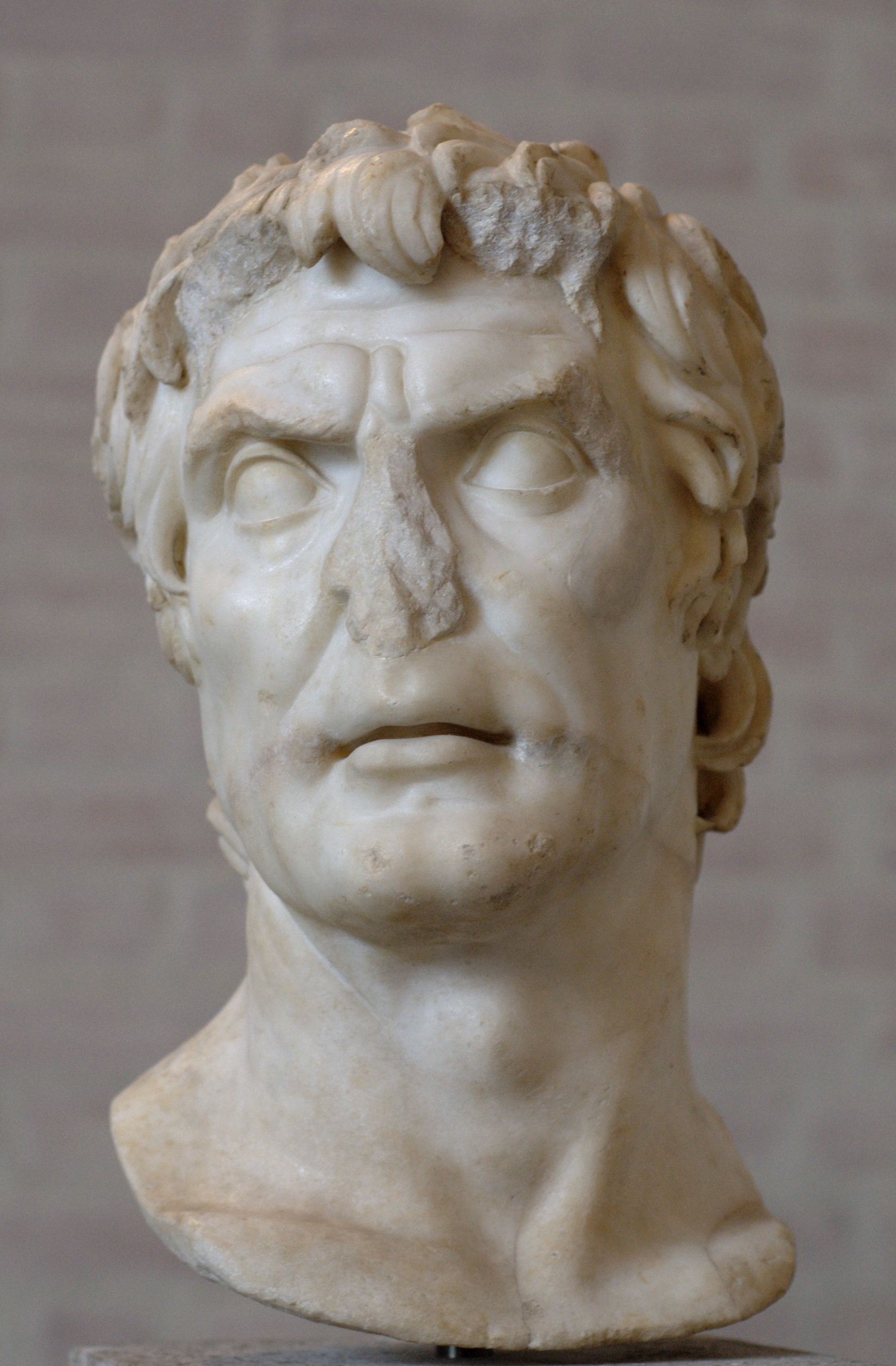
Late scuplture of Sylla
In 84 BC, supporters of Marius and Cinna sent an army to remove Sulla from his command. However, the commander of this army was assassinated, and many of his soldiers switched allegiance to Sulla. Meanwhile, the Numidian king Hiempsal, a loyal ally of Sulla, was overthrown by the usurper Hiarbas, who had secured the support of Marius and Cinna’s followers.
In 83 BC, after a provisional victory against Mithridates, Sulla returned to Italy, determined to seize control of Rome from his enemies. The young Pompey (the future rival of Julius Caesar) raised three legions to support him. Metellus, the former commander of the Roman forces against Jugurtha, also joined him. His opponents, meanwhile, allied themselves with two Italian peoples neighboring Rome: the Samnites and the Lucanians.
In November 82 BC, a brutal battle took place at the gates of Rome as Sulla’s army clashed with his rivals. Approximately 50,000 soldiers killed in this battle, but Sulla emerged victorious. In the following day, he ordered the execution of 8000 captured combatants during a senate meeting.
Gold denarius depicting Sulla’s triumphal chariot, issued in 82 BC
After his victory, Sulla was elected dictator by the Senate. He implemented a series of profound reforms to the Republic’s institutions, which he claimed were aimed at restoring traditional Roman values. However, his reforms, rather than restoring the old order, introduced radical changes, such as expanding the Senate and bolstering the authority of magistrates. Unlike previous Roman dictators, who were granted temporary powers for specific purposes and renounced them once their mission was over, Sulla sought to use his position as a means to increase his personal power. Also, to eliminate any opposition, Sulla unleashed a reign of terror, proscribing thousands of his enemies.
In 80 BC, Sulla was elected consul and resigned as dictator. He withdrew from public life and devoted the remainder of his days to penning his memoirs. He passed away in 78 BC.