Ce site présente l'histoire de l'Afrique du Nord avant les conquêtes arabes – This website presents the history of North Africa before the Arab conquests – يعرض هذا الموقع تاريخ شمال إفريقيا قبل الفتوحات العربية
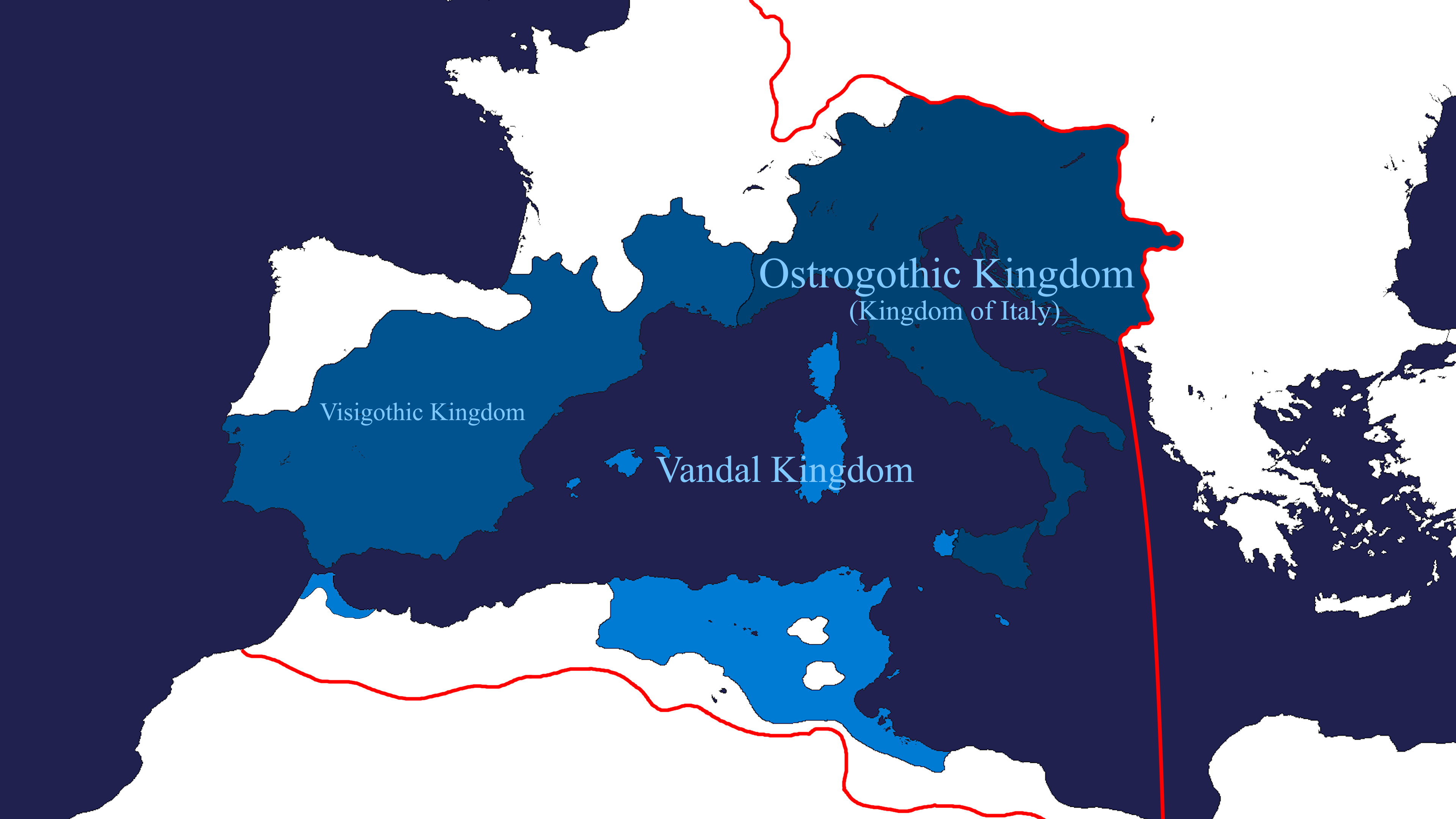
At the time of the Byzantine reconquest of North Africa, the Spanish Visigoths profited from the Vandal defeat to take control of African territory across the sea from Spain, around Sebta. They occupied Sebta for around ten years, and then were expelled by the Byzantines.
The Sebta peninsula
When the Byzantines attacked Carthage in 533, the Vandal King Gelimer sent messengers to Spain, to ask the Visigoths for help. When the messengers arrived in Toledo, the Visigothic capital, Carthage had already fallen. Theudis, King of the Visigoths, was already informed of the defeat of the Vandals, but the messengers didn’t know. Theudis received the messengers well and served a banquet in their honor, but when they requested an alliance against the Byzantines, he refused and sent them back to get more news. The messengers returned to Carthage without knowing that their King was defeated, and they were killed by the Byzantines on their arrival.
Theudis then decided to seize the opportunity after the Vandal defeat: he crossed the Gibraltar Strait and took the city of Sebta and the surrounding region. The Visigothic occupation of Sebta was the only lasting Gothic presence in North Africa, despite several unsuccessful attempts to settle there.
In 542, the Byzantines laid siege to Sebta on land and sea. The Visigoths sent an army, but failed to keep the city. According to the bishop Isidore of Sevilla, the Visigothic occupants refused to fight on Sabbath day, allowing the Byzantines to attack them and kill each man of them.
In the early 6th Century, the Vandal Kingdom of Carthage was closely allied to Theodoric the Great, King of the Visigoths of Italy and the most powerful Germanic king of the time. Many Gothic military commanders were serving the Vandals in North Africa. One of them, Godas, a Gothic nobleman who had been named governor of Sardinia by the Vandal King Gelimer, rebelled against his master and supported the Byzantine Emperor Justinian in his reconquest of North Africa.
After the death of Thrasamund, Amalafrida led a revolt against his successor Hilderic, but she was captured and executed. Hilderic also had the Gothic soldiers around her put to death, in order to reduce Gothic influence in his kingdom.
Hilderic’s anti-Gothic and pro-Catholic policy was opposed by the Vandal nobility. In 530, Hilderic was overthrown by Gelimer, who reigned in his place.
Godas of Sardinia
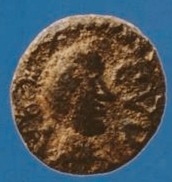
Bronze coin with the effigy of Godas, found in Sardinia
Gelimer, desiring to win back Gothic favor, named the Gothic nobleman Godas governor of Sardinia, a Mediterranean island under Vandal control.
Around 533, Godas revolted against Gelimer, ceased paying the taxes due to Carthage, and proclaimed himself King of Sardinia. He also made an alliance with the Byzantine Emperor Justinian, who he hoped would recognize his sovereignty over Sardinia.
Gelimer sent a large army to Sardinia, led by his brother Tzazo and made of most of the Vandal soldiers available in Africa. Tzazo took Cagliari, the island’s capital, and killed Godas.
However, Godas’ revolt proved to be fatal to the Vandal Kingdom: while Tzazo was in Sardinia, the Byzantine army, led by general Belisarius, landed in North Africa. In the absence of a Vandal army able to defend their territory, the Byzantines took control of the whole area in a few months. When Tzazo returned to Africa, Carthage was already taken. Tzazo himself was defeated and killed by the Byzantines shortly after.
In 511, Gesalec, King of the Visigoths of Spain, was overthrown by the King of the Ostrogoths of Italy Theodoric the Great. Gesalec fled to Carthage, to the court of the Vandal King Thrasamund. When he tried to reconquer Spain, Thrasamund entrusted him with the Vandal fleet. He later abandoned him, under pressure from Theodoric.
Context
Visigothic Kingdom of Spain – Light orange: territory lost in 507, after the defeat against the Franks
The Goths, who had been living in Spain since the 5th Century, established a Kingdom there on the ruins of the old Roman administration. Since the conquest of Italy by Theodoric the Great, their Kingdom was called the Visigothic (Western Gothic) Kingdom of Spain, to distinguish it from the Ostrogothic (Eastern Gothic) Kingdom of Italy.
Alaric II, King of the Visigoths, was married to Theodegotha, the daughter of Theodoric the Great, King of the Ostrogoths. Theodoric was the most powerful Germanic King of his time.
Gesalec King of the Visigoths
Alaric II was killed in 507, in battle against the Franks. His only legitimate son, Amalaric, was too young to be king. The Visigoths chose Gesalec, an illegitimate son of Alaric II, as his successor. At the beginning of Gesalec’s reign, Theodoric the Great supported him.
The Empire of Theodoric the Great after Gesalec’s fall
In 508, the Burgunds conquered Narbonne, the Visigothic capital. Gesalec fled to Barcelona. Three years later, in 511, he was overthrown by Theodoric the Great, who proclaimed himself King of the Visigoths until his grandson Amalaric came of age.
Gesalec fled to Carthage, where he received the support of the Vandal King Thrasamund. To help him take back his throne, Thrasamund entrusted him with the Vandal fleet to invade Spain.
When Theodoric the Great heard that the King of the Vandals, who was his ally, married to his sister Amalafrida, had chosen to support Gesalec, he got angry, and sent him a letter ordering him to withdraw his support for Gesalec. Thrasamund, who understood that he was not powerful enough to confront the King of the Ostrogoths, abandoned Gesalec. Shortly after, Gesalec was captured and killed.
Theodoric the Great reigned over a unified Gothic Empire until his death in 522. After he died, his two grandsons Amalaric and Athalaric succeeded him in Spain and Italy.
Amalafrida, sister of Theodoric the Great, the founder of the Ostrogothic Kingdom of Italy, married the Vandal King Thrasamund. Their marriage marks an alliance between the two kingdoms, which opened a new era of prosperity for the Vandals in Africa.
Context
Theodoric the Great, King of the Ostrogoths from 471 to 526
The Goths were divided into two tribes: the Visigoths (Western Goths) and the Ostrogoths (Eastern Goths). Around 375, when the Huns invaded their territory, some Goths fled into Roman territory, where they waged war against the Romans. The Visigoths are the descendants of the Goths who settled in Roman territory, while the Ostrogoths are the descendants of those who remained in their historical territory East of the Danube.
The Ostrogoths were vassals of the Huns. After Attila the Hun died in 453, they became independent and migrated towards the Balkans. They were loyal to Aspar, the commander of the Eastern Roman army, who had Gothic origin. They agreed to fight for the Roman army, except against the Vandals.
To increase his influence, Theodoric allied himself by marriage with other Germanic kingdoms. He married the daughter of Childeric I, King of the Franks (the sister of the famous King Clovis), and gave his two daughters in marriage to Sigismund, King of the Burgunds, and to Alaric II, King of the Spanish Visigoths. Finally, he arranged the marriage between his sister Amalafrida and Thrasamund, King of the Vandals of Carthage.
Amalafrida of Carthage
Amalafrida of Carthage – Image created by ChatGPT
Amalafrida was the daughter of the Ostrogothic King Theodemir. Born around 470, she was very young when her father died and her brother Theodoric succeded him. She had two children from her first marriage; her husband’s name is unknown. Her son Theodahad later becamer King of the Ostrogoths, while her daugther Amalaberga married Hermanfrid, King of the Thuringii.
Around 500, Theodoric the Great decided to arrange a marriage between Amalafrida, who was now a widow, and Thrasamund, the new King of the Vandals. Theodoric sent Amalafrida to Carthage with a considerable dowry. She was accompanied by 1.000 elite Gothic warriors affected to Thrasamund’s service, and 5.000 armed guards for her personal security.
Coin with the effigy of Thrasamund
Thrasamund’s alliance with Theodoric the Great marks the beginning of an era of peace and prosperity for the Vandal Kingdom of Africa, propitious to the flourishment of arts and culture. Nothing else is known about Amalafrida’s role as Queen of the Vandals, but she certainly contributed to Gothic influence in Carthage.
In 511, Gesalec, King of the Spanish Visigoths, was overthrown by Theodoric the Great and fled to Carthage. Thrasamund supported him, and entrusted him with the Vandal fleet to invade Spain; but after he received a letter of warning from Theodoric the Great, he backed out to avoid provoking Theodoric.
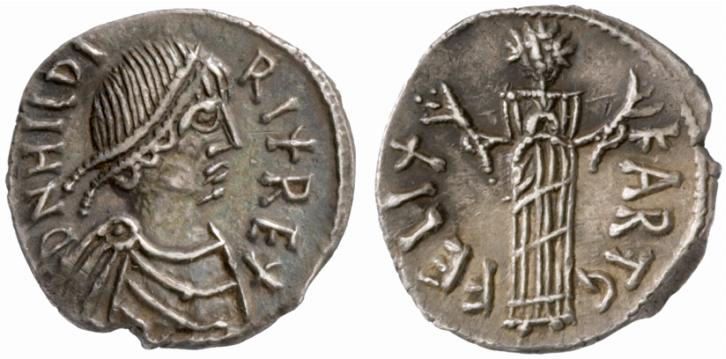
Coin with the effigy of Hilderic
After Thrasamund’s death in 523, his successor Hilderic decided to lead a policy of religious tolerance for the African Catholic Christians, who were persecuted by his predecessors. Amalafrida was opposed to this policy, and led a revolt against Hilderic. Her supporters fought the army of Hilderic at Capsa (Gafsa) and were defeated. Amalafrida was arrested and imprisoned, and then died in prison. Hilderic also had her Gothic soldiers executed, in order to reduce Gothic influence in his Kingdom.
Fifteen years before the Vandal invasion of North Africa, another Germanic people, the Goths, already tried to invade the region. Around 415, the Gothic King Wallia tried to lead his people across the Gibraltar Strait, but failed.
Context
Gothic Bible translated by Wulfila
The Goths were the most influential of the Germanic people who invaded the Roman Empire in the 4th Century. Originally from Scandinavia, they spread to Eastern Europe, from where they started attacking the Roman Empire in the 3rd Century. The arrival of the Huns, around 375, forced them to take refuge in Roman territory. In 378, they defeated the Roman army at the Battle of Adrianople; the Roman Emperor Valens was killed in this battle. From that time on, they were at war with the Romans.
The Goths were converted to Arian Christianity in the 4th Century, under the influence of the Arian bishop Ulfilas, who translated the Bible into their language and developed the Gothic alphabet.
Sack of Rome by the Goths
In 403, the Goths, led by their new King Alaric, invaded Italy. In 410, Alaric’s army pillaged Rome: it was the first time that the Imperial capital was taken by a foreign army. Galla Placidia, the Emperor’s sister, was kidnapped and forced to marry Athaulf, Alaric’s successor.
After this, Athaulf led his people to Gaul, and, from there, to Spain, where other Germanic tribes, like the Vandals, were already settled. Constantius, the new commander of the Roman army, pursued Athaulf. Bonifatius, the future governor of Roman Africa at the time of the Vandal conquest, served as an officer in the army of Constantius. In 413, he was victorious in battle against the Goths in Massalia: in this battle, he reportedly wounded the Gothic King Athaulf himself.
Athaulf was assassinated in 415, in Barcelona. His successor, Sigeric, reigned only 7 days before he was also killed. Wallia, the son of a former king, was chosen to succeed him. Athaulf and Sigeric were considered as too acquiescent to the Romans, while Wallia promised to adopt a more hawkish line against Rome.
Attempted invasion of North Africa
Wallia tries to cross the Gibraltar Strait – Image created by ChatGPT
If the Gothic invasion of North Africa had been successful, all later history would have been different. The Goths were far larger in numbers and better-organized than the Vandals. Had they settled in North Africa, they would have been able to establish a lasting presence in the region, as they did in Spain later on. A Gothic Kingdom in Africa might have been able to resist the Byzantine reconquest.
Later on
Spain in the time of Wallia
The failure of the Gothic invasion of North Africa forced Wallia to think through his ambitions. He signed a peace treaty with the Roman general Constantius, and let Galla Placidia, the sister of Emperor Honorius, who had been kidnapped by the Goths, return to Rome.
This treaty made Wallia a Roman ally. He then fought the Vandals, Alans and Sueves in Spain, in the name of Rome. He killed Attaces, King of the Alans, and inflicted his people such a defeat that they were virtually eradicated. The survivors were assimilated with the Vandals, and the Kings of the Vandals took the title of “Kings of the Vandals and Alans”.
Visigoth Kingdom of Aquitania
The Romans, concerned that their ally would become too powerful for them, called Wallia back to Gaul. Wallia died in 415, just before he left Spain. After his death, the Romans settled the Goths in Aquitania.
The daughter of Wallia was the mother of the Roman general Ricimer, who later became the master of the Roman Empire.
The Gothic King Alaric, who was the mortal enemy of the Romans in the early 5th Century, had the ambition of conquering North Africa. After placing an usurper who favored his interests on the imperial throne in Rome, he started planning his campaign; but he never went through with his plans.
The Goths were the most influential of the Germanic people who invaded the Roman Empire in the 4th Century. Originally from Scandinavia, they spread to Eastern Europe, from where they started attacking the Roman Empire in the 3rd Century. The arrival of the Huns, around 375, forced them to take refuge in Roman territory. From that time on, they were at war with the Romans.
Alaric’s parade in Athens
Alaric became King of the Goths in 395. After the death of Emperor Theodosius the Great, he led a high-level insurgency against the Romans. He started by taking Athens, in Greece. In 403, he invaded Italy.
In 409-410, Alaric proclaimed a new Emperor, Priscus Attalus, instead of Emperor Honorius. Priscus Attalus controlled Rome, while Honorius reigned in Ravenna.
Heraclianus, the governor of Roman Africa, remained loyal to Honorius and cut the delivery of African wheat to the city of Rome, where Priscus Attalus was settled. Against this threat, Alaric wanted to lead a military campaign against Heraclianus in Africa. His ambition went far beyond fighting a Roman governor: he wanted to conquer North Africa, as he coveted this territory for its riches and its strategic importance as bread basket of the Roman world.
Sack of Rome by the Goths
Priscus Attalus, the usurper named by Alaric, refused to let the King of the Goths take the head of his troops for a campaign against Heraclianus. Alaric, angered by his refusal, deposed him. After the fall of Priscus Attalus, Alaric’s army pillaged Rome: it was the first time that the Imperial capital was taken by a foreign army.
After the sack of Rome, Alaric went to Southern Italy. He was planning to sail to Sicily – still to invade Africa from there ? We don’t know, but it is possible. His fleet was destroyed by a storm. Alaric fell ill and died soon after. His successor, Athaulf, settled the Goths in Gaul.