

Français – عربي – ⵜⴰⵎⴰⵣⵉⵖⵜ – English
At the beginning of the 5th Century, the Roman Empire was weakened by the Barbarian invasions. During the reign of Emperor Honorius, the governor of Africa, Heraclianus, revolted and claimed the Imperial throne.
Context

Emperor Theodosius the Great, who is known mostly for establishing Christianity as the official religion of his Empire, died in 395. After his death, the Roman Empire was divided between his sons: Arcadius (395-408) in the East, Honorius (395-423) in the West. The two new Emperors were young and inexperienced, especially Honorius, who was only 10 years old when his father died. Stilicho, a general with Vandal origins, ensured the regency.
At the same time, the invasions of Roman territory by foreign populations, which started in the 3rd Century, were continuing. In 403, the Goths, led by their new King Alaric, invaded Italy. In 406, a confederation of Germanic tribes, led by the Vandals, crossed the Rhine, entered Gaul, and devastated the country.

Next to these invasions, the Empire was also facing internal revolts. In 407, Constantine, a Roman soldier based in Britain, proclaimed himself Emperor and established his power in Gaul, where he fought the Barbarians who were settled there.
Stilicho, the most powerful Roman general, failed to quash Constantine’s revolt, which was even gaining popularity in Gaul. His failure enabled his enemies, who had long been jealous of his influence, to prepare a plot against him. Stilicho was executed in 408. The military officer in charge of his execution was called Heraclianus.
Heraclianus governor of Africa

As a reward, Emperor Honorius named Heraclianus comes Africae, governor-general of the diocese of Africa, which included all Roman provinces in North Africa. He succeeded Bathanarius, the brother-in-law of Stilicho, who was also executed.
After Stilicho’s death, unrest broke out in the whole Empire, with mass massacres of the families of foederati – Barbarian warriors integrated into the Roman army, like Stilicho’s father. The survivors fled to Alaric, the King of the Goths, to seek his protection, thus enlarging the ranks of his army.
In 409-410, Priscus Attalus was proclaimed Emperor instead of Honorius, with Alaric’s support. Heraclianus remained loyal to Honorius and cut the supply of African wheat to the city of Rome, where Priscus Attalus was established. A few months later, Priscus Attalus was overthrown by Alaric, after refusing to let Alaric lead a campaign against Heraclianus in Africa. After Priscus Attalus’ fall, Alaric’s army sacked Rome.
The Christian author Jerome of Stridon claims that Heraclianus mistreated Roman nobles who fled to Carthage during Priscus Attalus’ usurpation. Jerome described Heraclianus as a drunkard and a corrupt man. His description is certainly exaggerated, but probably contains a part of truth.
It was also during Heraclianus’ mandate as a governor that the Donatist controversy came to a final resolution: in 411, Emperor Honorius sent his emissary Marcellinus to Carthage, to lead a public conference opposing Catholic and Donatist bishops. At the end of this conference, the Donatists were condemned.
Heraclianus’ revolt

Late 412, Emperor Honorius named Heraclianus consul for the year 413. However, before even taking this function, Heraclianus revolted and proclaimed himself Emperor. His motivations are difficult to understand, as he was at the peak of his career. It is possible that he felt threatened by the growing power of Constantius, the new commander of the Roman army, whom he saw as a rival.
Heraclianus started by cutting the supply of African wheat to Rome, and to Alaric’s troops, which were based in Gaul, close to Massalia. He then assembled a fleet to invade Italy.
Heraclianus landed in Italy in March 413. Constantius sent an army to meet him. Heraclianus was defeated, and fled to Carthage, where he was killed. According to one version, Heraclianus was so scared by the size of the enemy army that he abandoned his troops.
Later on
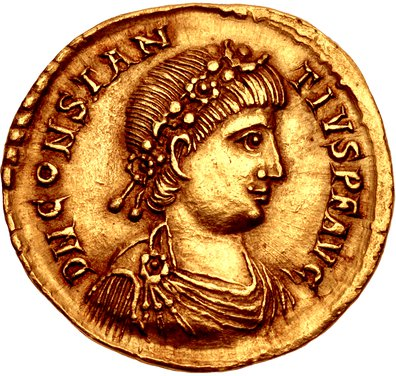
The defeat of Heraclianus’ revolt allowed Constantius to concentrate on fighting the Goths, until he succeeded in forcing them out of Gaul. In 421, Honorius named him co-Emperor. He also married Galla Placidia, the Emperor’s sister. Their son Valentinian III became Emperor after Honorius died.
Marcellinus was falsely accused by the Donatists of supporting Heraclianus’ revolt, sentenced to death and executed. The bishop Augustine of Hippo pleaded in vain for the Roman authorities to spare his friend’s life.
Bonifatius, an officer of Constantius during his campaign against the Goths, later became the last governor of Roman Africa, before the region was conquered by the Vandals.