

Français – عربي – ⵜⴰⵎⴰⵣⵉⵖⵜ – English
The Roman domination over North Africa, after lasting for over four centuries, finally crumbled when the Vandals, a Germanic people, invaded the region. The Vandals founded a new Kingdom, with Carthage as its capital. In this article, we will discover the history of the Vandal Kings of Africa.

The founder of the Vandal Kingdom of Carthage was Gaiseric, or Genseric (427-477). He became King of the Vandals in Spain, where his people were settled, and then led his men over the Straight of Gibraltar, to conquer North Africa. In 439, he conquered Carthage and made it his capital. We wrote a detailed article on him.

After consolidating his control over Africa, Gaiseric even attacked Rome, the Imperial capital. To appease the Vandals, the Roman Emperor Valentinian III had promised that his daughter Eudocia would marry Huneric, Gaiseric’s son. In 455, Valentinian was killed, and his murderer forced Eudocia to marry his son. Gaiseric used this as a pretext to invade Rome and loot the city. He raptured Eudocia, together with her mother, and brought her to Carthage, where she was wed to Huneric. Gaiseric’s sack of Rome significantly accelerated the city’s decline, which eventually led to the final fall of the Roman Empire.
During the final part of his reign, Gaiseric resisted several Roman attempts to reconquer North Africa. He died in 477, aged 87. No other Vandal King after him had the same authority over his people.

Gaiseric’s successor was his eldest son Huneric (477-484). He had spent his childhood as a hostage in Rome, after the 435 peace treaty between his father and the Roman Emperor. His wife, Eudocia, was the daughter of Roman Emperor Valentinian III, but their marriage was difficult because of their religious difference: Huneric was an Arian, Eudocia a Catholic Christian. Because of the tension between them, Eudocia left Huneric before he became King, and ended her life in Jerusalem.
After succeeding his father on the throne, Huneric had his brothers killed.
At the beginning of his reign, Huneric tried to appease the tensions in his Kingdom, by giving back to the Carthaginian merchants the goods that had been confiscated by his father and allowing the Christian community to elect a new bishop of Carthage, after 24 years of vacancy. Later, however, he again persecuted his Christian subjects. Several thousands were martyred after refusing to convert to Arianism. By the end of his reign, the Amazigh of the Aures, under their chief Masties, rebelled against the Vandal domination.
According to Vandal law, the throne belonged to the oldest prince. Gunthamund (484-496), son of Gento, the youngest son of Gaiseric and the only one Huneric hadn’t killed, was older than the sons of Huneric, making him Huneric’s successor.

Gunthamund (484-496) was the most popular King since Gaiseric. He ended the persecutions against the Christians, thus restoring stability in his Kingdom, which was about to fall apart. He suddenly died around the age of 40.

His brother Thrasamund (496-523) had the longest reign of any Vandal King, except Gaiseric. He married Amalafrida, the sister of Theodoric the Great, the founder of the Ostrogoth Kingdom of Italy, which had succeeded the Roman Empire. His reign was an era of peace and prosperity, enabling the flourishing of arts and culture. Close to the end of his life, he led a military campaign in Tripolitania, against the Amazigh chief Cabaon, and was defeated by him.
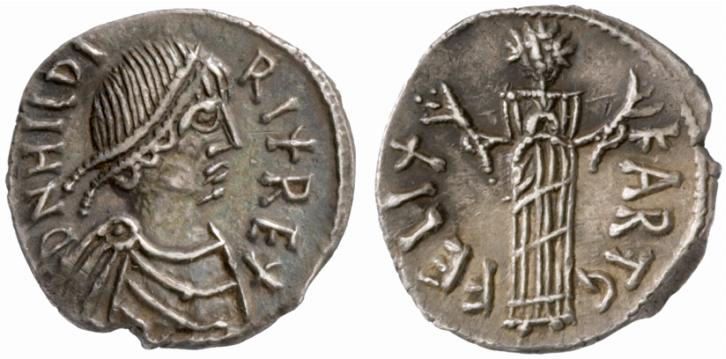
After he died, his cousin Hilderic (523-530), the son Huneric and Eudocia, succeeded him, while he was already over 60 years old. He was openly homosexual. He entertained good relations with the Byzantine Empire. During his reign, the Vandals in North Africa started converting to Catholic Christianity, without any opposition from Hilderic, whose mother was a Catholic Christian.

By the end of his reign, Hilderic was overthrown by his cousin Gelimer (530-534), with the support of the Vandal nobility, who were concerned about Hilderic’s complacency toward Catholic Christianity. The Byzantine Emperor Justinian, who supported Hilderic, declared war against the Vandals. In 533, an army of 15.000 men, led by general Belisarius, landed in North Africa. The Byzantines, supported by the local Amazigh tribes, took control of the whole Vandal territory in a few months: the Vandal Kingdom of Carthage had fallen.

3 thoughts on “The Vandal Kings of Africa”