

Français – عربي – ⵜⴰⵎⴰⵣⵉⵖⵜ – English
Since the 1st Century, a new religion, Christianity, quickly spread around the whole Roman Empire. North Africa, from its large, cosmopolitan cities to its most remote rural areas, proved to be an especially fertile ground for the Christian Gospel. In this article, we will discover the main churches and other Christian archaeological remains that still exist today in Algeria and Morocco.
Series: Churches and Other Christian Buildings of Ancient North Africa – Tunisia – Libya – Algeria and Morocco
Algeria

The oldest Christian center in modern-day Algeria was Cirta (Constantine), capital of Numidia. The city probably had a Christian majority by the end of the 3rd Century. However, no remains of an ancient Christian church building have been found in Constantine.
Later on, the city of Hippo (Annaba) became the main Christian center in Numidia, due to the influence of its bishop, the famous Augustine. The ruins of the church of Hippo, where Augustine preached, are still visible today.

Further South, St-Crispina’s Basilica, in Tebessa (formerly Theveste), is a particularly well-preserved Christian church, built on the site of the martyrdom of Crispine, a Christian woman who was beheaded for her faith in Theveste in 304. In the same region, the churches of Madaura (M’daourouch) and Thagaste (Souk Ahras), where Augustine was born, sadly have not survived to our time.

In Timgad (formerly Thamugadi), the ruins of the Church of Bishop Optatus, one of the leaders of the Donatist movement, can be seen.
The ruins of the old city of Sitifis (Setif) contain two Christian Basilicas. The neighboring town of Cuicul (Djemila) also has Christian remains: two churches and a baptistery.

In Tipaza (formerly Tipasa), St-Salsa’s Basilica is consecrated to a 14-year old Christian girl who was killed for her faith by the city’s inhabitants. Tipasa also has catacombs, less well-known than those of Sousse.
Caesarea (Cherchell), capital of Mauretania Caesariensis, was largely destroyed by the Vandals. While no church building survived their pillage, the city contains several Christian inscriptions, that can be seen at the Cherchell National Museum.
Morocco
In modern-day Morocco, the oldest archaeological trace of a Christian presence is a 3rd-Centyry pottery engraved with an anchor, that was found at Souk El Arbaa: the anchor is a Christian symbol of the assurance the believers have when they face the storms of life. (Source)
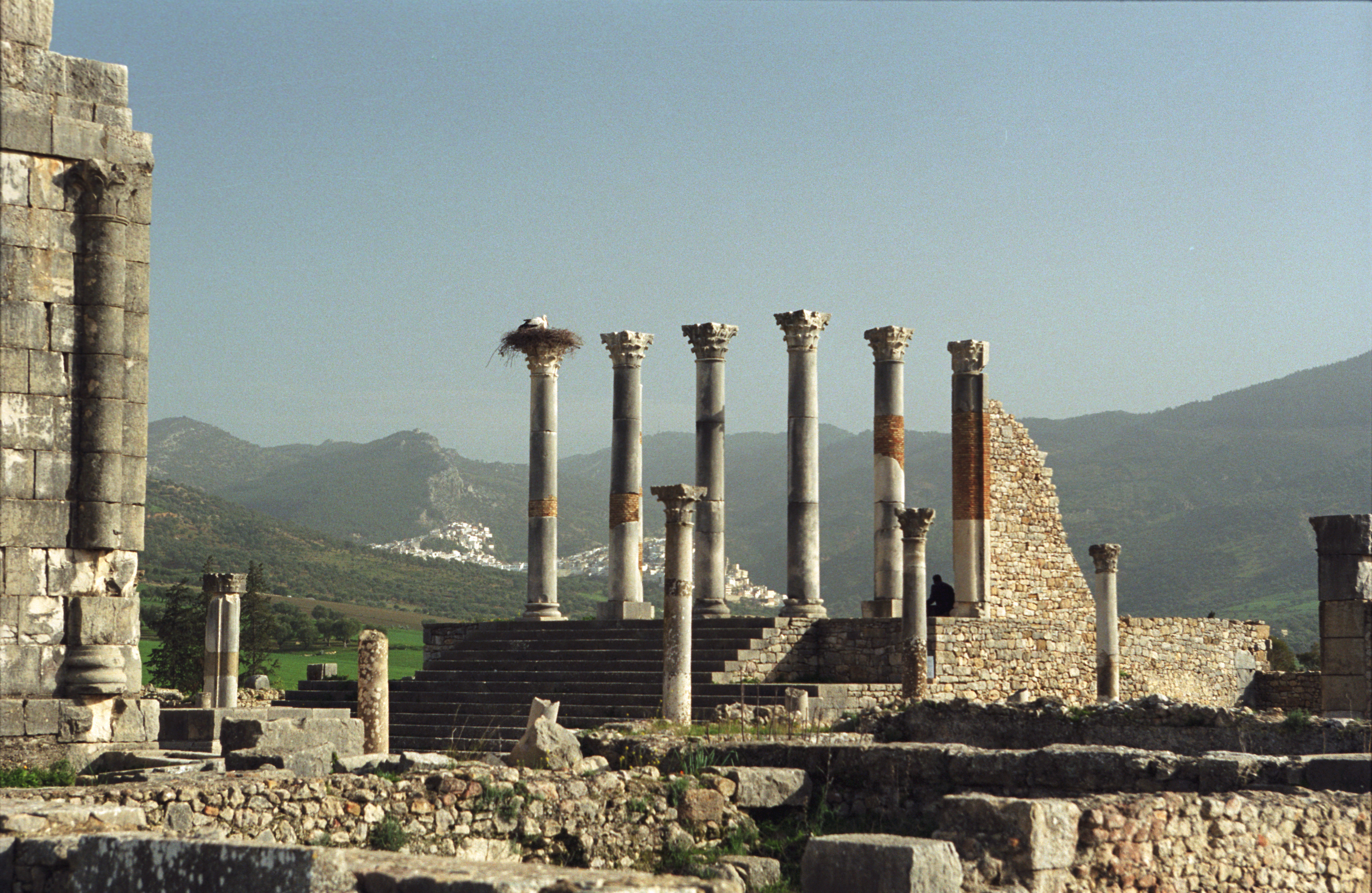
The archaeological site of Volubilis contains Christian inscriptions. The site of the Christian Basilica of Volubilis is known, and its foundations are still visible, but the building itself has disappeared.

In Lixus (Larache), the other major archaeological site that goes back to Roman Antiquity, the ruins of the old church of Lixus are still visible. Christian inscriptions and artifacts with crosses have also been found.
In Tangier (formerly Tingis), while no remains of a pre-Islamic church building have survived until today, Christian tombs have been found.

Zilil (Dchar Jdid) is a Roman colony, founded by Emperor Augustus for veterans of the Actium War. The city was located between Tangier and Asilah. A large ancient structure, dated from the 4th or the 5th Century, might be a church, but this is not sure. Its plan conforms to other Roman African churches. Potteries with crosses and other Christian symbols have also been found.
Finally, the Chellah archaeological site, close to Rabat, is mostly of Islamic (Merinid) origin, but excavations have enabled archaeologists to find 5th-Century Christian tombs, and maybe even the foundations of a pre-Islamic church building.
| Sidi Yahya ben Younes: a Christian saint in Oudja? Sidi Yahya ben Younes is the patron saint of the city of Oudja, in Eastern Morocco. His mausoleum is in the city, in the oasis of Sidi Yahya. According to local legends, Sidi Yahya is actually Saint John the Baptist! This prophet, the cousin and forerunner of Jesus Christ, is mentioned in the Quran as Yahya ibn Zakaria. After his execution by King Herod Antipas of Judea, he was reportedly buried in Oujda. |
