

Français – عربي – ⵜⴰⵎⴰⵣⵉⵖⵜ – English
After the Roman conquest, the Punic language and culture did not disappear, but kept a deep influence in the former Carthaginian territories. The Ghorfa Steles, a series of steles that were found in Maghrawa, Tunisia, show the links between the Punic cultural heritage and the new Roman African civilisation.

The Ghorfa Steles are a collection of Punic-Roman steles dating from the end of the 1st Century to the beginning of the 2nd Century AD, over 200 years after the fall of Carthage. These steles were discovered gradually, between 1842 and 1967, in Maghrawa, close to Makthar, Tunisia. As they were scattered after their discovery, their exact provenance was determined only recently, by the works of the Tunisian researcher Ahmed M’Charek.
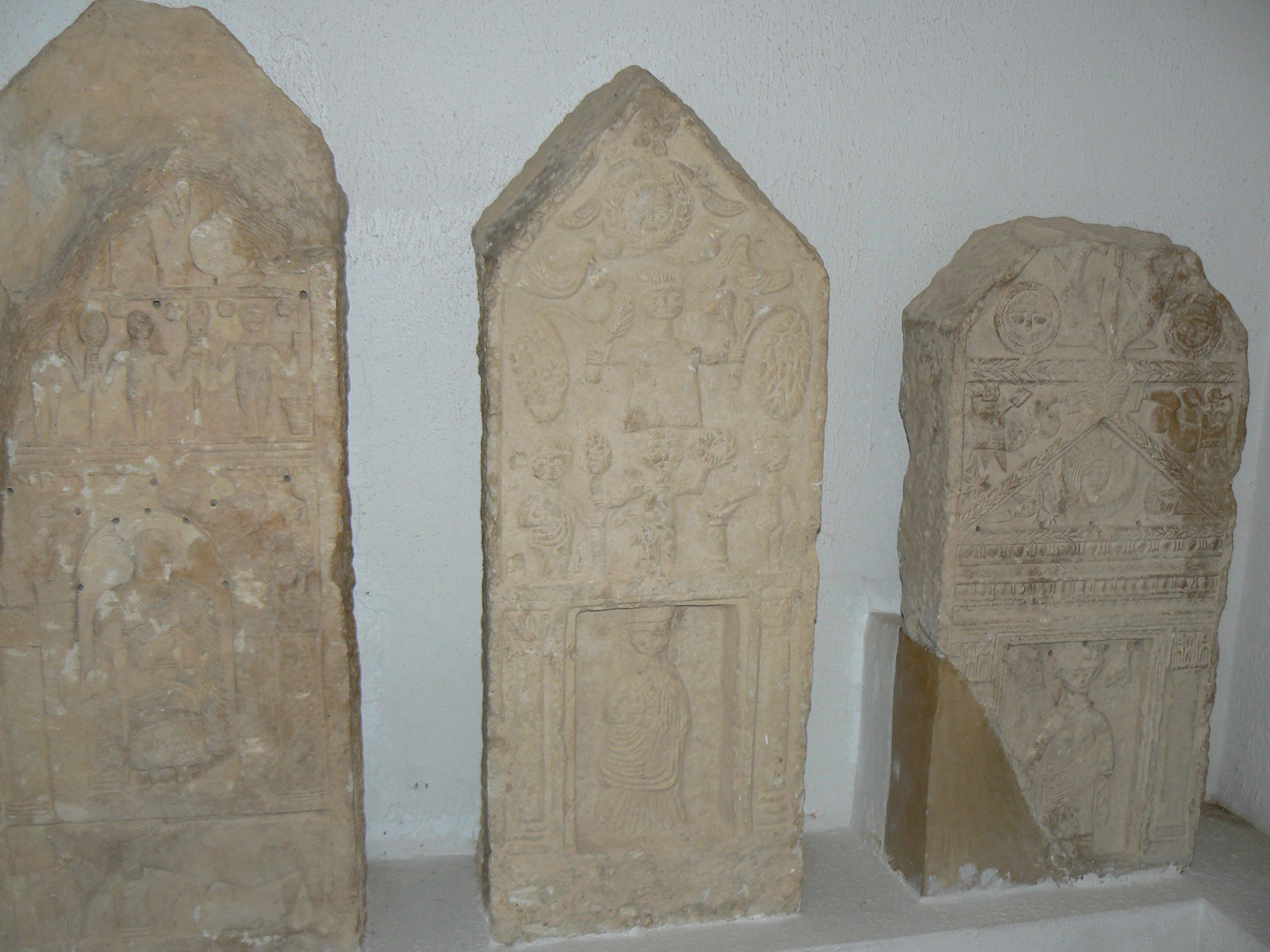
The Ghorfa steles are now shared between several Tunisian and foreign museums. The British Museum, in London, has the largest share, with a collection of 22 steles. 3 steles are exposed at the Musée du Louvre, in Paris, and 2 others at the Kunsthistorisches Museum, in Vienna. Finally, 17 steles are still in Tunisia: 12 at the National Bardo Museum, 4 at the Makthar Museum and the last one at the Dougga Antiquarium. The cover image of this article shows the collection of the Bardo Museum.
The Ghorfa steles are around 1.75m high. They have a triangular top, and contain three successive levels. Some steles also have dedications written in Latin.


The steles’ three levels represent the cosmic hierarchy according to the traditional Punic worldview. The upper level shows the world of the gods, represented in human form, with astral symbols of the sun and moon. The sign of Tanit sometimes appears, together with Roman divinities like Mercury and Venus. The middle level is the level of the dedicant, who dedicates the stele to the gods: he is standing in what appears to be a chapel, with columns and pontoons. The dedicant can be a man or a woman. Finally, the lower level represents the world of men. This level often shows scenes of sacrifices.
These steles tell us a lot about the religious and cultural syncretism in Roman Africa at this time, with a mix between Punic and Roman divinities and symbols.
