

Français – عربي – ⵜⴰⵎⴰⵣⵉⵖⵜ – English
The Phoenician alphabet, one of the oldest in the world, is at the origin of several of the most common alphabets in the world today, including the Latin and Arabic alphabet. In North Africa, it was used in Carthage and the whole Carthaginian Empire.
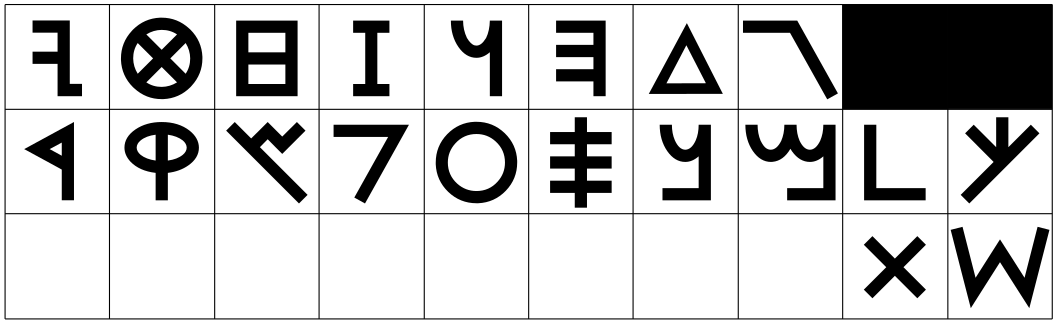
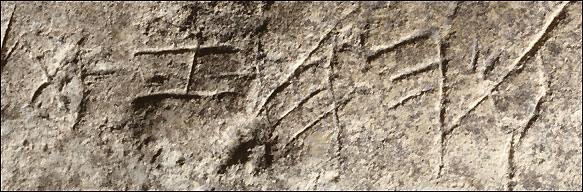
The Phoenician alphabet is an alphabet of 22 letters. It was developed around 3000 years ago, by the ancient Phoenicians. It is an abjad, an alphabet in which only the consonants are written, just like the Arabic alphabet. It is written from right to left, again like Arabic. It is one of the oldest alphabets invented by man, in which each sign represents one sound, while other older forms of writing, like Cuneiform of Egyptian hieroglyphs, were far more complex and accessible only to a highly trained scribal class.
From Phoenicia, the Phoenician alphabet spread through the Middle East, and then the Mediterranean basin. The Phoenicians were a maritime trading civilisation: as their ships navigated around all Mediterranean ports, they brought with them not only goods for sale, but also their alphabet and other forms of knowledge. The Phoenician alphabet was more simple to learn than other common forms of writing at the time, making its adoption by other people easier.

With time, other people in the ancient Mediterranean world developed their own alphabet, based on the Phoenician alphabet. The Hebrews, neighbors of the Phoenicians, created their alphabet around the 10th Century BCE, which they used to write down their sacred texts. The Greeks also developed an alphabet, which is still used today, from the Phoenician alphabet. According to the Greek historian Herodotus, the inventor of the Greek alphabet was the Phoenician prince Cadmus of Tyre. In Italy, the Etruscan alphabet, derived from the Greek alphabet, gave birth to the Latin alphabet.

In North Africa, the Phoenician alphabet was used in Carthage and the other Phoenician colonies. In the Carthaginian Empire, it was used to write the Punic language, a Phoenician dialect. As the Carthaginian scribes remained attached to traditional Phoenician grammar, the inscriptions that have been found give only few indications on the linguistic evolution of Punic, compared to the original Phoenician language.

Tifinagh, potentially the world’s oldest alphabet, is an indigenous North African writing system, used by the ancient Amazigh to write their language. The link between the Phoenician alphabet and Tifinagh is debated: some specialists believe Tifinagh to be a strongly altered adaptation of the Phoenician alphabet, but most hold that this alphabet developed according to an indigenous North African model, with only limited Phoenician influences.

As the Phoenician alphabet was originally engraved in stone with a stylus, the letters had a quite angular shape. In the Roman era, a more cursive form or writing, the Neo-Punic alphabet, developed in North Africa.
The Phoenician alphabet is the ancestor of the most widely used alphabets in the world today. On the one hand, via the Greek alphabet, it gave birth to the Latin alphabet, as well as the Cyrillic alphabet, used to writer Slavic languages. On the other hand, is also gave birth to the Semitic alphabets, like the Arabic, Hebrew, and Ethiopian alphabet.
