

Français – عربي – ⵜⴰⵎⴰⵣⵉⵖⵜ – English
The roots of the first men who inhabited our region go back thousands of years. They originated from the Nile valley, crossed the Northern part of the Sahara desert and settled in the Northern part of the African continent. The region’s vast fertile and well-watered lands offered abounding pastures for them and their flocks. Their culture has changed very little through the centuries: the traditional way of life of their descendants in our time is still very much like what we know about their oldest ancestors.

Most of the oldest North Africans were nomadic herders, who lived in tents and moved according to the seasons, with their herds of sheep and goats. With time, some of them settled themselves permanently in the fertile plains between the mountains, where they lived in wooden or earthen houses, raised cattle and grew wheat, barley, and olive trees. Whether nomadic or sedentary, everywhere they were, they lived close to nature.

The men made tools of wood and stone, while the women wove cloth and made pottery. Those resources were then exchanged according to everyone’s needs. Metals were used only for jewelry, and money was unknown.
They dressed in tunics ornate with red bands. In colder climates, their tunics were made of wool, with hoods. Both men and women enjoyed jewelry, especially made of silver.
Their basic meal was a thick semolina made of wheat or barley: seksu, which they ate with goat or sheep milk.
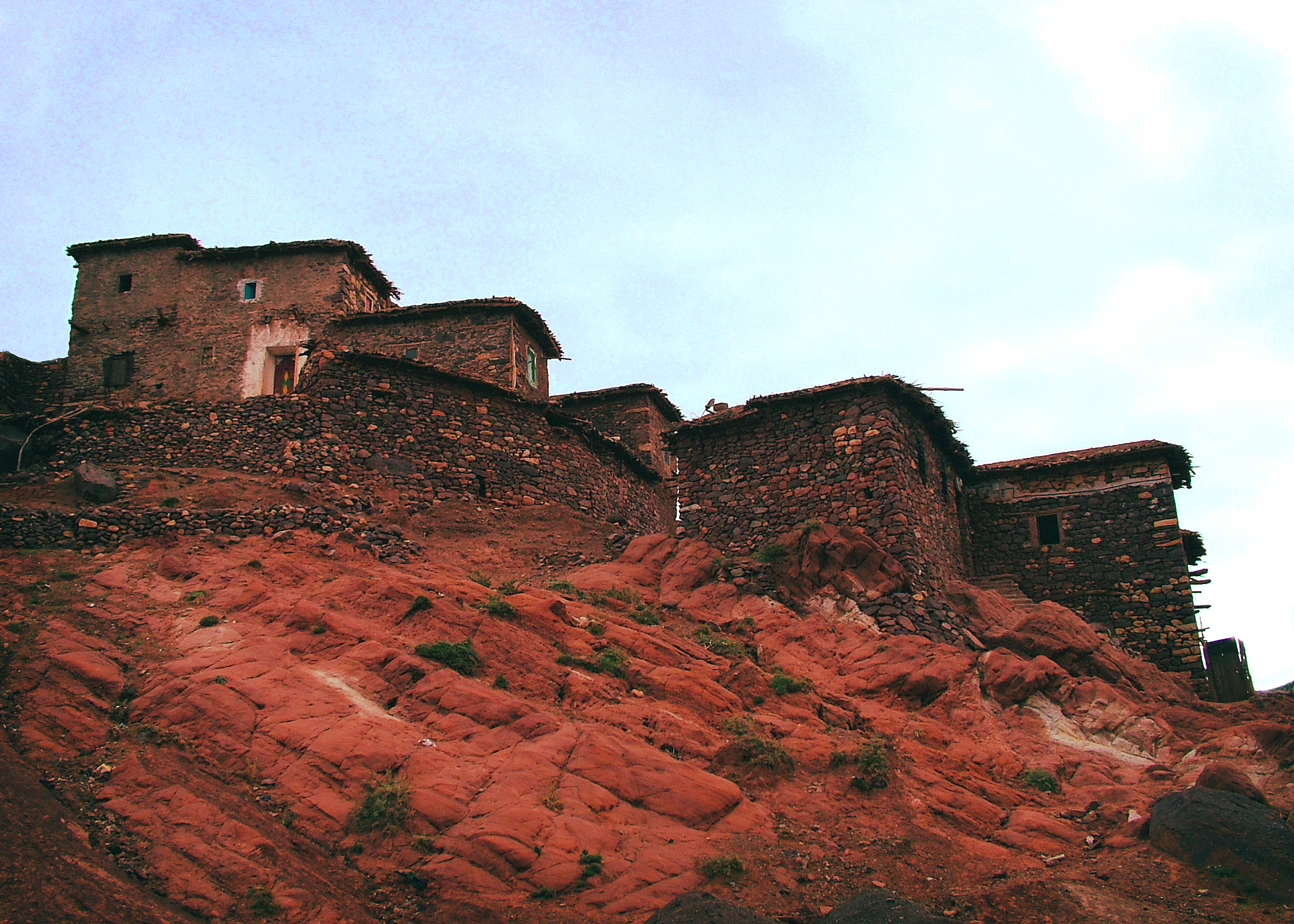
Families lived together, under the leadership of the grandfather or the oldest uncle. They built their villages on the montainsides, in order to be able to defend themselves easily in case they were attacked. The women made carpets, another emblematic skill, with the carpet patterns representing tribal symbols.
Tribes and villages formed regional alliances, for mutual protection or to attack rival tribes. Those tribal confederations were led by an assembly composed of the chiefs of each tribe.
Because they were living in such close contact with nature, they were fascinated by the forces that appeared to be hidden behind the natural realm. In their imagination, the sky was the abode of the sun god, who was sometimes represented as a young lion with a shining mane. Other important divinities were Ayyur, the moon, and Gurzil, the thunder. The jnun, spirits of the earth, lived in the rocks. Seasonal fertility rites were supposed to ensure a good harvest and good health for the herds.

At the same time, nature could be as terrifying as it was beautiful, and the need for protection against evil spiritual powers was strongly felt. They wore talismans – for example bones and seashells, and used spells and charms. The symbol of the open hand, as a protection against the evil eye, long predates Islam.
What was the name of those first North Africans? The Greeks, the most prominent civilisation of the old Mediterranean world, called them Libyi. At other times, the indigenous people of North Africa, or certain specific tribes, were called Massylii, Numidians, Mauri, Getulians, or Garamantes.
Later, their new Arab neighbours would call them بربر, Berber, a name derived from the Greek barbaroi, foreigners, which also became “Barbarians” in English.
The name which they called themselves was Amazigh, plural Imazighen, which means “free men” in their language. This name has existed for thousands of years: it was known in the Antiquity and can be found in various forms in the literature of other people groups.
