

Français – عربي – ⵜⴰⵎⴰⵣⵉⵖⵜ – English
According to a legend, during the Prophet Mohammed’s life, seven Amazigh men travelled to Meccah, where they converted to Islam, and then returned to their country, to preach Islam to the tribes in their area. Their descendants became the Regraga tribes, living on the Atlantic coast of Morocco, between Safi and Essaouira. Every year, in early spring, their religious brotherhood organizes a daour (pilgrimage) commemorating the Seven Saints of the Regraga.
The legend of the Seven Saints
The legend tells that the Seven Saints of the Regraga were Amazigh from modern-day Morocco. They were Christians, but also awaited the coming of a last prophet. Their names were Sidi Ouasmine Ilias, Sidi Said Essabek, Sidi Aissa Boukhabiya, Sidi Yaala ben Ouatil, Sidi Saleh, Sidi Boubker Achemasse and Sidi Aissa Mouloutad.
One day, they heard of an extraordinary man who was preaching the word of God in Arabia, and got on their way to meet him. When they arrived in Meccah, they were touched by the teaching of Mohammed, recognized him as the last prophet they had been waiting for, and converted to Islam. They thus were Companions of the Prophet.
In Mecca, the Seven Saints were surprised to find that the Prophet Mohammed spoke their language, miraculously, without having ever learned it. However, his daughter Fatima, who couldn’t understand a word of what they were saying, described their language as rejraja, “lapping”, because she thought it sounded like the noise of a river crossing stones. This became the name of their tribe. (A more likely etymology would be that “Regraga” is the Arabic form of Iyragrāgn, from the verb arg, “blessing” in Tashilhayt Tamazight: the Regraga are a tribe that carries baraka.)

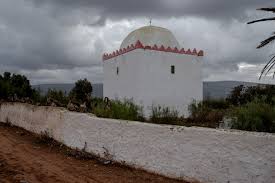
After their conversion, the Prophet sent the Seven Saints back North Africa, to preach Islam there. Every year, the Seven Saints travelled across their region, to preach Islam to the Amazigh tribes. Their travels are at the origin of the daour tradition. The tombs of the Seven Saints are the main sanctuaries of the Regraga.
This legend is obviously not historical: no Islamic source mentions the Seven Saints’ visit to Meccah. The Oulema of Fes already doubted their status of Companions of the Prophet in the 17th Century. However, this legend reflects the importance of the Regraga in the region’s history and spiritual life.
The Regraga: a tribe of apostles

The Regraga are an Amazigh tribe of the Masmuda confederation. Originally from the Jebel Hadid, they now live in the Chiadma region, between Safi and Essaouira. The Moroccan Oulema Mohamed Mokhtar Soussi believes that their original territory spread over the Souss and part of the Sahara, from Oued Tensift to Seguia el-Hamra. The Moroccan sociologist Abdelkader Mana wrote a reference book on the history and customs of the Regraga.
This tribe already played an important role in the region in the pre-Islamic era: they were known as apostles (Hawâriyyûn), a noble tribe, highly respected for their baraka.
Before the arrival of Islam, the Regraga were Christian. This raises an important question: as the history of Christianity in North Africa was mostly (but not exclusively) linked to Roman influence, how did a tribe that lived so far away from the Roman borders convert to Christianity?

According to their own legends, the ancestors of the Seven Saints of the Regraga professed a doctrine close to Arianism, which denied Christ’s divinity. They also believed that Christ had announced the coming of a last prophet. As they were considered heretical and persecuted by the official Church, they fled by sea and landed on the shore of the Oued Tensift, in Kouz, where they founded a prayer place called Timzkden N’Houren (Mosque of the Apostles). (Source) This story sounds suspicious: the Arian doctrine is closer to Islam than orthodox Christian doctrine; it is probably a rewriting of the history of the Regraga after their conversion to Islam, meant to make their religious origins look closer to the Islamic ideal. Also, there is no indication that there were any pre-Islamic Christian groups who believed in the future coming of another prophet after Christ : this idea was born with Islam.

Another explanation would be more likely from a historical perspective. It is known that after the Vandal conquest, some Amazigh tribes converted to Christianity under the influence of Christian captives whom the Vandals had sold to them as slaves. This was the case for the Caprapicti tribe, in Southern Tunisia. It is possible that the Regraga also converted through such captives.
The legend says that the Seven Saints preached Islam to the Amazigh tribes of their region. However, the religious authority of the Regraga tribe goes back to the pre-Islamic era. Could it be that their reputation comes from being the first Christian tribe in the region, who preached Christianity to the other tribes? This would be impossible to prove, but a reasonable assumption.
The moussem of the Regraga
Today, the Regraga are split into thirteen zaouias, spread over the Chiadma region: Akarmoud, Ait Sidi Baâzzi, Retnana, Taourirte, Boulaâlam, Talmeste, Tikten, Ahgissi, Marzoug, Mramer, Loukrate, Mzilate and Sekiyate.

Every year, in March, these zaouias organize the daour of the Regraga, a pilgrimage through the region’s holy places. In around 40 days, the pilgrims walk 460 kilometers and stop at 44 stops. The pilgrimage traditionally starts on the Thursday closest to the spring equinox, according to the Amazigh agricultural (solar) calendar, which is different from the Islamic lunar calendar. The daour of the Regraga marks the end of winter, and the return of the fertile season. A moussem, with a souk and festivities, accompanies it.

At the heart of this pilgrimage is the famous baraka of the Seven Saints: the Regraga, as holders of the baraka of their ancestors, transmit it to the other tribes. In his book, Abdelkader Mana, the “discoverer of the Regraga”, develops the concept of “caprification”: the Regraga nomads “fecundate” the Arab-speaking tribes of the Chiadma region with their baraka, for the year to come. (Source)
During the pilgrimage, the inhabitants of the region seek the baraka of the Regraga, through petitions for protection, fertility, health, healing and success. In return, they make offerings of food or money, or they host the pilgrims.
The baraka of the Regraga today?
Walid Regragui, the coach of the Moroccan football team1, which performed brilliantly at the last World Cup, won the Arab Cup, and finished second at home in the African Nations Cup2, is from the Regraga tribe. Could the success of the national team under his leadership be due to the baraka of the Regraga?
Learn more (in French)
Les Regraga sur “Rivages d’Essaouira”, le site d’Abdelkader Mana
REGRAGA : SUR LES CHEMINS DE LA BARAKA
Le daour des Regraga au Maroc. Un rite de régénérescence.
Culture, légendes et traditions: il était une fois… le daour des Regraga


