

Français – عربي – ⵜⴰⵎⴰⵣⵉⵖⵜ – English
The philosopher Aristippus of Cyrene, originally a disciple of the great Athenian philosopher Socrates, later founded his own philosophical school, in his native city. This school, known as the Cyrenaic school, taught that the only good we should all aspire for in life is pleasure.
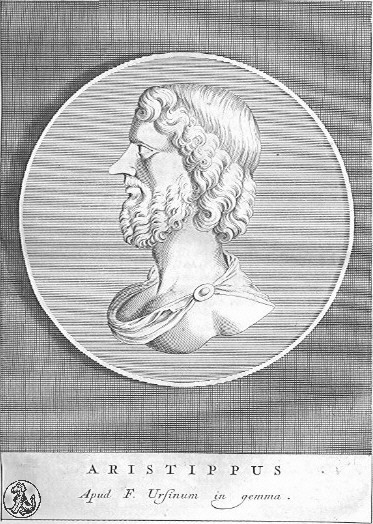
Aristippus, the founder of this philosophical school, was born in Cyrene, around 435 BCE. While in Greece to see the Olympic Games, he met Socrates in Athens and became his disciple. However, his philosophy quickly showed significant differences with Socrates’ teaching, especially on his interest for pleasure. For this reason, he left for Syracuse, where he lived a life of luxury and sensuality, at the court of king Dionysius of Syracuse. Later on, he returned to Cyrene, where he founded his philosophical school.
The philosophical doctrine developed by Aristippus is centered on the quest for pleasure: Aristippus believed that the meaning of life consists not only in avoiding suffering, as taught by other philosophical schools, but in actively seeking pleasure, under all its forms, but especially physical pleasure, considered as more intense and lasting. However, his philosophy is not an immoral hedonism: Aristippus acknowledged the importance of respecting social conventions and taught that altruistic behavior can also be a source of pleasure. Contrary to Socrates, who believed that the supreme good is virtue, while pleasure taken in virtuous behavior is of secondary importance, Aristippus held that pleasure should be our first goal, even when we are virtuous. Aristippus also insisted on the importance of not letting the object of our pleasure dominate our senses, which would destroy the pleasure we get from it. He taught one should always remain master of oneself: “I possess, but I am not possessed.”
Aristippus was also the first of Socrates’ disciples who agreed to be paid for his teaching, which Socrates firmly condemned. For this reason, as well as because of his doctrine, Socrates’ other disciples criticized him a lot, accusing him of betraying their master’s thought.
After Aristippus died, his daughter Arete succeeded him as head of his philosophical school. His grandson Aristippus the Younger formalized the Cyrenaic philosophical doctrine.
No writings of the Cyrenaic philosophers are available today: their thought is known only via other later authors.
The Cyrenaic philosophy fell into obsolescence during the 3rd Century, replaced by Epicureanism, another philosophical doctrine based on hedonism.
